With tariff negotiations between the United States and Taiwan having wrapped up, Taiwan's pro-U.S., pro-independence president declared that the two sides must build a "non-red global supply chain" to counter China.
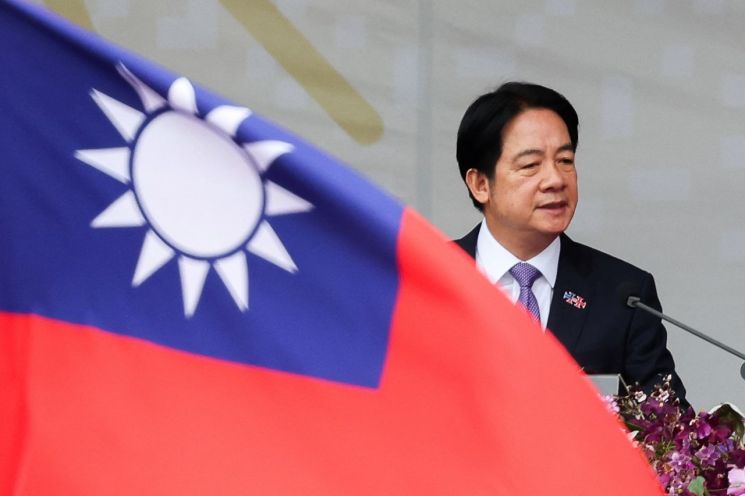
According to Taiwanese media outlets such as Liberty Times and United Daily News on the 3rd, Lai Chingte, President of Taiwan, held a press conference on the 6th U.S.-Taiwan "Economic Prosperity Partnership Dialogue (EPPD)" in Washington, D.C., on January 27. The EPPD was attended by Kung Minghsin, Taiwan's Minister of Economic Affairs, and Jacob Helberg, U.S. Under Secretary of State for Economic Growth, Energy, and the Environment.
President Lai stated that this round of dialogue focused on four key areas: (1) strategic linkage of supply chain security, (2) cooperation on critical minerals, (3) cooperation with third countries, and (4) bilateral cooperation.
President Lai said that the United States and Taiwan will establish working groups to promote practical cooperation in core areas such as supply chains and certification of unmanned aerial vehicle (drone) systems. Through this, he indicated their intention to jointly build a safe and resilient "non-red global supply chain" network.
The term "non-red supply chain" refers to a concept that counters the "red supply chain," which denotes China's exclusive and closed value chain.
President Lai said, "In a changing geopolitical environment, advanced industries such as artificial intelligence (AI) and semiconductors are placing greater emphasis on security, reliability, and resilience, and are accelerating the construction of a flexible 'non-red supply chain.' At this critical juncture, Taiwan and the United States have made their determination to jointly strengthen economic security concrete by signing the 'Silicon Era Declaration and Taiwan-U.S. Joint Statement on Economic Security Cooperation' at this EPPD meeting."
He also said, "Through this dialogue, Taiwan and the United States will push forward concrete plans focused on supply chain security, drone system certification, investment, and the removal of tariff barriers, so that our partnership can keep pace with the speed at which the global industrial landscape is being reshaped and lead the next generation of prosperity."
He added, "These achievements clearly show that cooperation between Taiwan and the United States is not confined to specific industries, but is a comprehensive, cross-sector, and deeply interconnected relationship," stressing that "Taiwan and the United States are indispensable core partners for each other's prosperous future."
At this meeting, the United States, through the Silicon Era Declaration, proposed AI supply chain security in order to secure the safety of the AI ecosystem. The two sides agreed to build a joint partnership in AI and advanced technology fields and reached agreement on specific cooperation regarding AI terminal applications.
President Lai emphasized, "Tariff negotiations are only one part of U.S.-Taiwan cooperation. Taiwan's goal is for both sides to deepen their economically strategic partnership through exchanges and dialogue, and to expand the outcomes of cooperation."
© The Asia Business Daily(www.asiae.co.kr). All rights reserved.