A study has found that electromagnetic fields from mobile phones do not affect cancer incidence. This contrasts with previous claims that using a mobile phone for 30 minutes a day for more than 10 years increases the risk of brain tumors and acoustic neuromas compared to the general population.
The Electronics and Telecommunications Research Institute (ETRI) announced on the 3rd that, in an animal experiment conducted jointly with Japan to verify the impact of long-term exposure to radiofrequency (RF) electromagnetic fields emitted by mobile phones on cancer development, the researchers did not find any significant association between RF exposure and the incidence of brain or heart tumors.
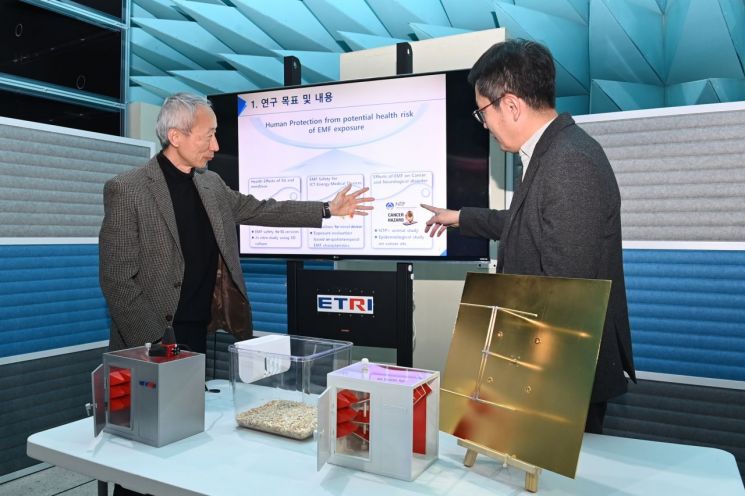 Researchers at the Electronics and Telecommunications Research Institute are explaining the purpose and main contents of an international collaborative study to verify the association between mobile phone electromagnetic fields and cancer. Electronics and Telecommunications Research Institute
The joint study was launched to determine whether mobile phone electromagnetic fields are carcinogenic at exposure intensities that form the basis of human safety standards, and to scientifically verify the 2018 findings of the National Toxicology Program (NTP) under the U.S. National Institutes of Health (NIH), which reported increased brain, heart, and adrenal tumors in male rats that were exposed for life to electromagnetic fields (900 MHz CDMA at about 6 W/kg).
Another background factor for initiating this research was that international organizations, including the World Health Organization (WHO), recommended additional studies to verify the reproducibility and validity of the NTP findings.
ETRI and a Japanese research team jointly planned the "Korea-Japan Joint Study on the Carcinogenicity and Genotoxicity of Mobile Phone RF Electromagnetic Fields" and, starting in 2019, launched the world’s first long-term toxicology animal study using a cross-border integrated data approach.
The study applied the same research system as the NTP and established a joint protocol based on the OECD toxicity testing guidelines. Korea and Japan conducted experiments under unified conditions, using the same laboratory animals, feed, equipment, and identical electromagnetic exposure environments.
For the experiment, the two countries’ research teams divided the animals into three groups: an RF exposure group, a sham exposure group, and a cage control group. Each group consisted of 70 rats, which were exposed to 900 MHz CDMA electromagnetic fields at an intensity of 4 W/kg from early pregnancy through 104 weeks after birth, covering their entire lifespan. This exposure level is the basis for setting human safety standards.
As a result, patterns of changes in body temperature, body weight, and feed intake due to electromagnetic exposure were generally similar in both Korea and Japan. However, feed intake tended to be somewhat lower in the RF exposure group than in the sham exposure group. Survival rates showed no significant differences among groups in Korea, while in Japan the RF exposure group exhibited relatively higher survival.
In the tumor incidence analysis, all experimental groups in Korea showed tumor incidence rates within the range of spontaneous occurrence, and no statistically significant differences were observed between the RF exposure and sham exposure groups in major organs such as the heart, brain, and adrenal glands. In Japan as well, there were no differences among groups in tumor incidence or time of onset, and the incidence of tumors in the main target organs was low.
In conclusion, both Korea and Japan found no significant association between long-term exposure to CDMA mobile phone electromagnetic fields and the incidence of brain, heart, or adrenal tumors.
Ahn Younghwan, a neurosurgery professor at Ajou University School of Medicine and the principal investigator of the study, said, "This study is meaningful in that it shows the tumor increases reported by the NTP were not reproduced at exposure levels that form the basis of human protection standards," adding, "We expect that these results will help alleviate excessive concerns about mobile phone electromagnetic fields."
Moon Jeongik, head of the Radio Environment Monitoring Research Laboratory at ETRI, said, "This study is also significant in that it presents a standard protocol for international joint animal experiments and establishes a foundation for integrating and analyzing experimental data across countries," and added, "The research team will pursue follow-up large-scale studies to scientifically clarify carcinogenic associations in complex electromagnetic environments where 4G and 5G coexist."
Meanwhile, this study was carried out as part of the Ministry of Science and ICT and the Institute of Information & Communications Technology Planning & Evaluation (IITP) projects, "Establishing a Foundation for Protecting Public Health in Complex Electromagnetic Environments" and "Systematic Identification of Human Health Risks from Electromagnetic Fields as Radio Services Evolve."
The research findings are scheduled to be published online on the 3rd in Toxicological Sciences, an international journal in the field of toxicology. The journal will simultaneously feature papers from both the Korean and Japanese research teams.
© The Asia Business Daily(www.asiae.co.kr). All rights reserved.