Economic Impact Analysis of Japanese-Style Gimbap Ehomaki
Seasonal Food Enjoyed on Setsubun (February 3) Gains Popularity
Rising Prices and Changing Consumer Patterns Lead to Surging Sales
The economic impact of Ehomaki, which is sold in Japan for Setsubun (February 3), has been estimated at around 680 billion won.
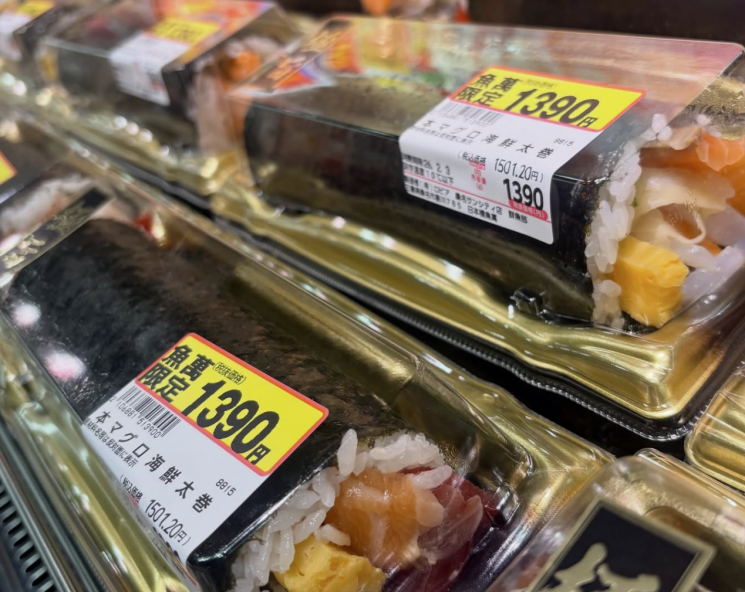 Lopia Kuwana Sun City Store, a major Japanese discount supermarket chain. Lopia Sun City Store Instagram
On the 3rd (local time), Japanese media outlet Yorozu quoted Katsushiro Miyamoto, an emeritus professor at Kansai University in Japan who is well known for his analyses of economic impact, as saying that "the economic impact of Ehomaki sold for this year's Setsubun is estimated to be approximately 72,881,380,000 yen (about 680 billion won)."
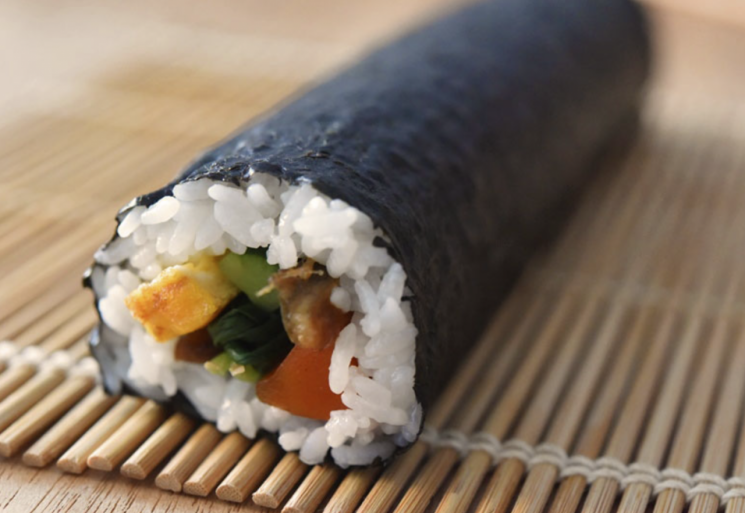
Ehomaki is a seasonal food eaten in Japan during Setsubun, and its appearance is very similar to Korean gimbap. However, the ingredients differ: while gimbap tends to use relatively standardized fillings such as pickled radish, spinach, carrot, and egg, the composition of ingredients in Ehomaki varies widely depending on the region and the retailer.
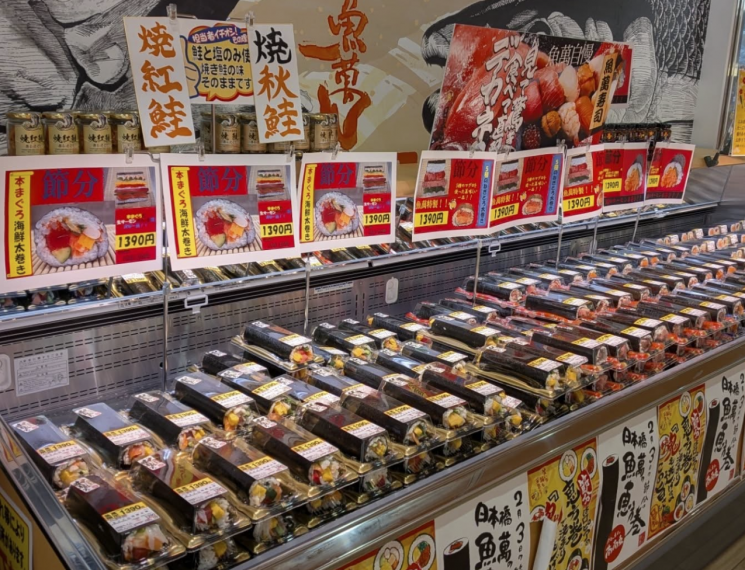 Ehomaki is being sold at Lopia's Nagoya store, a major discount supermarket chain in Japan. Lopia Nagoya Instagram
According to Professor Miyamoto's research, total sales of Ehomaki this year are expected to reach about 32,978,000,000 yen (3.071 billion won), an increase compared with 2025 (27,479,000,000 yen) and 2024 (31,655,000,000 yen). Based on these sales, the resulting economic impact is explained to be around 72.8 billion yen.
Professor Miyamoto cited continued price increases and changes in consumption patterns as the background for the rise in sales. He explained, "Consumer prices, especially for food, surged in 2024 and 2025," adding, "This trend is likely to continue this year as well." He went on to say, "As consumers show a stronger preference for premium products, high-priced Ehomaki is selling well, and the price of Ehomaki itself is rising every year."
In fact, Ehomaki that includes ingredients such as gold leaf seaweed, bluefin tuna, abalone, shark fin, snow crab, caviar, and Yonezawa Wagyu (premium beef from the Yonezawa region) costs between 5,000 yen (46,000 won) and 10,000 yen (93,000 won) per roll. Despite these high prices, demand for premium Ehomaki is reportedly increasing.
In the same analysis, Professor Miyamoto estimated the loss caused by Ehomaki being discarded after sales at about 1,648,900,000 yen (15.4 billion won). This figure assumes a disposal rate of 5% or more for Ehomaki and calculates that a portion of the expected total sales of approximately 32,978,000,000 yen will not be sold and will end up being thrown away.
Through Kansai University, he stated, "It is remarkable that a single food item can generate this level of sales in just one day," but added, "Since the country is working to reduce food waste, cooperation from society is necessary."
© The Asia Business Daily(www.asiae.co.kr). All rights reserved.