"Prostate Cancer Must Be Detected Early Through National PSA Screening"
Korean Urological Association: Over 50% of New Patients Are High-Risk Cases
National Responsibility Can Be Strengthened with an Annual Budget of 16.4 to 26.1 Billion Won
As prostate cancer has become the leading cancer among men in Korea, there is growing demand to introduce the Prostate Specific Antigen (PSA) test into the national cancer screening program. While prostate cancer is considered relatively mild in Europe and the United States, it has been found that in Korea, where PSA testing is not commonly performed, a high proportion of cases are only discovered after the cancer has progressed to a high-risk state.
 As prostate cancer has become the leading cancer among men in our country, there is increasing demand to introduce the Prostate Specific Antigen (PSA) test into the national cancer screening program. Getty Images
The Korean Urological Association held a "Policy Forum for the National Cancer Screening of Prostate Cancer" on February 2 at the Korea Press Center in Jung-gu, Seoul, urging the government to implement an organized national screening program to address the risks of prostate cancer.
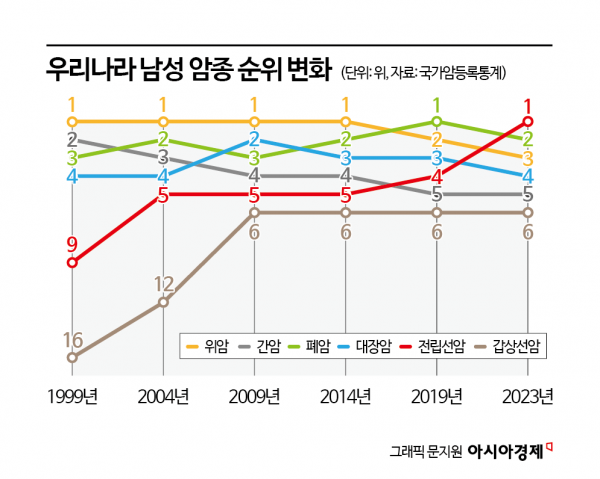
According to the 2023 National Cancer Registry Statistics released last month, prostate cancer has overtaken lung and stomach cancer, which previously held the top spots, to become the most common cancer among Korean men.
Prostate cancer is a representative cancer of old age, with the risk increasing sharply as people get older. Experts point out that the rise in prostate cancer in Korea, which has entered a super-aged society, is an expected outcome. Additionally, chronic issues of modern life such as a Westernized diet, lack of exercise, and obesity are also factors that increase the risk of developing prostate cancer.
 The Korean Urological Association held a "Policy Forum for the National Cancer Screening of Prostate Cancer" on the 2nd at the Korea Press Center in Jung-gu, Seoul, urging the government to include the PSA test in the national cancer screening program to address the risks of prostate cancer. Korean Urological Association.
According to Koh Younghui, Chair of the Prostate Cancer National Screening Task Force at the Korean Urological Association and Professor of Urology at Ewha Womans University School of Medicine, an analysis of prostate cancer cases detected at 51 general hospitals in Korea between 2010 and 2020 showed that more than 50% of new prostate cancer patients were diagnosed at a high-risk, aggressive stage. This contrasts with the United States, where since the 2000s, a significant portion of newly detected prostate cancer cases have been low-risk. In the United States, where PSA screening is widespread, a reversal in risk distribution has occurred (with the frequency shifting from high-risk to low-risk prostate cancer following the introduction of mass screening). However, in Korea, the absence of an early screening system means that aggressive cancers are often only discovered at an advanced stage.
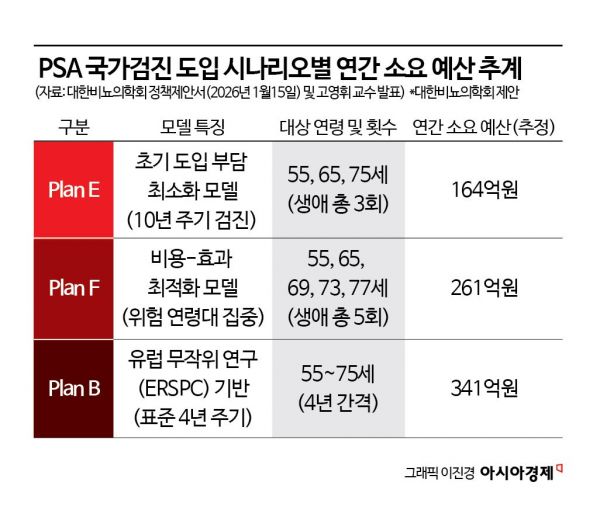
The association also emphasized that introducing PSA screening into the national program would not place a significant financial burden on the government. While the annual cost of screening for the six major cancers is approximately 1.4 trillion won (as of 2024), the estimated budget required for prostate cancer screening is only between 16.4 billion and 34.1 billion won per year.
Koh predicted, "If we do not mandate annual testing for everyone, but instead focus on high-risk age groups and adjust the screening interval based on medical evidence, applying a 'Korean-style efficiency model,' the system could be established with an annual budget of just 16.4 billion to 26.1 billion won."
Suh Sungil, President of the Korean Urological Association and Professor of Comparative Medicine at Sungkyunkwan University School of Medicine, stated, "If prostate cancer is left untreated and progresses to bone metastasis and beyond, the social costs associated with expensive anticancer drugs, robotic surgery, and long-term care become astronomical. Introducing the relatively inexpensive PSA test into the national system is the most reliable investment for maintaining the financial health of the national health insurance program."
Currently, prostate cancer diagnosis in Korea relies on "opportunistic screening," where individuals choose to get tested on their own. Any man over the age of 40 can receive a PSA test covered by health insurance for a low cost of about 15,000 won, but in most cases, people only undergo testing after experiencing uncomfortable symptoms and at the recommendation of medical staff. If the blood PSA level is above a certain threshold, further evaluation for cancer is conducted through ultrasound or MRI (magnetic resonance imaging), and, if necessary, a biopsy is performed.
President Suh emphasized, "PSA testing should be transitioned to an organized, government-managed screening program. By systematically managing the screening interval through the national screening system, we can alleviate concerns about unnecessary overdiagnosis and accurately identify patients who urgently need treatment."
© The Asia Business Daily(www.asiae.co.kr). All rights reserved.














