Ticketing Scams Persist Despite Penalties on Macro-Based Scalping
Scammers Disappear After Inducing Second Transfers... Most Losses Are Small
Experts: "Criminal Profits Still Exceed Fines"
"They told me that the ticket price had to be sent again because the fee had been deducted. I thought something was wrong and asked for a refund, but then I was blocked and all contact was cut off."
Park, a 19-year-old who tried to buy a ticket for a popular musical, recently lost 400,000 won while attempting to receive a transferred ticket via X (X, formerly Twitter). Having previously received tickets this way, Park transferred the ticket price along with personal information such as name, age, and phone number without much suspicion. Then the seller suddenly claimed that "the booking fee was deducted" and demanded another transfer. When Park, suspecting a scam, requested a refund, the seller immediately disappeared and could no longer be reached.

College student Yoon Yedam (25) also suffered similar damage. In September last year, while trying to purchase a ticket to a popular concert, Yoon attempted to get a ticket transferred through social networking services (SNS) and was swindled out of 360,000 won. Yoon did not particularly doubt the transaction until the seller showed a verification screen indicating that the ticketing had been completed. However, Yoon began to feel that something was off when the seller repeatedly demanded that the transfer be made not under Yoon's real name but under the SNS account nickname, citing the "risk of third-party fraud." When the seller asked for the money to be sent again, Yoon replied, "If you give me a refund, I will transfer it again," but contact was cut off at that point. Yoon said, "Looking back now, it was nothing but nonsense meant to carry out the scam," expressing frustration.
'Proxy ticketing scams' are spreading, in which scammers pretend to transfer tickets for popular performances, take the money, and then vanish. Recently, a method has been spreading in which scammers demand 'repeated transfers,' either by asking for additional money under the pretext of fees or by claiming that the specified depositor name does not match.
According to the police and other authorities on the 9th, there were 183,080 cases of cyber fraud between January and October 2024, and among them, peer-to-peer direct transaction fraud accounted for the largest share at 44.3% (81,252 cases. A significant portion of these is presumed to be proxy ticketing and scalping scams.
Although an amendment to the Public Performance Act to punish scalping transactions using macros took effect in 2024, various types of scams are still exacerbating the damage. The methods are broadly similar: scammers show a screen proving that the ticket has been reserved to reassure the buyer, then disappear after receiving the money. On some online communities, as the number of people scammed in the same way by a specific individual has increased, victims are even discussing joint action.
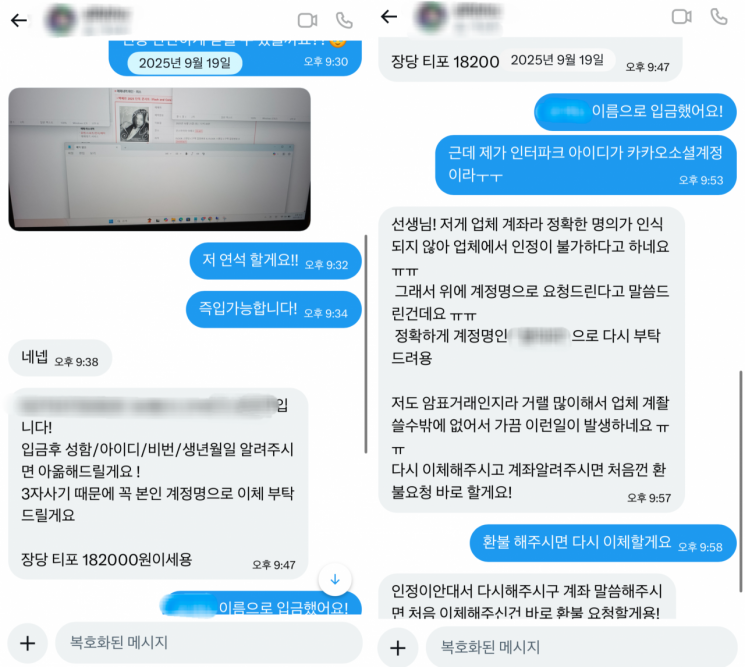 A messenger chat window in which Yoon Yedam (25) communicated with the seller to purchase concert tickets. The seller demanded a second transfer, saying, "It won't be recognized unless the payment is made under the social media account name." Provided by a reader.
When people try to engage in scalping transactions instead of going through legitimate ticketing procedures, about half of them end up being scammed. According to the Anti-Corruption and Civil Rights Commission, 51.1% of respondents with experience in scalping transactions said they had been scammed. Over the five years from 2019 to 2023, there were a total of 549 complaints related to scalping, and the number increased every year except during the COVID-19 pandemic in 2020 and 2021.
The problem is that such cases inevitably fall down the list of investigative priorities in practice. In particular, because the loss per victim is usually only in the tens of thousands of won, even when suspects are caught, they are often given only light fines or suspended sentences. In fact, according to a survey on scalping users by the Korea Music Label Industry Association, 57.2% of victims of scalping scams suffered losses of at least 50,000 won but less than 200,000 won.
Ultimately, critics point out that the economic gains that can be obtained from large-scale illegal sales exceed the level of punishment, meaning that the safety net is not functioning properly. Under the current Public Performance Act and National Sports Promotion Act, those who make illegal sales using macros can be punished by up to one year in prison or a fine of up to 10 million won. Oh Yoonseong, a professor in the Department of Police Administration at Dongguk University, said, "Because there is such high demand for tickets, even if they are caught in a crackdown, the money they make is greater than the fines," and added, "We need alternatives such as punishing both sellers and buyers when tickets are purchased through unofficial channels."
Meanwhile, the so-called 'Scalping Eradication Act' (amendments to the Public Performance Act and the National Sports Promotion Act), which imposes a surcharge of up to 50 times the sale amount on those who illegally resell tickets, passed the plenary session of the National Assembly on January 29. Unlike the previous law, which only punished the use of macros, the core of the amendment is a blanket ban on scalping transactions themselves.
© The Asia Business Daily(www.asiae.co.kr). All rights reserved.


















