Recent Decline of Exchange Rate to 1,430 Won Level Deemed "Comfortable"
NPS Should Diversify Hedging Instruments... Reliance on FX Swaps with the Central Bank Not Advisable
Issuance of Dollar-Denominated Bonds Could Serve as a Natural Hedge
New Framework to Be Decided Within 3?6 Months... Structural Changes Expected in the FX Market
Lee Changyong, Governor of the Bank of Korea, emphasized that the won-dollar exchange rate exceeding 1,480 won at the end of last year was "difficult to justify given the historically high current account surplus," describing it as a "significant depreciation." He assessed the recent decline to the 1,430 won level as "comfortable." Regarding the ongoing expansion of overseas investments by the National Pension Service (NPS) being cited as a major factor behind the high exchange rate, he pointed out that the NPS should raise its current foreign exchange hedge target ratio, which stands at 0%.
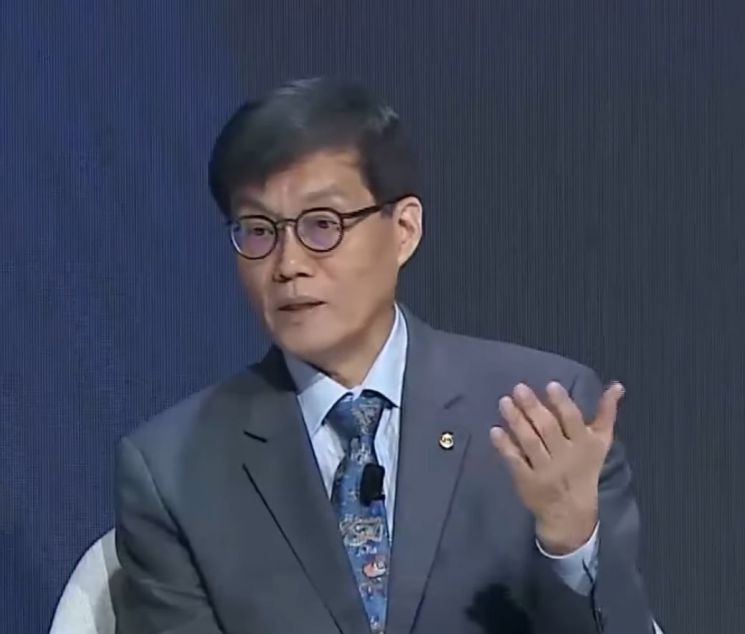 Lee Changyong, Governor of the Bank of Korea, held a discussion with Jan Hatzius, Chief Economist at Goldman Sachs, on the theme of "Policy Decisions in the Era of Global Divergence" at the "Global Macro Conference" held in Hong Kong on the 28th. Bank of Korea YouTube
National Pension Service to Halve Overseas Investments This Year... Expected to Reduce Dollar Demand by Over $20 Billion
According to a video released by the Bank of Korea on January 30, Governor Lee, in a discussion with Jan Hatzius, Chief Economist at Goldman Sachs, at the "Global Macro Conference" hosted by Goldman Sachs in Hong Kong on the 28th, stated, "The National Pension Service's overseas investments have continued to increase, and their investment scale has become quite large compared to the size of our foreign exchange market. Expectations of won depreciation have been continuously generated, which has led individual investors to once again prefer overseas investments."
He gave a positive assessment of the NPS's recent strategic changes. The NPS Fund Management Committee recently decided to raise the target allocation for domestic stocks and bonds by 0.5 and 1.2 percentage points, respectively, while lowering the target allocation for overseas stocks from 38.9% to 37.2%, a decrease of 1.2 percentage points. The reduction in overseas investment is expected to improve the dollar supply-demand balance in the foreign exchange market. Governor Lee noted, "The National Pension Service has announced it will halve its overseas investment scale this year," adding, "This means at least a $20 billion reduction in dollar demand."
He also mentioned the need to raise the NPS's foreign exchange hedge target ratio. Governor Lee said, "Currently, the NPS's FX hedge ratio target is 0%, but as an economist, my personal opinion is that the hedge ratio should be increased." He also called for diversification of hedging instruments. "Given the size of our country's derivatives market, we should not rely solely on foreign exchange swap transactions with the central bank. We need to secure other hedging instruments or sources of dollar funding," he said, adding, "There is discussion about allowing the NPS to issue dollar-denominated bonds, which could serve as a natural hedge from an asset-liability management (ALM) perspective."
Governor Lee reiterated his intention to promptly discuss changes in the NPS's investment approach. He stated, "Relevant institutions will discuss the optimal hedge ratio and appropriate overseas investment ratio," explaining, "This will likely be decided within three to six months, which could lead to changes in the structure of Korea's foreign exchange market."
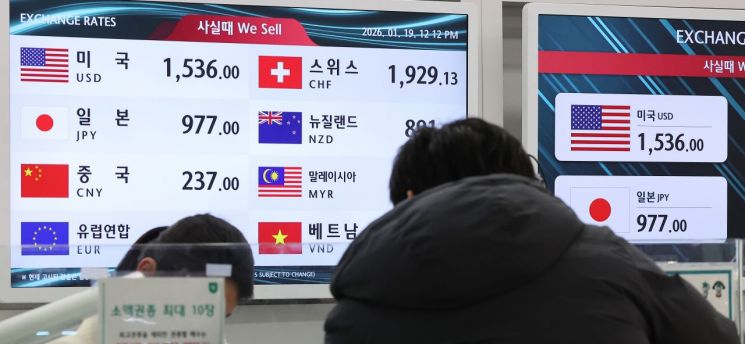 On the 19th, domestic and foreign nationals were inquiring about currency exchange at a bank exchange counter at Incheon Airport. Photo by Yonhap News
Strong AI-Related Exports... Growth Rate Could Be Revised Up to 1.8% This Year
He cited the resolution of political risks and robust exports in key industries as reasons for forecasting this year's economic growth rate at 1.8%, up from last year's 1.0%. Governor Lee said, "Last year was truly exceptional. At the beginning of the year, political risks increased significantly due to the unnecessary declaration of martial law," adding, "Therefore, achieving a 1% growth rate was very fortunate." He continued, "The most important drivers this year are exports of semiconductors, defense, automobiles, and shipbuilding, with particularly strong performance in the semiconductor industry and artificial intelligence (AI)-related exports. At this point, I see some upside risk to the 1.8% forecast made last November." However, he cautioned that due to "K-shaped growth," the growth rate in non-IT industries is expected to remain at 1.4%.
He also pointed out that trade with China is no longer a driving force for Korea's economic growth. Governor Lee explained, "The Korean economy had already decoupled from China long before the US-China conflict arose. This is not due to political or geopolitical tensions, but because China and Korea have similar industrial structures and China's competitiveness has increased significantly." He added, "While China remains one of the largest trading partners, it is no longer the core pillar of Korea's growth. In fact, the United States has become much more important, and Europe and other Asian countries have also gained greater significance."
If the Exchange Rate Remains at 1,470-1,480 Won for an Extended Period, Inflation Forecasts Should Be Raised
Even if this year's economic growth rate recovers to 1.8% or higher, the inflation rate is expected to remain at 2.1%, close to the target of 2.0%. Governor Lee said, "Thanks to the Bank of Korea starting to raise the base rate earlier than other countries, Korea already recorded an inflation rate of about 2% as early as 2023, much earlier than other countries," adding, "This year, despite the significant depreciation of the won, the inflation rate remained around 2.3% and has now fallen to 2.2%. The fact that international oil prices have stayed low, despite the depreciation of the won, has helped keep inflation just above 2%." He cited the high exchange rate as a risk factor for inflation. "If the exchange rate stays in the 1,470 to 1,480 won range for an extended period, we may have to raise our inflation forecasts somewhat," he said, "but fortunately, the rate is coming down, so we should be able to maintain our current forecast."
He also reiterated the limitations of interest rates in addressing "K-shaped recovery." He said, "Interest rates are not an appropriate tool for resolving the K-shaped recovery issue. Clearly, this issue must be addressed through fiscal policy and other institutional reforms, but we are also under political pressure."
© The Asia Business Daily(www.asiae.co.kr). All rights reserved.


















