Discussion at the "Global Macro Conference" Hosted by Goldman Sachs
Governor Lee: "We Should Not Rely Solely on Swaps with the Central Bank"
Lee Changyong, Governor of the Bank of Korea, emphasized that the won-dollar exchange rate exceeding 1,480 at the end of last year "cannot be justified, considering the historically high current account surplus. It was a significant depreciation." He described the recent level, which has come down to the 1,430 won range, as "comfortable." Regarding the situation where the National Pension Service's continued expansion of overseas investments is cited as a key factor behind the high exchange rate, he pointed out that the National Pension Service's current foreign exchange hedging target ratio, which stands at 0%, should be increased.
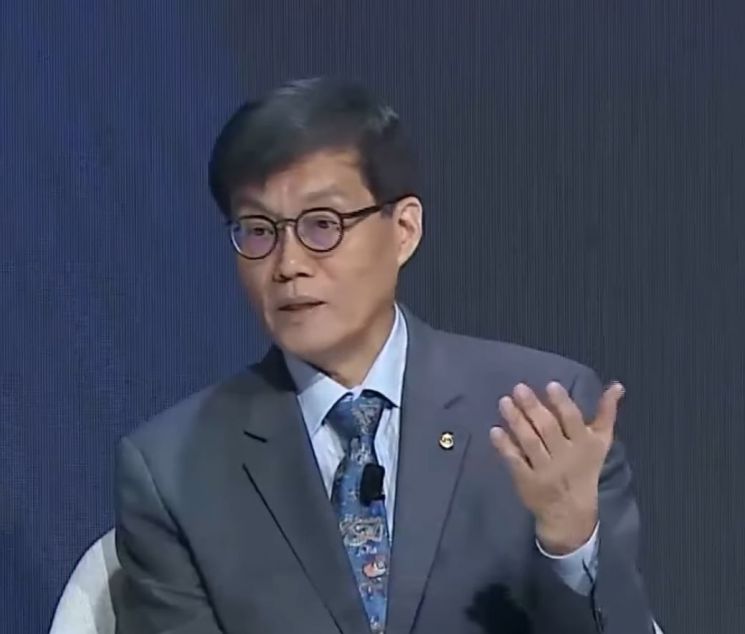 Lee Changyong, Governor of the Bank of Korea, engaged in a discussion with Jan Hatzius, Chief Economist at Goldman Sachs, on the topic of "Policy Decisions in the Era of Global Divergence" at the "Global Macro Conference" held in Hong Kong on the 28th. Bank of Korea YouTube
According to a video released by the Bank of Korea on the 30th, Governor Lee, during a discussion with Jan Hatzius, Chief Economist at Goldman Sachs, at the "Global Macro Conference" hosted by Goldman Sachs in Hong Kong on the 28th, stated, "The National Pension Service's overseas investments continue to increase, and the scale of their investments has become quite large compared to the size of our foreign exchange market. Expectations for a weaker won have persisted, which in turn has led individual investors to favor overseas investments again."
He gave a positive assessment of the recent strategic changes by the National Pension Service. The Fund Management Committee of the National Pension Service recently decided to raise the target allocation for domestic stocks and bonds by 0.5 percentage points and 1.2 percentage points, respectively, while lowering the target allocation for overseas stocks from 38.9% to 37.2%, a decrease of 1.2 percentage points. The reduction in the proportion of overseas investments is expected to improve the dollar supply and demand in the foreign exchange market. Governor Lee pointed out, "(The National Pension Service) announced that it will halve the scale of overseas investments this year," adding, "This means at least a $20 billion reduction in dollar demand."
He also mentioned the need to raise the National Pension Service's foreign exchange hedging target ratio. Governor Lee said, "Currently, the National Pension Service's foreign exchange hedging target is 0%, but as an economist, my personal opinion is that the hedging ratio should be increased." There is also a call for diversification of hedging instruments. He stated, "Considering the size of Korea's derivatives market, we should not rely solely on foreign exchange swap transactions with the central bank. We need to secure other hedging instruments or sources of dollar funding." He emphasized, "There are discussions underway about allowing the National Pension Service to issue dollar-denominated bonds, which could provide a natural hedge from an asset-liability management (ALM) perspective."
Additionally, Governor Lee reiterated his intention to promptly discuss changes in the National Pension Service's investment approach. He said, "Relevant agencies will discuss the optimal hedging ratio and appropriate proportion of overseas investments," adding, "Along with this, a decision will likely be made within three to six months, which will bring changes to the structure of Korea's foreign exchange market."
© The Asia Business Daily(www.asiae.co.kr). All rights reserved.












