Ten Key Agendas Including Regenerative Tourism and Embedded AI Proposed
Suggestions for a Paradigm Shift in Tourism Policy
There was a suggestion that the domestic tourism industry must move beyond a quantitative growth strategy focused on increasing the number of inbound visitors and enter a phase of qualitative transformation that involves redesigning the very structure of the industry.
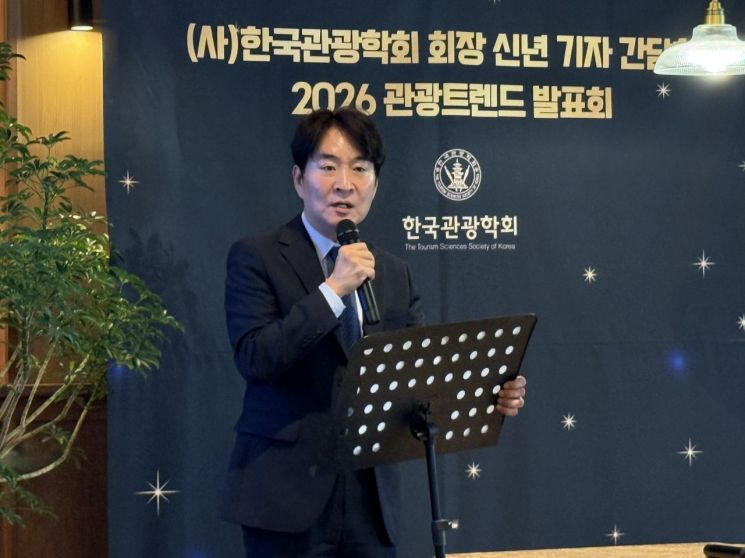 On the 29th, at the Ananti at Gangnam Hotel in Gangnam-gu, Seoul, Seowon Seok, President of the Korean Tourism Association and Dean of the College of Hotel and Tourism at Kyung Hee University, delivered a congratulatory speech at the Korean Tourism Association New Year Press Conference. Photo by Korean Tourism Association
On January 29, the Korean Tourism Association held a New Year press conference at the Ananti at Gangnam Hotel in Gangnam-gu, Seoul, and announced the "2026 Core Trends for the Development of Korean Tourism." At the event, Seowon Seok, President of the Korean Tourism Association and Dean of the College of Hotel and Tourism at Kyung Hee University, delivered New Year’s greetings and emphasized the need to shift the direction of tourism policy. This was followed by a presentation from Joon Heo, Professor at the College of Cultural Convergence Knowledge at Dongduk Women's University, who introduced the 2026 tourism trends and ten key strategies.
Seowon Seok: "Tourism Policy Should Now Focus on 'Structure' Rather Than 'Scale'"
In his remarks, Seowon Seok stated, "The number of inbound tourists has recovered rapidly, and the scale of visitors is close to policy targets, but simply increasing visitor numbers does not directly translate into tourism industry competitiveness," stressing the need for a paradigm shift in policy.
He continued, "Tourism has now reached a stage where it must go beyond being a consumption industry centered on accommodation and shopping, and instead, the structure of stays, the quality of consumption, and the ripple effects across industries must be designed together." He added, "2026 is a period of major transformation, as demographic changes and intensifying global competition converge, presenting a golden opportunity to fundamentally change the nature of the tourism industry."
He also mentioned the need for a strategy to expand already competitive sectors-such as gastronomy, medical, wellness, beauty, and K-culture-by linking them with tourism experiences to create high value-added, stay-type content. He stressed that tourism should be redefined as a core platform for industrial convergence.
Professor Joon Heo Proposes "RED-UNICORN" as the 2026 Tourism Trend
The trend presentation was delivered by Professor Joon Heo of Dongduk Women's University. Based on analysis data from 210 tourism studies faculty members, Professor Heo presented "RED-UNICORN" as the keyword that encapsulates the structural transformation of the tourism industry in 2026.
Professor Heo explained, "While previous discussions of tourism trends have focused on analyzing consumer preferences, this presentation is centered on providing an actionable framework to address gaps in policy and systems."
"RED-UNICORN" is a concept that combines "Red," symbolizing the dynamism of 2026 (the year of the Red Horse in the lunar calendar), and "Unicorn," which refers to rare, high value-added industries. It delivers the strategic message that Korean tourism must achieve qualitative advancement and grow into a unique and leading industry.
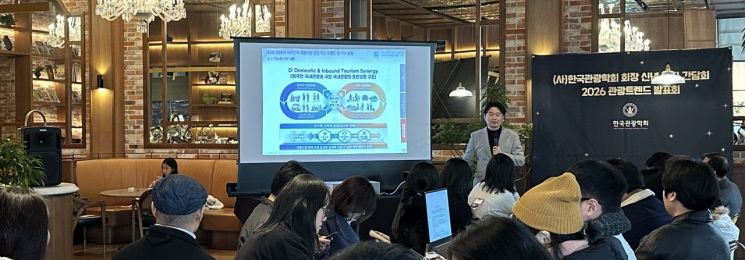 On the 29th, at the Ananti at Gangnam Hotel in Gangnam-gu, Seoul, Professor Joon Heo of Dongduk Women's University College of Cultural Convergence Knowledge presented this year's tourism industry trends at the Korea Tourism Association's New Year press conference. Photo by Korea Tourism Association
From Regenerative Tourism to Embedded AI: Ten Key Agendas
Professor Heo first identified the following as core axes of transformation: ▲ Regenerative tourism to overcome and recover from regional crises ▲ Embedded AI and digital experiences that seamlessly permeate the tourism field ▲ Domestic and inbound synergy, where foreign and domestic tourism reinforce each other.
He then proposed seven strategies for entering high value-added industries: ▲ Hyper-personalized travel operating systems ▲ Global hospitality readiness ▲ Integrated wellness tourism ▲ K-fandom economy convergence content ▲ Open innovation tourism ecosystems ▲ Mainstreaming ESG ▲ A blueprint for next-generation tourism talent.
Professor Heo emphasized, "AI is no longer just a convenience feature in tourism, but a core operational infrastructure responsible for demand forecasting, price optimization, and managing repeat visits." He added, "Rather than showcasing technology, we must evolve to a stage where it is naturally embedded within the experience."
The Korean Tourism Association plans to develop the ten "RED-UNICORN" agendas announced this time into a strategic archive that can be accumulated and compared annually, rather than a one-off trend suggestion, in order to support policy-making by the government and local authorities.
Seowon Seok stated, "We will systematically accumulate the collective intelligence of the Tourism Association to strengthen the public forum connecting academia, policy, and industry," adding, "We will support Korean tourism in becoming a unicorn industry with sustainable competitiveness in the global market."
© The Asia Business Daily(www.asiae.co.kr). All rights reserved.













