Seminar Held Ahead of Samsung Life Insurance's Financial Report
Concerns Raised Over Expanding the Role of Accounting Standards
After Samsung Life Insurance was subject to a reversion order by financial authorities due to accounting deviation, an analysis has emerged suggesting that, under the new International Financial Reporting Standards (IFRS 17) system, the failure to recognize insurance liabilities related to participating insurance contracts could be mistaken for accounting fraud.
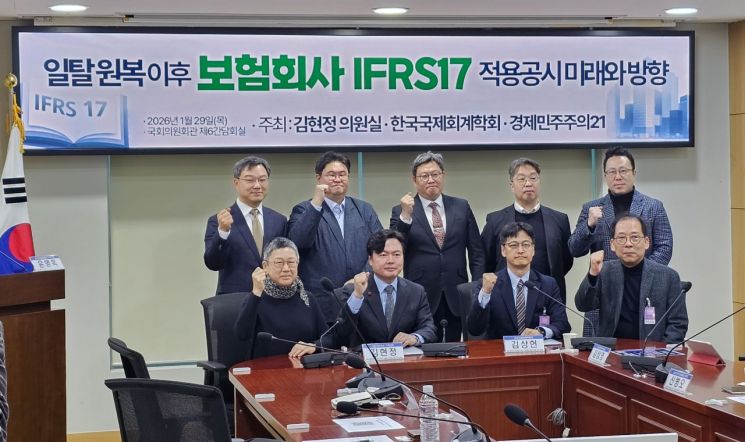 Participants of the seminar "The Future and Direction of IFRS 17 Application Disclosure in Insurance Companies After Reversion to Original Deviation" held on the 29th at the National Assembly Members' Office Building in Yeouido, Seoul, are taking a commemorative photo. Photo by Lee Seunghyung
At the seminar titled "The Future and Direction of IFRS 17 Application Disclosure in Insurance Companies After Reversion to Original Deviation," held on the 29th at the National Assembly Members' Office Building in Yeouido, Seoul, Professor Son Hyuk of Keimyung University stated, "If insurance liabilities related to participating insurance contracts are not recognized under the IFRS 17 system, it could be misconstrued as accounting fraud. Therefore, it is essential to provide annual disclosures and simulations that clearly explain the continuation and scope of policyholder rights."
Alongside Professor Son Hyuk, the seminar was attended by Kim Sangheon, President of the Korean Academic Society of International Accounting, Park Sungjong, Professor at Hankyong National University, Shin Byungo, Managing Director at Deloitte Anjin LLC, and Kim Kwangjung, Attorney at Law Firm Class Hangyeol.
The industry is closely watching Samsung Life Insurance's financial statement, which will be disclosed in March. This report is expected to include information regarding the share allocated to participating policyholders. In the 1980s and 1990s, Samsung Life Insurance sold participating insurance products and used the premiums paid by policyholders to acquire an 8.51% stake in Samsung Electronics. The amount that should be paid to these policyholders has been treated as a separate liability called "policyholder equity adjustment," which previously triggered controversy over "deviant accounting." As of the end of September last year, this amount was estimated to be in the 12 trillion won range, and it is believed to have increased significantly since then.
Professor Son stated, "After the reversion of deviant accounting, the phenomenon of insurance liabilities related to participating insurance contracts not being recognized in some insurers' financial statements may appear to be a faithful application of IFRS 17's measurement logic from the perspective of life insurers, but this is a significant misconception. Participating insurance contracts are based on a structure that promises to distribute dividends to policyholders when excess profits occur. These rights persist independently of the insurance liability measurement at a specific point in time. Nevertheless, if insurance liabilities are presented as 'zero' without sufficient explanation, it could be misunderstood as a deprivation of policyholder rights."
On this point, Professor Park Sungjong of Hankyong National University said, "The concern that a disclosure of 'zero' insurance liabilities could cause misunderstanding regarding policyholder protection is valid to some extent." However, he added, "Some proposals to address this issue require explanations that go beyond the conceptual framework and measurement logic of IFRS 17, or may impose excessive practical burdens and lead to interpretational inconsistencies." He further stated, "Future discussions should focus on clarifying the explanations for insurance liability measurement results and refining disclosures. At the same time, any attempt to expand the role of accounting standards on the grounds of policyholder protection as a policy objective should be approached with greater caution."
Previously, in December last year, the Financial Supervisory Service and the Korea Accounting Standards Board held a joint meeting for inquiries on the Korean International Financial Reporting Standards (K-IFRS). In response to a question from the Korea Life Insurance Association regarding whether deviant accounting could continue for the obligation to pay dividends related to participating insurance contracts, they answered, "It can no longer be applied," thereby concluding that deviant accounting would no longer be permitted in the domestic life insurance industry.
© The Asia Business Daily(www.asiae.co.kr). All rights reserved.












