Gaps in Xiaomi's After-Sales Service Centers During the Transition Period
Xiaomi, which had emphasized strengthening after-sales service (AS) as the core of its strategy tailored for the Korean market, is struggling to win over Korean consumers due to disruptions in parts supply and a lack of service centers.
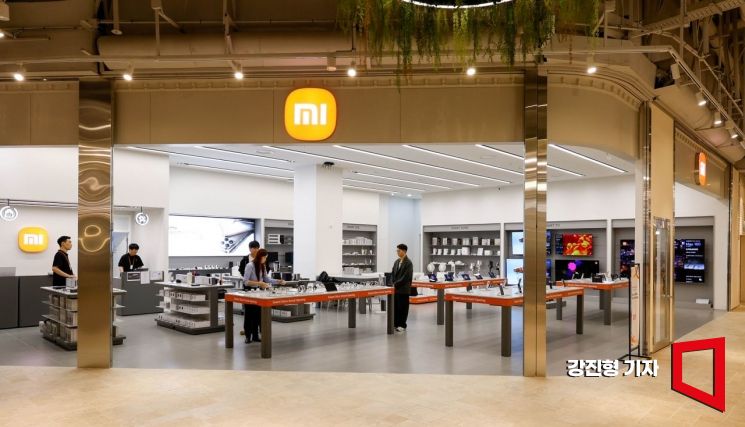 September 25, 2025, Xiaomi Store NC Eastpole Guui Branch, Gwangjin-gu, Seoul. Photo by Kang Jinhyung
As of January 30, Xiaomi operates 16 AS centers nationwide, combining both directly managed and outsourced locations. The directly managed centers include the first dedicated AS center, which opened last October on Hangang-daero in Yongsan-gu, Seoul, as well as two other locations in Seoul and one in Gyeonggi Province. Since last month, service agency Winia Aid has been handling Xiaomi product repairs at 12 locations across the country, replacing the previous provider ServiceN.
However, there are significant regional disparities in service center accessibility. Users outside the Seoul and Gyeonggi areas can only send their devices by courier to the directly managed centers, making same-day repairs difficult. Even with Winia Aid, there are only two locations in Seoul, four in Gyeonggi, and one each in Gangwon, Busan, Ulsan, Daejeon, Gwangju, and Jeonju, so users in other regions face challenges in getting repairs. This stands in stark contrast to Samsung Electronics, which has over 170 mobile phone service centers, and Apple, with more than 80 repair shops.
The bigger issue is the supply of parts. Even at directly managed AS centers, repairs are delayed due to supply chain disruptions. This leads to a lack of clear guidance for customers on which items can be repaired and the current status of their service. A representative from a Xiaomi directly managed AS center said, "If the parts are available, repairs can be done quickly, but it is often difficult to guarantee same-day service. If the parts are in a domestic warehouse, it takes one to two weeks after ordering, but in the worst case, if we have to order from China, it could take up to a month."
Service agencies have also reported difficulties in providing smooth repairs for Xiaomi products recently. Since December of last year, there has been a backlog of Xiaomi repair requests, and parts are not arriving promptly. A representative from Winia Aid’s A branch said, "Even when we request parts, the headquarters does not tell us whether there is stock in Korea or when they will send them, so both customers and we are frustrated. For example, a customer who requested a battery replacement two months ago still has not received the service and is using a rental phone."
A representative from Winia Aid’s B branch said, "Currently, we do not have most mainboards for Xiaomi smartphone models, so they have to be shipped from China over two to three weeks. Normally, repair centers keep parts in advance, but Xiaomi’s policy is to send parts as needed upon request, so there is no buffer stock."
Regarding the operation of service centers, Xiaomi stated only its official position that 'trust' is its highest value. A Xiaomi representative explained, "In addition to high-quality products and reasonable prices, we have always prioritized providing consistent service that consumers can trust. We plan to gradually review and promote the opening of additional directly managed service centers according to service demand."
Kim Yongjin, Professor of Business Administration at Sogang University, said, "The fundamental limitation for foreign companies is the difficulty of establishing an initial AS network. If AS, where speed is the key competitive factor, is weak, the lock-in effect that keeps consumers loyal is diminished." He added, "Since Xiaomi sells a wide range of electronic products, it needs many service centers, and partnering with logistics companies to utilize 'third-party logistics' for repairs via courier could be a solution."
© The Asia Business Daily(www.asiae.co.kr). All rights reserved.

















