Korea Disease Control and Prevention Agency Announces Revised CPR Guidelines
The domestic cardiopulmonary resuscitation (CPR) guidelines have been revised for the first time in five years. The updated guidelines include new instructions for chest compression techniques for infants under one year old and methods for attaching automated external defibrillator (AED) pads to women without removing their underwear.
The Korea Disease Control and Prevention Agency and the Korean Association of Cardiopulmonary Resuscitation announced the "2025 Revised Korean Cardiopulmonary Resuscitation Guidelines" on January 29, 2026.
This revision is based on the guidelines last updated in 2020, incorporating the latest domestic and international research findings and input from 16 professional organizations. Experts reviewed international CPR consensus statements and studies to develop the recommendations.
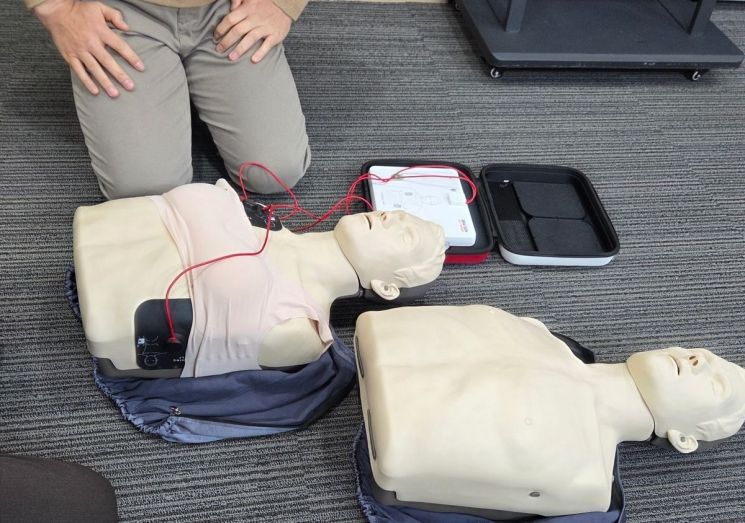
In the field of basic life support, the new guidelines propose that emergency responders instruct callers on how to use an AED to increase its usage rate.
It is known that the use of AEDs is lower in female cardiac arrest patients, partly due to concerns about physical contact. Therefore, the guidelines recommend attaching the AED pads directly to the bare chest without removing the underwear (bra), by adjusting its position to avoid breast tissue.
According to the guidelines, the pads should be placed by moving the underwear to the side, with one pad between the right collarbone and the nipple, and the other on the left side of the torso.
Lee Changhee, a professor at Namseoul University who participated in revising the guidelines, explained, "Experimental results showed that not removing the underwear did not significantly affect the placement of the pads or the effectiveness of the electrical shock."
While chest compressions are generally the first step in CPR, for cardiac arrest caused by drowning, standard CPR including rescue breaths should be performed. Laypersons who have not received training in rescue breathing should perform compression-only CPR, while trained emergency medical personnel should start with rescue breaths.
For infants under one year old, the previous guidelines recommended the "two-finger compression technique" for a single rescuer and the "two-thumb encircling hands technique" for two or more rescuers. The revised guidelines now recommend the two-thumb encircling hands technique regardless of the number of rescuers.
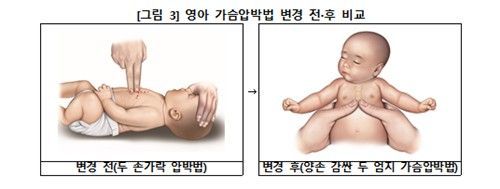
The Korea Disease Control and Prevention Agency explained that the two-thumb encircling hands technique for infants helps maintain consistent compression depth and force, and is less likely to cause finger pain or fatigue.
When an infant's airway is blocked by a foreign object, abdominal thrusts are not recommended due to the risk of internal organ injury. The revised guidelines now recommend, in addition to the existing five back slaps and five abdominal thrusts, the use of a single hand's heel (the area between the palm and wrist) for compressions.
Additionally, the use of AEDs, previously recommended mainly for adults with non-traumatic cardiac arrest, has now been extended to children aged one year and older. A new "emergency care" section has also been added, providing response guidelines for patients with chest pain, suspected acute stroke, shock, and syncope.
Other major revisions include the integration of the "chain of survival" steps for resuscitating cardiac arrest patients. The chain of survival, previously divided into adult, pediatric, out-of-hospital, and in-hospital categories, has been unified, and a separate "rehabilitation and recovery" stage has been added.
Im Seungkwan, Commissioner of the Korea Disease Control and Prevention Agency, stated, "With this revision, we hope to expand the implementation of CPR by the general public and improve the survival rate of cardiac arrest patients. We will actively promote the revised guidelines to relevant organizations and the public, and ensure they are fully reflected in CPR training materials and on-site practices."
The revised guidelines can be downloaded by anyone from the Korea Disease Control and Prevention Agency website.
© The Asia Business Daily(www.asiae.co.kr). All rights reserved.
!["The Woman Who Threw Herself into the Water Clutching a Stolen Dior Bag"...A Grotesque Success Story That Shakes the Korean Psyche [Slate]](https://cwcontent.asiae.co.kr/asiaresize/183/2026021902243444107_1771435474.jpg)

















