Small Scale and Resident Opposition Remain Key Challenges
Only 6% Success Rate Under Moon Administration
Special Law Aims to Accelerate Progress
But Passage Through 10 Committees Could Take Years
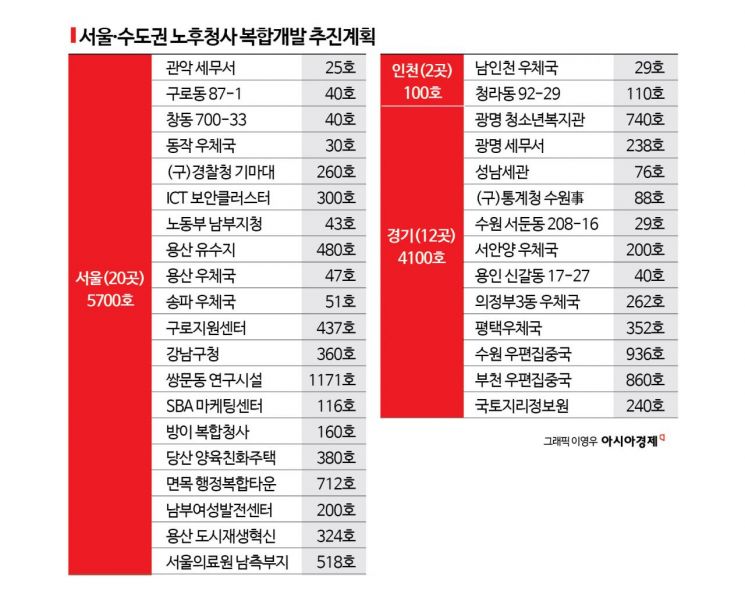
In this latest plan, the government announced its intention to supply approximately 10,000 housing units (specifically, 9,900 units) by identifying 34 sites, including old public office buildings and idle land, in addition to urban development projects. This demonstrates the government's determination to secure as much land as possible, even small leftover plots, for housing supply. These sites were secured through four months of consultations with ministries and local governments, following the announcement of the plan for mixed-use redevelopment of aging government buildings in the September 7 policy last year. Despite the government's strong will to expand supply, many remain skeptical about the effectiveness of these measures.

First, the scale is small. With 10,000 units across 34 sites, the average per site is only about 300 units. The largest site is an educational research facility in Ssangmun-dong, Dobong-gu (1,171 units), while most others, such as Gangnam-gu Office (360 units) and Songpa Post Office (51 units), are limited to several dozen or a few hundred units. Although these sites have the advantage of being located near subway stations in the city center, it is questionable whether the volume is significant enough to stabilize the housing market in the greater Seoul area.
The ability to execute these projects also needs to be verified. Mixed-use redevelopment of old government buildings is not a new policy. The Moon Jae-in administration also pursued similar projects from 2017, selecting 34 candidate sites, but as of the first half of last year, only two sites had actually been completed and occupied. That is two out of 34 sites in eight years, a success rate of just 6%. Excessive demands for development profits by the institutions owning the buildings, opposition from local residents, and passive cooperation from local governments have all been obstacles.
The typical model for mixed-use redevelopment of old government buildings involves demolishing the existing building and constructing a high-rise, with government offices on the lower floors and residences above. Usually, the office temporarily relocates and returns after completion, but in cases like the Suwon Mail Distribution Center included in this plan, logistics facilities will be relocated entirely to a new site, and the original land will be developed solely for housing. In such cases, construction cannot start until the new facility is completed, so some projects have been postponed until 2030.
For the institutions owning these buildings, there is the burden of relocating to temporary offices during construction and sharing the completed building with residents afterward. If they are not guaranteed sufficient development profits, they have little incentive to cooperate. Conversely, if they demand excessive profits, the project's financial viability diminishes, making private sector participation difficult. This dilemma was the main reason for the slow progress during the Moon Jae-in administration.
Local resident opposition is another variable. Most of these sites are in low-rise residential areas. When high-rise mixed-use buildings are constructed, residents often object due to concerns about loss of sunlight and increased traffic congestion. Many of the candidate sites selected during the Moon Jae-in administration faced delays or were canceled altogether due to such opposition.
The government emphasizes that this time will be different. To accelerate the process, it is pursuing a special law for mixed-use redevelopment of old public office buildings and other sites to supply housing in city centers. In December of last year, Democratic Party lawmaker Park Sanghyuk and others introduced the bill, and two days later it was referred to 10 relevant standing committees, including the Land, Infrastructure and Transport Committee and the Strategy and Finance Committee. The core provisions include mandatory review of mixed-use redevelopment for government buildings over 30 years old, ministerial authority to grant permits, and relaxation of floor area ratio regulations.
If the special law passes, the central government will have grounds to push the projects forward even if local governments or building-owning institutions are uncooperative. An official from the Ministry of Land, Infrastructure and Transport stated, "This time, we have conducted sufficient prior consultations with relevant agencies and local governments, and through the special law, we aim to encourage local participation by including provisions for increased floor area ratios, project funding, and support for community infrastructure. One of the reasons previous attempts failed was the lack of support for relocation costs and other expenses."
However, the legislative schedule remains uncertain. Since the special law must be reviewed by 10 standing committees, it could take considerable time to pass the National Assembly. While the government aims to enact the law within this year, it is difficult to be optimistic given the need to coordinate differences between committees and consult with relevant ministries. Without the special law, the projects would have to proceed as before, making it unlikely that outcomes will differ from those under the Moon Jae-in administration.
Securing additional sites will also be challenging. Since many of the best-located old government buildings have already been identified, future opportunities will likely be limited to small-scale, sporadic projects. Although the government has stated it will "continue to identify additional sites," there is a finite supply of prime land near subway stations.
Lee Changmu, professor of urban engineering at Hanyang University, commented, "Because compensation or agreement from association members is not required, these are projects that the public sector can accelerate if it is determined to do so. With the current government's drive, I believe it is possible." However, he added, "There remains the question of whether the results will be significant enough to justify the effort."
© The Asia Business Daily(www.asiae.co.kr). All rights reserved.
![User Who Sold Erroneously Deposited Bitcoins to Repay Debt and Fund Entertainment... What Did the Supreme Court Decide in 2021? [Legal Issue Check]](https://cwcontent.asiae.co.kr/asiaresize/183/2026020910431234020_1770601391.png)
















