Improving Sewage Infrastructure to Prevent Flood Risks
Expanding 1.43 km of Stormwater Pipelines Across Four Sections
Gwangmyeong City in Gyeonggi Province will establish a large-scale stormwater detention facility and expand stormwater pipelines in the Haan-dong area to prevent flooding caused by heavy rainfall.
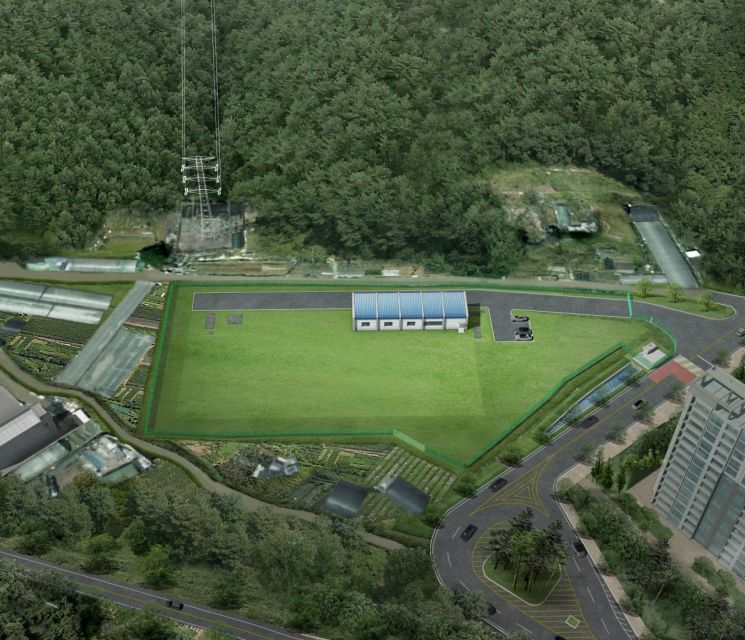 A bird's-eye view of the 'stormwater detention facility' planned to be constructed by Gwangmyeong City to prevent frequent flooding in the Haan-dong area. The upper part will be designed as a park to be used as a leisure space for citizens. Provided by Gwangmyeong City
On January 29, Gwangmyeong City announced that it will install a stormwater detention facility with a capacity of 26,000 tons in the Haan-dong 685-1 area and upgrade 1.43 kilometers of stormwater pipelines across four sections to address the area's chronic flooding issues.
The stormwater detention facility is a key urban infrastructure designed to temporarily store rainwater that rushes into the sewage system during heavy downpours and then gradually release it after the rain stops, thereby preventing urban flooding.
The commercial district of Haan-dong suffered severe flooding in August 2022 when 109.5 mm of rain fell per hour. The city determined that the existing sewage facilities were insufficient to effectively respond to similar natural disasters, prompting the development of a comprehensive improvement plan. To secure funding, the city applied to the Ministry of Environment to designate the area as a "priority management zone for sewage system improvement," and this designation was granted in November of that year.
Once designated as a priority management zone, comprehensive national-level improvements become possible in high-risk flood areas, and the city can receive national funding for large-scale sewage improvement projects, enabling more systematic and stable project execution.
In August 2024, the city established the "Haan Drainage Area Sewage Improvement Plan," detailing the installation of the stormwater detention facility and the expansion of stormwater pipelines.
According to the plan, the city will invest a total of 49.9 billion won, including national and provincial funds, to install the 26,000-ton capacity detention facility and expand and upgrade 1.43 kilometers of stormwater pipelines across four sections.
Stormwater pipelines are channels that quickly carry rainwater from roads and residential areas to rivers or detention facilities. Expanding their capacity improves drainage during heavy rainfall. The targeted sections for pipeline improvement are: Geumdang Intersection to Anyangcheon-ro, Haan Catholic Church to Gwangmyeong Church, the single-lot section on Ori-ro, and the Haan 6th Complex section on Ori-ro.
The city plans to complete major administrative procedures in the first half of this year and begin construction on the stormwater pipeline expansion in the second half. Construction of the detention facility will begin after land compensation is finalized, with the goal of completing the project by 2028.
In particular, the upper space of the detention facility will be developed as a cultural park, aiming to improve the living environment as well as prevent flooding.
Additionally, to prevent manhole fall accidents during floods, the city plans to install fall-prevention devices on 1,430 manholes within the priority management zone by July. These devices will prevent people or vehicles from falling in, even if manhole covers are dislodged during heavy rain.
Park Seungwon, Mayor of Gwangmyeong City, stated, "We will strengthen safety infrastructure to protect citizens' lives and property from recurring heavy rainfall. We will continue to proactively respond to climate change and make the entire city safer and more livable."
© The Asia Business Daily(www.asiae.co.kr). All rights reserved.