"Momentum for Dollar Decline, 'Secondary Effect' Drives Further Drop"
If 1,420 Won Breaks, Another Wave of Selling Possible... If Not, Consolidation Likely
Lower Levels Attract Real Dollar Demand... 1,410 Won Expected in First Half
The previous day, the won-dollar exchange rate plummeted to the 1,420 won level, bringing this month's average exchange rate below 1,460 won. Although the decline was partially reversed overnight as the US moderated the pace of the dollar's weakening, the exchange rate continued to move in the upper 1,420 won range in early trading, lowering its level compared to the previous high of 1,478.1 won. Experts believe that the won-dollar exchange rate will continue to face downward pressure for the time being due to ongoing external momentum for a weaker dollar. However, they also predict that the lower bound in the low 1,400 won range will be supported as demand for buying the dollar at lower prices emerges at these levels.
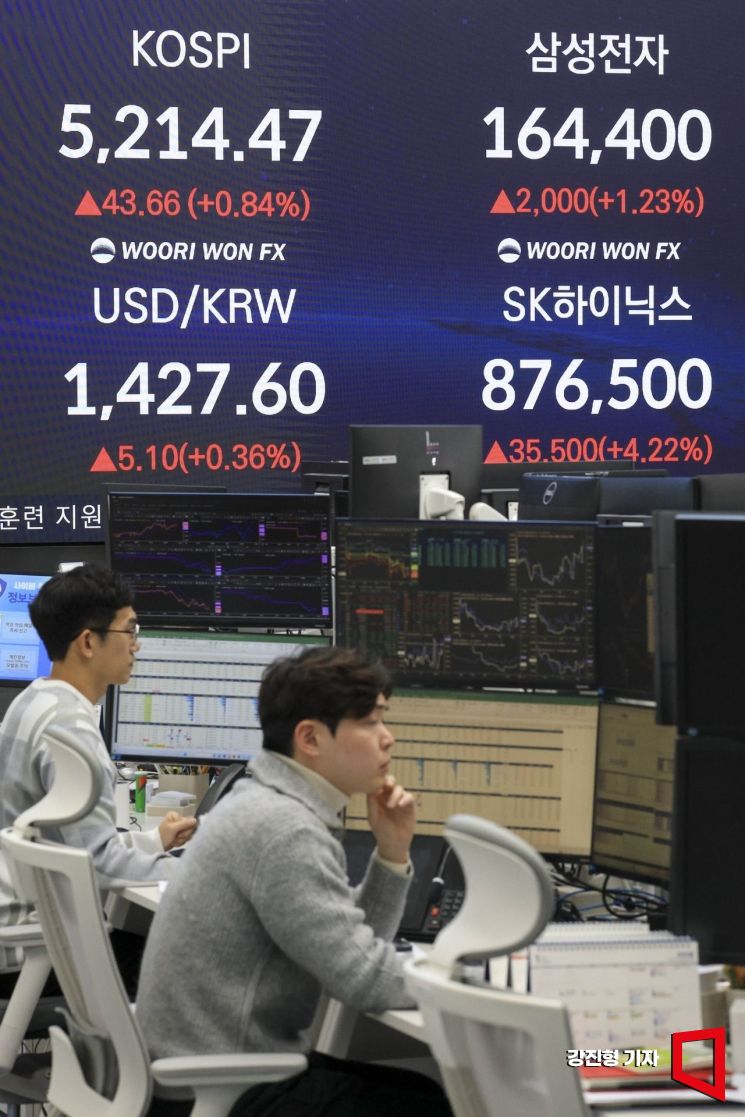 On the 29th, dealers were working in the dealing room at the Woori Bank headquarters in Jung-gu, Seoul. On that day, the won-dollar exchange rate started trading at 1,429.60 won, up 7.1 won from the previous trading day.
Sharp Drop the Previous Day Brings January’s Average Exchange Rate to the 1,450 Won Level
On January 29, the won-dollar exchange rate opened at 1,429.6 won, up 7.1 won from the previous trading day at the Seoul foreign exchange market, and fluctuated in the upper 1,420 won range during early trading. The exchange rate closed the previous week’s trading at 1,422.5 won, down 23.7 won, marking the lowest level since October 20 of last year (1,419.2 won). This was due to a combination of factors, including concerns over a US federal government shutdown following President Donald Trump’s threat to annex Greenland. The prospect of the US Federal Reserve intervening amid yen strength also contributed to dollar weakness, supporting the won’s appreciation. As a result, the average exchange rate for this month (January 1-28) dropped to 1,458.7 won, the lowest since October of last year (1,424.8 won).
Overnight, the United States made remarks warning against a weak dollar. US Treasury Secretary Scott Bessent said in a CNBC interview on the 28th (local time) that the United States is "absolutely not" intervening to induce yen strength, and added, "We have a strong dollar policy." As a result, the yen weakened and the dollar strengthened. The yen-dollar exchange rate, which had plummeted to the 152 yen range the previous day, is now fluctuating in the low 153 yen range. The dollar index, which measures the value of the dollar against the currencies of six major countries, fell to 95.702, its lowest level in four years, the previous day, but is now hovering in the low 96 range. Kyungwon Min, an economist at Woori Bank, said, "The US response overnight seemed to be a warning against the dollar’s rapid weakening, which put a slight brake on the dollar’s decline," but also forecast, "The dollar’s trend has not shifted to a strengthening phase, so the value of major currencies will likely see only mild adjustments."
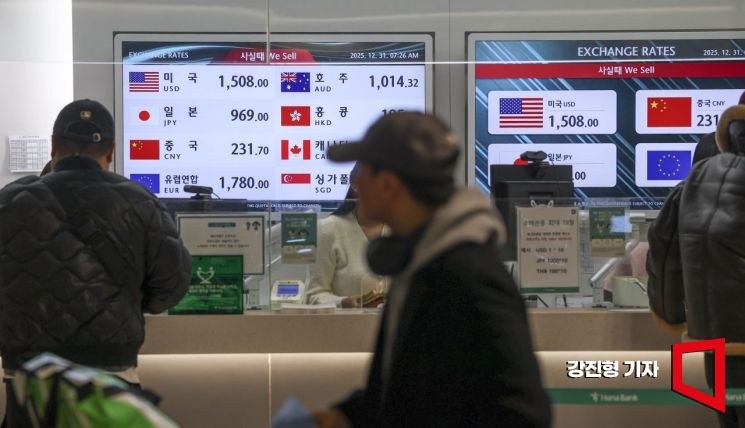 At the end of last year, the electronic board at the currency exchange booth in Terminal 1 of Incheon International Airport displayed the buying price of the US dollar.
Continued Weak Dollar Momentum... Downward Pressure on the Won-Dollar Exchange Rate Expected to Persist
Experts believe that as external momentum for a weaker dollar persists, the won-dollar exchange rate will continue to decline as a result. Although the pressure for a weaker dollar may ease as the US policy rate was kept unchanged overnight, the overall trend is not expected to change significantly. Baek Seokhyun, an economist at Shinhan Bank, said, "The current situation is reminiscent of last April’s ‘Sell America’ episode, when global capital sold off US Treasury bonds, US stocks, and the dollar," and added, "President Trump is skilled at shifting the narrative by introducing stronger measures when faced with unfavorable conditions. The emergence of a new dovish (monetary easing) Fed chair, who has proven loyalty to President Trump, could provide additional momentum for a further decline in the dollar," he said.
Junghee Moon, chief economist at KB Kookmin Bank, also commented, "For the first quarter of this year, I see the lower bound at 1,380 won and the upper bound at 1,480 won, with the average likely around 1,430 won." She added, "If the 1,420 won level is breached in the short term, more selling could occur, but if it holds, a period of consolidation is more likely."
However, Dollar Buying at Lower Levels Is Expected to Provide Support... Movements Around 1,420 Won Remain a Variable
However, experts forecast that every time the exchange rate drops, demand for currency exchange by residents investing in overseas stocks and aggressive buying by importers for payment purposes will provide support for the lower bound. Daun Moon, a researcher at Korea Investment & Securities, said, "Currently, the environment is one where downward pressure on the exchange rate is dominant from both economic and policy perspectives," but added, "It is difficult to say that sentiment for a weaker won has been completely reversed, so real demand for the dollar will flow in every time the level drops." The expectation is that the won-dollar exchange rate will gradually lower its floor in the first half of this year, repeating a pattern of slight rebounds after declines.
Experts also say that in the second half of the year, the level could rise compared to the first half, as the structural imbalance in domestic supply and demand has not fundamentally changed. The main variables for the exchange rate include the US Federal Reserve’s rate path, Trump’s tariffs, the US midterm elections in November, and whether the global artificial intelligence (AI) investment boom continues. Moon, the economist, said, "In the first half, I think the rate could fall to the 1,410-1,420 won range, but in the second half, it will be more difficult to go lower," adding, "With the delay in US rate cuts and persistent inflation issues, the exchange rate will likely hover in the low 1,400 won range."
© The Asia Business Daily(www.asiae.co.kr). All rights reserved.


















