Dormitories at Universities in the Seoul Metropolitan Area Accommodate Only About 18% of Students
On-Campus Dorms Are Highly Competitive, While Public Dorms Suffer from Accessibility Limits
With Nowhere Else to Go, Students Are Pushed into the High-
Before he could fully enjoy the joy of being accepted to Chung-Ang University, 18-year-old Kim Dohyun from Suseong District in Daegu received a notice that he had been rejected from the dormitory. Kim said, "Public dormitories or local student housing, which take about 1 hour and 20 minutes from school, were not a viable alternative," adding, "I ended up renting a studio apartment that is 500,000 won more expensive per month than the dormitory and in worse condition."
At another university in Seoul, some students who filed a move-in report using their dormitory address were rejected in the next semester's dormitory selection. This was because their address was classified as being "near the school." The students complained, saying, "It has become a situation where students who actually break the law by keeping their resident registration at their family home in the provinces receive extra points and are accepted instead."
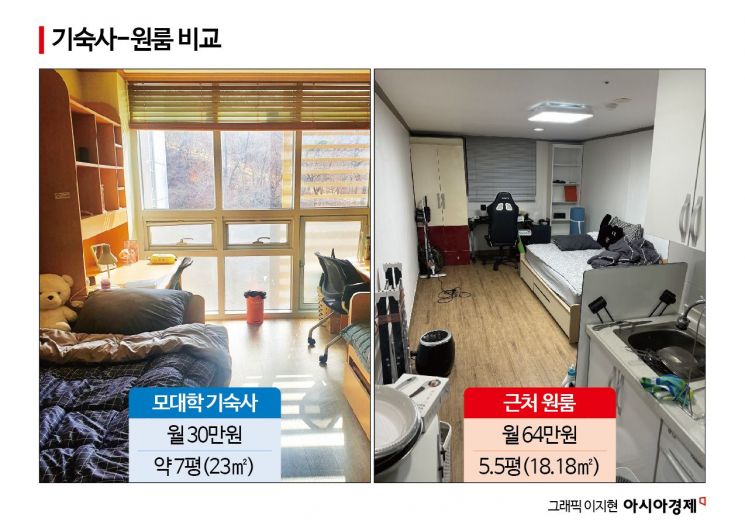
As monthly rents around universities have risen steeply, more college students are seeking dormitories to reduce their housing costs. However, on-campus dormitories are so competitive that they are "pie in the sky," and even public dormitories, which are cited as a supplementary measure, are being criticized for not functioning as a practical alternative due to significant constraints in accessibility and recruitment schedules.
According to university information disclosure data on the 4th, as of October last year the nationwide dormitory accommodation rate at universities was 22.2%. Narrowing the scope to the Seoul metropolitan area, it falls to 17.8%. This means that fewer than 2 out of every 10 students can be accommodated.
Students whose resident registration places them in the greater Seoul area have even less chance of getting into a dormitory. Lee Minji (22), a Dongguk University student who moved up from Siheung in Gyeonggi Province, said, "Even though it takes 4 to 5 hours round-trip to commute, I get the same penalty as students living in Seoul," adding, "Just because I am classified as living in the metropolitan area, I have to pay 800,000 won a month in rent to live in a studio apartment."
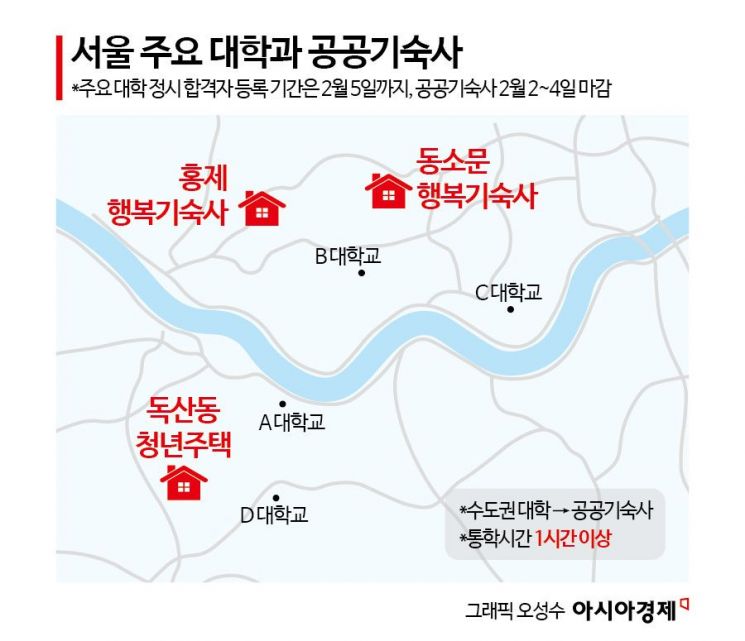
Public dormitories, which were prepared as an alternative, are also not in an easy situation. Public dormitories, which are operated jointly by the central government, local governments, and universities to make up for the low accommodation rate of on-campus dormitories, are relatively cheap at around 300,000 won per month. The problem is that the recruitment period is very tight. This year, the registration period for regular admission successful applicants at major universities runs until the 5th. However, applications for admission to the Hongje and Dongso-mun Haengbok Dormitories and the Doksan-dong dormitory-type youth housing close earlier, between the 2nd and 4th. This creates a contradictory situation in which students have to apply for dormitories before even deciding which university they will attend.
An official at a public dormitory in Seoul said, "If we want students to move in before the semester starts in March, it is difficult to push the application deadline back any further," adding, "Even though the timeline is tight, competition is still fierce."
The government is pushing to expand Haengbok Dormitories to ease housing costs for college students, but the process has not been smooth. Even when there are plans to build more dormitories, they are often scrapped due to opposition from local residents. In Gwangjin District in Seoul, a project was canceled last year, and it took eight years for the Dongso-mun Haengbok Dormitory to open due to construction delays after the project was approved in 2015.
As dormitory supply fails to keep up with demand, students are being driven into the monthly rental market. According to the "December Dabang Neighborhood Map" released by the real estate platform Dabang, the average monthly rent for a studio apartment in Seoul, based on a 10 million won deposit, was 640,000 won. For a college student to afford this, they would need to work at least 14 hours a week at this year's minimum wage of 10,320 won per hour. There are also many cases where students lower their housing standards and move into gosiwon-style micro-rooms.
Experts advise that the government should take the lead in resolving the housing crisis. Lee Sang-eun, a professor in the Department of Social Welfare at Soongsil University, diagnosed the situation by saying, "At major public universities in the United States, about one-third of all students live in dormitories, but universities in Korea lack both the land and the financial resources to expand dormitory facilities." He added, "For the safety of students, the government needs to actively step in to resolve the housing shortage," and said, "Even if it is not easy to coordinate interests with landlords, it is desirable, if necessary, to move in the direction of increasing supply."
© The Asia Business Daily(www.asiae.co.kr). All rights reserved.