Blue House Aides Say "It Finally Feels Like We've Found Our Place"
President Sets Up Office in Yeomin Building
Minimal Restrictions on Nearby Citizens Even After the Return
In the early morning before sunrise, in front of the main gate of the Blue House in Jongno-gu, Seoul, Blue House staff members, wearing thick coats to shield themselves from the biting wind blowing down from the foot of Bugaksan Mountain, lined up at the Yeonpungmun entrance with their access badges around their necks. They greeted their colleagues in passing and, after passing through the speed gates equipped with metal detectors, headed one by one to their respective offices in the Yeomin Building.
It has been a month since the presidential office was relocated to the Blue House. The return to the Blue House was made official at midnight on December 29 last year. The phoenix flag and emblem, which had been displayed in Yongsan, were moved to the Blue House, and the official name of the presidential organization reverted to "Blue House." Staff members I met at the Blue House said, "In Yongsan, it always felt like we were temporarily renting space, but now it feels like we've finally found our place." They also emphasized, "Returning from Yongsan to the Blue House is not a regression to the past, but a process of establishing a more stable axis for state administration," and added, "We are striving to communicate more closely with the public in order to deliver policies that people can truly feel."
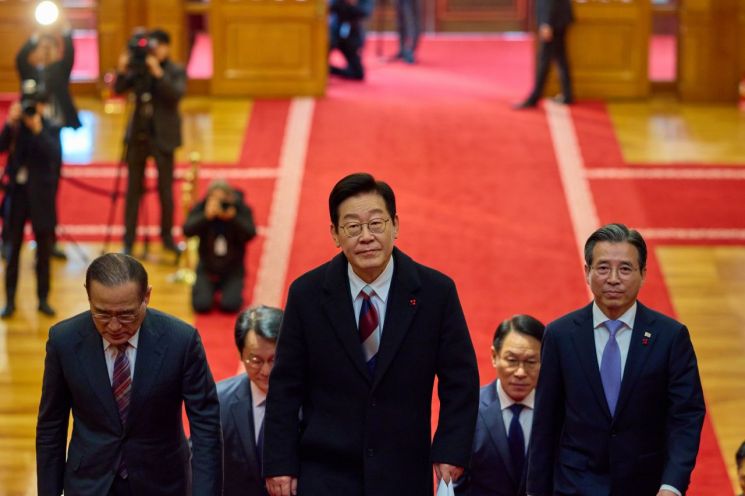 President Lee Jae-myung is arriving at the Blue House for his first day at work after relocating the Yongsan Presidential Office to the Blue House on December 29 last year. Photo by Yonhap News
The functions of the Blue House buildings have been thoroughly determined with a focus on maximizing the efficiency of state affairs. The president's intention to be closer to the public is also reflected in these changes. President Lee Jae-myung, instead of working from the main Blue House building, usually conducts his work in the Yeomin Building to reduce the psychological distance between himself and the people. The main building is primarily used for official events with significant protocol, such as summits. The intent is to break away from the negative perception of the Blue House as a "palace behind nine gates" by handling routine work such as approvals and reports in the office wing, where staff are always present. The main office, created when former President Roh Tae-woo rebuilt the main Blue House building in 1991, was a symbol of the president's status and authority. However, since it is about 500 meters away from the Yeomin Building, where most staff work, face-to-face meetings required either driving or walking more than 15 minutes, leading to significant inefficiencies in work.
Key aides are now positioned within what is called a "one-minute cut" distance. In the first Yeomin Building, the president works alongside Kang Hoon-sik, Chief of Staff; Kim Yong-bum, Chief Policy Officer; and Wi Sung-lac, National Security Advisor, so that they can quickly make decisions and respond together. In addition to these three chiefs, the first Yeomin Building also houses aides from the Protocol Secretary's Office, the Speech Secretary's Office, Hong Ik-pyo, Senior Secretary for Political Affairs, Ha Jung-woo, Senior Secretary for AI and Future Planning, and Ha Jun-kyung, Senior Secretary for Economic Growth. The second Yeomin Building contains the National Situation Room and the Office of the Senior Secretary for Civil Affairs, while the third Yeomin Building houses the National Security Office and the Office of the Senior Secretary for Public Relations. One secretary at the Blue House said, "We feel the change in the way we work much more than the change in space due to the relocation," and added, "There is always a sense of tension that President Lee could call us in at any time."
After returning to the Blue House, the Presidential Security Service has minimized checks on citizens and vehicles passing in front of the Blue House, following the principles of "open security" and "low-profile security." The "Daengdaeng Run" dog-shaped running course (Gwanghwamun-Gyeongbokgung-Blue House-Samcheong-dong) is also not restricted. In reality, the area near the Blue House office is bustling with citizens jogging and tourists taking "proof shots" on roads where the main building is visible. The "open studio," which was set up inside the Yongsan presidential office to expand communication with the public, has also been moved to Sarangchae, where no separate entry application is required.
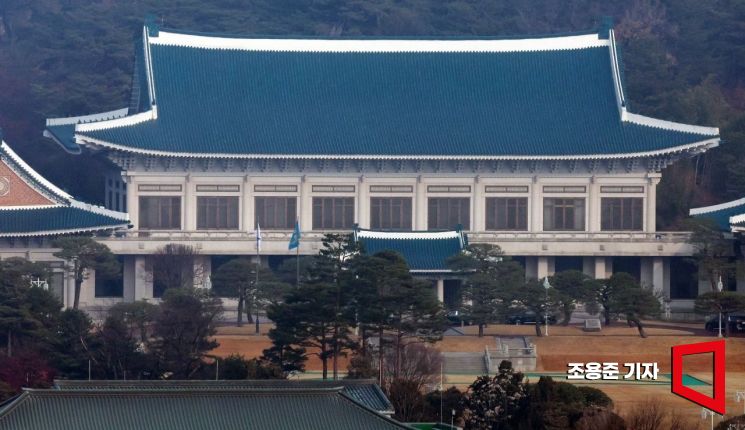 On December 29, when President Lee Jae-myung arrived at the Blue House, marking the official start of the Blue House era again after 3 years and 7 months, the phoenix flag was hoisted at the Blue House in Seoul. 2025.12.29 Photo by Cho Yongjun
It is also said that preparing for external events has become much easier. The Yongsan presidential office, having been designed as a Ministry of National Defense building, was often criticized for lacking the formality required for top-level events. Another Blue House secretary explained, "Now that we can utilize the main building, the State Guest House, and Sangchunjae according to the needs of each event, we are able to hold a variety of ceremonies and events befitting our nation's dignity."
However, the return process has not been fully completed. Renovations on the Blue House residence are still underway, as the design and construction take considerable time. President Lee is still commuting from the existing residence in Hannam-dong. The hiking trail on Bugaksan Mountain, which was closed due to the Blue House's return, has not yet been fully reopened as maintenance is still ongoing. In addition, the Office of the Secretary for Administration, which is responsible for the relocation process, is known to be carrying out additional repairs while moving between the Blue House and Yongsan. Controversy continues over the use of taxpayer money for the moves between Yongsan and the Blue House. It is said that the total cost of the move to Yongsan under the Yoon Suk-yeol administration and the return to the Blue House under the Lee Jae-myung administration amounts to 130 billion won. Some claim that, including all derivative costs, the total could reach several hundred billion won.
The period during which the Blue House will symbolize the presidency is not expected to be long. President Lee has promised to quickly relocate the presidential office to Sejong and has repeatedly expressed his hope to complete his term there. The government plans to integrate the basic and detailed designs for the presidential office in Sejong and to prepare the design and site so that construction can begin in August 2027. The target move-in date is August 2029. Originally, the Sejong presidential office was scheduled for completion in May 2030, but the timeline has been advanced at President Lee's direction.
© The Asia Business Daily(www.asiae.co.kr). All rights reserved.


















