After Prime Minister Kim Minseok returned from his visit to the United States, U.S. President Donald Trump made a surprise announcement of a "25% tariff increase" on Korea. This led to a barrage of criticism in the National Assembly regarding the effectiveness of the so-called "high-level hotline."
At the plenary session of the National Assembly's Foreign Affairs and Unification Committee on the 28th, Song Eonseok, a member of the People Power Party, asked about the timing of the receipt and reporting of a letter urging the implementation of follow-up measures to the Korea-U.S. trade agreement, which was delivered to the Korean side through the acting U.S. ambassador to Korea. Foreign Minister Cho Hyun responded, "I understand that it was reported to both the Blue House and the Prime Minister's Office," adding, "We received it on the 13th and reported it on the 14th." This was when Prime Minister Kim was about to depart for the United States. Minister Cho added, "Of course, the Prime Minister was briefed on the letter and was aware that it contained very serious matters before he left."
Prime Minister Kim visited the United States from the 22nd and returned on the 26th, but just a day later, on the 27th, President Trump posted a message stating that he would "raise tariffs back to 25%." Prime Minister Kim had highlighted the establishment of a "hotline" between the two countries' second-in-command officials as the biggest achievement of his solo diplomatic trip to the U.S.-the first such trip in 41 years since the 1987 system. However, there are now criticisms that this hotline failed to function within just one day of his return.
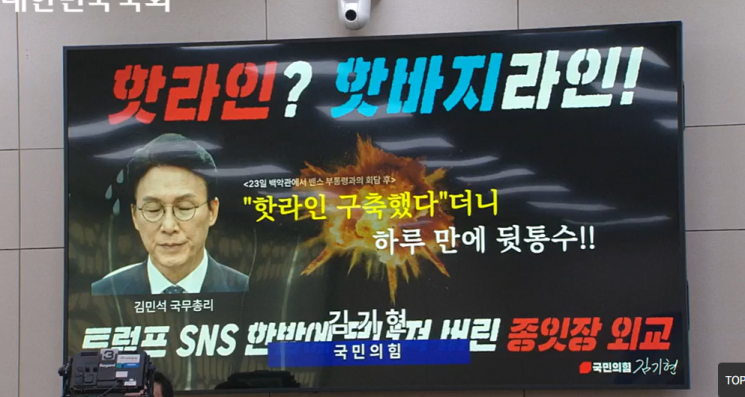
Regarding this, Kim Gihyeon, a member of the People Power Party, said, "They said the main purpose was to establish a hotline, but it turned out to be a 'hotbaji line' (meaningless line). If there was no intention to even detect U.S. trends, that is simply incompetent," he criticized.
Kim Sangwook, a member of the ruling Democratic Party of Korea, also expressed concern, saying, "I understood that the meeting between Prime Minister Kim Minseok and Vice President Pence was held in a mutually beneficial atmosphere, but the tariff issue is causing confusion."
Meanwhile, Minister Cho stated that, regarding the view that President Trump's decision to reimpose tariffs on Korea is an indirect expression of dissatisfaction over recent issues such as the Coupang incident or online platform regulations, "After that message from President Trump, our contacts with the U.S. State Department have led us to conclude that there is no direct connection to Coupang or the Online Platform Act."
© The Asia Business Daily(www.asiae.co.kr). All rights reserved.

















