Interview with Jung Geunsik, Superintendent of the Seoul Metropolitan Office of Education
Limits of Elementary and Secondary Innovation at the Barrier of Competitive College Admissions
Universities Must Also Select and Educate Students Based on
"Educational reform cannot be achieved simply by seeking change only in elementary and secondary classrooms. The overall framework must include connections to university admissions and higher education."
On January 27, Jung Geunsik, Superintendent of Seoul Metropolitan Office of Education, emphasized in an interview with The Asia Business Daily that fundamental change in education is difficult as long as classroom innovation, the admissions system, and university education operate separately. He stressed the need for a major transformation in education spanning from 'elementary and secondary education' to 'higher education.' This is because, no matter how much the education office promotes creative talent and leads innovative education in elementary, middle, and high schools, the momentum is ultimately lost in the face of the multiple-choice, problem-solving format of the college entrance exam.
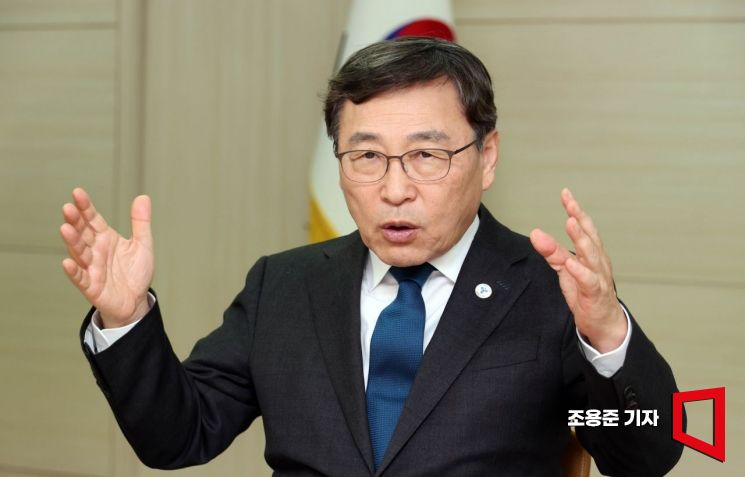 Jung Geunsik, Superintendent of Seoul Metropolitan Office of Education, is being interviewed by The Asia Business Daily at the Seoul Jongno-gu Office of Education. Photo by Jo Yongjun
The Seoul Metropolitan Office of Education's recent announcement of its plan for 'expanding essay and written assessments and absolute grading for the college entrance exam and school records by 2033, and abolishing the college entrance exam by 2040' stems from this awareness. There are limits to the current outdated education system in nurturing talent needed for the age of artificial intelligence (AI), and the biggest obstacle is the college entrance exam itself. Jung also believes that for the government's initiative to establish 'ten Seoul National University-level institutions' to succeed, the current university admissions system must be revised. To strengthen competitiveness through the 'specialization' of each university, institutions must be able to select students who fit their desired profiles, but this is difficult under the current exam-oriented system. He sees a 'phased transition' based on absolute grading and AI-driven essay and written assessments as inevitable.
Jung also emphasized the need to establish a 'consultative body between superintendents and university presidents' to ensure that changes in the field of education extend to university admissions and higher education. "Until now, there has been no consultative body between superintendents, who are responsible for early childhood and elementary education, and university presidents," he said. "To drive educational change organically, we need to work together."
The following is a Q&A with Superintendent Jung.
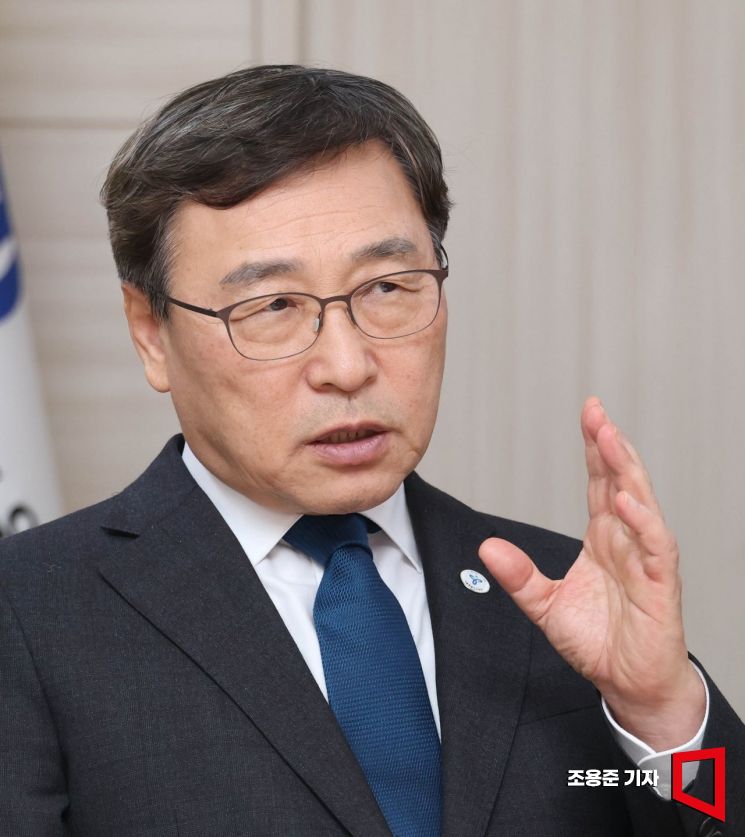 Jung Geunsik, Superintendent of Seoul Metropolitan Office of Education, is being interviewed by The Asia Business Daily at the Seoul Jongno-gu Office of Education. Photo by Jo Yongjun
- What is the background behind the proposal to abolish the college entrance exam in 2040?
▲With the school-age population declining rapidly and the ongoing AI and digital transformation, maintaining the current overheated competition centered on multiple-choice, relative grading is not sustainable for students or society. Around 2040, the number of students eligible for university entrance will decrease by about 254,000 compared to current enrollment standards. In this situation, there is no reason to persist with the current admissions system that drives excessive competition. In the AI era, abilities such as forming one's own ideas, building arguments, collaborating, and persuading through speech and writing become more important than simply choosing the correct answer quickly. However, the current evaluation and admissions system makes it difficult to sufficiently assess these competencies.
The proposal to abolish the college entrance exam is a long-term roadmap designed to allow ample time for preparation in line with these trends. In this process, both school record evaluations and university selection methods must change together. The push to expand essay and written assessments and the discussion of absolute grading are for the same purpose. We will actively cooperate with the National Education Commission and the Ministry of Education to facilitate social consensus based on data and feedback from the field.
- Why did you propose 'expanding absolute grading and essay/written assessments' for the 2033 academic year instead of 2032?
▲The intention is to set the major direction of university admissions in advance before current elementary students enter middle school, and to ensure that schools have sufficient notice and a stable transition period to prepare for the changes. The 2033 timeline proposed by the Seoul Metropolitan Office of Education is intended to ensure that improvements to the admissions system are implemented alongside revisions to the middle and high school curriculum, resulting in tangible changes. For example, a career-focused semester in the second semester of the third year of middle school should be established to help students understand high school life and plan their future paths, while high schools should be able to flexibly operate the second semester of the third year to enhance the 'career-linked semester.' Considering curriculum revisions, the adoption of essay/written and absolute grading in the field, and the stabilization of AI grading systems, the 2033 academic year is proposed as a realistic point for schools to prepare without confusion.
- The AI-based essay and written assessment system 'Chaeum AI' is currently being piloted.
▲Last year, 66 schools conducted AI-based essay and written assessments, and the results showed a high level of agreement between teacher and AI evaluations. The reliability has reached a level of 0.8. The plan is to use the system as a tool to support, not replace, teachers in grading. As more data is accumulated, objectivity and fairness can be further improved. Chaeum AI will be expanded to 120 schools this year, with the goal of full implementation across Seoul by 2027.
- Some say that simply changing 'assessment' will not automatically foster creative talent. How should public education change?
▲Assessment cannot be discussed in isolation from the curriculum and teaching methods. 'Curriculum, instruction, and assessment' must be interconnected. The discussion about changing assessment ultimately leads to changing the curriculum and instruction as well. Improving assessment presupposes 'changes in teaching.' To this end, schools are working to spread competency-based instruction, such as discussions, debates, projects, and inquiry-based classes, while gradually shifting to essay and written assessment systems linked to instruction. We plan to introduce an AI-based essay and written assessment support system and provide training focused on practical, hands-on essay and written assessments. Furthermore, education in the AI era should also foster humanistic imagination in addition to technological skills. For this reason, we also intend to emphasize 'reading education.'
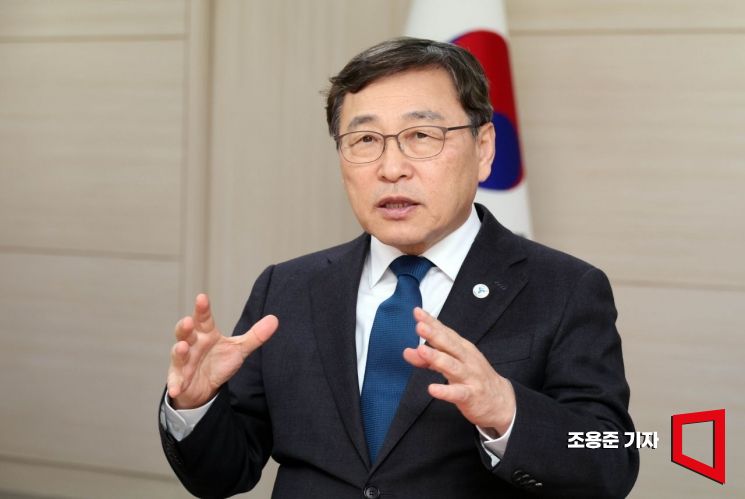 Jung Geunsik, Superintendent of Seoul Metropolitan Office of Education, is being interviewed by The Asia Business Daily at the Seoul Jongno-gu Office of Education. Photo by Jo Yongjun
- How should universities change?
▲To nurture future talent, elementary/secondary and higher education must go beyond simple connection and align in educational philosophy and direction. While creative and diverse educational innovations are being attempted at the elementary and secondary levels, as students advance, education becomes increasingly focused on university admissions. As a result, high school education inevitably becomes oriented toward entrance exams, and students are pushed into score-based competition rather than autonomy and diversity. To change this, universities need to take a more active interest in elementary and secondary education.
In this context, I believe a consultative body between superintendents and university presidents is necessary. Superintendents in charge of elementary and secondary education and universities should not operate separately. Universities should also change their student selection and education to align with future competency-based education. Instead of uniform selection, universities should be able to admit students who fit their unique characteristics.
- What policies would you like to emphasize this year?
▲I want this year to be one in which the educational community and citizens can truly feel the 'educational transformation.' To this end, I propose three major paradigm shifts for Seoul education. First, we will shift from 'knowledge and understanding-based education' to 'competency-based education.' Second, we will change the policy implementation process from 'top-down' to 'bottom-up.' We will quickly introduce and share policies that have already been realized and verified in the field to substantially reduce the administrative and educational burden on schools. Finally, we will transition to a partnership-based governance model centered on student growth. We will establish institutional channels for students, parents, and teachers to participate as partners in policy-making, and expand social discussion of major educational policies through public debate, strengthening consensus-based implementation. We aim for policies proven in Seoul to spread nationwide and for Seoul education to become a leading model of public education in Korea.
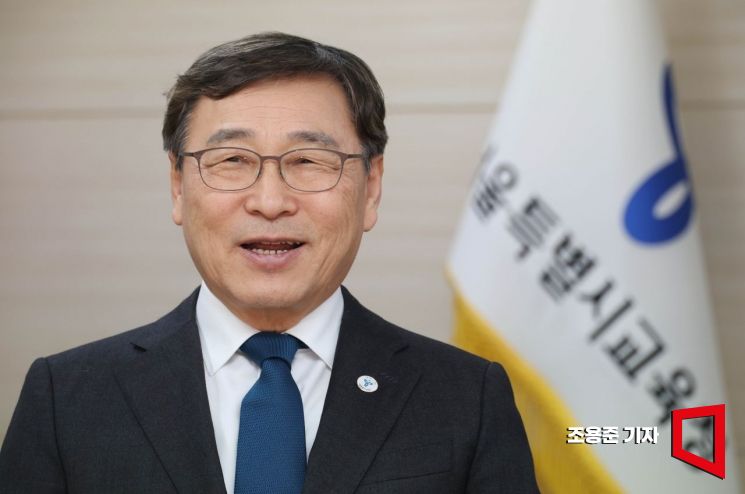 Jung Geunsik, Superintendent of Seoul Metropolitan Office of Education, is being interviewed by The Asia Business Daily at the Education Office in Jongno-gu, Seoul. Photo by Jo Yongjun
© The Asia Business Daily(www.asiae.co.kr). All rights reserved.



















