Remarks at the Atlantic Council Discussion
China Dominates Critical Mineral Processing
U.S. Can Counterbalance Through Cooperation With Mining Countries
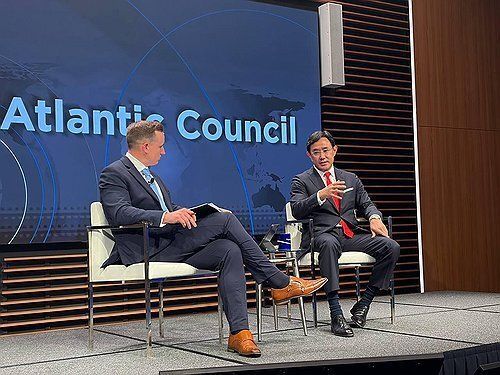 On the 27th (local time), at the Atlantic Council think tank in Washington DC, USA, Yoonbum Choi, Chairman of Korea Zinc (right), is having a conversation with Reed Blackmore, Director of the Atlantic Council Global Energy Center. Korea Zinc
Yoonbum Choi, Chairman of Korea Zinc, suggested that in order for the United States to offset China’s dominance in the critical minerals supply chain, it must expand cooperation with other countries not only in processing but also in mining.
On the 27th (local time), during a discussion with the Atlantic Council think tank in Washington D.C., Chairman Choi stated, “The United States does not need to achieve complete control of the critical minerals supply chain in order to counter or offset China’s dominance in the sector.”
Chairman Choi advised, “Do not focus solely on processing critical minerals,” explaining that while China dominates the processing of major critical minerals, there are other countries with strong positions in mining, such as Indonesia, the Democratic Republic of the Congo, and India.
He added that since mining countries rely heavily on critical mineral production for their economies, they may view China’s market dominance as a burden, emphasizing that the United States should actively seek cooperation with these nations.
Chairman Choi explained that China has aggressively scaled up its operations, disregarding profitability and other market principles, to expand its dominance over critical minerals essential for strategic industries such as artificial intelligence (AI) and robotics. He predicted, “China’s dominance will become even stronger, and other countries will become more vulnerable.”
Chairman Choi expressed a positive outlook on Korea Zinc’s critical minerals cooperation with the United States. Korea Zinc previously announced plans to build a 650,000-square-meter non-ferrous metal smelter in Clarksville, Tennessee, with production of 11 types of critical minerals scheduled to begin in 2029. The total investment is expected to reach 1.095 trillion won (approximately 7.432 billion dollars), and the U.S. government, which has been working to strengthen its self-sufficiency in critical minerals, will participate as a partner through equity investment and financial support.
Chairman Choi described this investment as a “mutually beneficial decision,” explaining that the U.S. government will secure 11 types of critical minerals, while Korea Zinc will achieve a “quantum leap” in terms of growth and entry into the U.S. market. He added that the United States should pursue more such bilateral investment collaborations if it wishes to form alliances with partner countries in the critical minerals sector.
Meanwhile, Chairman Choi attended the World Economic Forum (WEF, Davos Forum) held from January 19 to 23, where he served as an official speaker in a session on “Strategic Partnerships and Investment in Critical Minerals.” At the event, he emphasized that, for the sustainable growth of next-generation industries, the critical minerals supply chain must move away from dependence on specific regions and be reorganized into an integrated and stable industrial system based on long-term demand.
© The Asia Business Daily(www.asiae.co.kr). All rights reserved.

















