Trump Announces "25% Tariff Hike on South Korea"
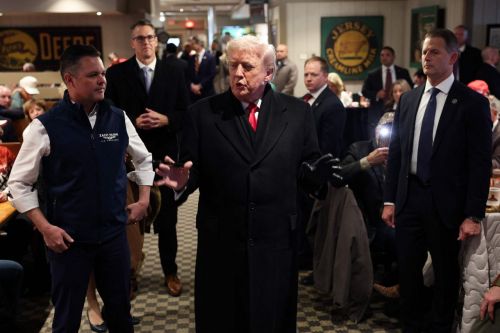 US President Donald Trump visited a restaurant in Iowa on the 27th (local time) and spoke in front of attendees alongside Republican Jack Nunn, a federal representative from Iowa. Photo by AFP Yonhap News
The White House explained that US President Donald Trump’s announcement on the 26th (local time) to raise tariffs on South Korea back to 25% was due to South Korea’s failure to fulfill the promises it made in exchange for the tariff reduction.
In response to The Asia Business Daily’s inquiry about the background and position on President Trump’s decision to increase tariffs, a White House official stated, “The simple reality is that South Korea reached an agreement with the Trump administration to secure lower tariffs,” and offered this explanation.
This official claimed that under the trade agreement between South Korea and the United States, “President Trump lowered tariffs on South Korea, but South Korea has made no progress in fulfilling the end of the bargain it committed to in return.” However, the White House did not provide answers regarding the specific background or the timing of the tariff increase mentioned by President Trump.
The previous day, President Trump announced the tariff hike on South Korea in a post on his social networking service, Truth Social. He stated, “The Korean legislature is not upholding the agreement between Korea and the United States,” and added, “Accordingly, I am raising tariffs on automobiles, timber, pharmaceuticals, and all other reciprocal tariffs on South Korea from 15% to 25%.”
Previously, the United States had agreed to lower itemized tariffs on Korean automobiles and reciprocal tariffs on South Korea from 25% to 15% in exchange for South Korea’s pledge to make a US investment worth 350 billion dollars (approximately 505 trillion won). It appears that the focus is on the fact that the Special Act on US Investment, which is necessary for this investment, has not been passed by the National Assembly.
The Special Act on US Investment was proposed by the ruling Democratic Party of Korea on November 26 of last year, following the release of a joint fact sheet summarizing the bilateral security and trade agreements between the two countries on November 13. In response, the United States retroactively reduced automobile tariffs to 15% (effective November 1) with an official gazette notice on December 4. However, the bill has yet to be passed by the South Korean National Assembly.
The US Congress also offered support. The Republican side of the House Judiciary Committee shared President Trump’s post announcing the tariff increase on South Korea on its X (formerly Twitter) account, writing, “This is what happens when American companies like Coupang are unfairly targeted.”
This is interpreted as linking the South Korean government and National Assembly’s moves to hold Coupang accountable for the massive personal information leak to “unfair treatment,” and associating it with President Trump’s tariff increase announcement.
The following is the full response from the White House.
The simple reality is that South Korea entered into an agreement with the Trump administration to secure lower tariffs. President Trump lowered tariffs on South Korea, but the South Korean side has made no progress in fulfilling its share of the agreement.
© The Asia Business Daily(www.asiae.co.kr). All rights reserved.

















