Full Opposition to Daegu-Gyeongbuk Integration Without Public Consensus
“Solutions for the Survival of the Northern Region Must Come First”
The Andong City Council has voiced strong opposition to the policy of “uninterrupted promotion of administrative integration” agreed upon by Daegu Metropolitan City and North Gyeongsang Province, officially stating that it cannot accept the push for integration without the consent of city and provincial residents and without concrete measures for balanced regional development.
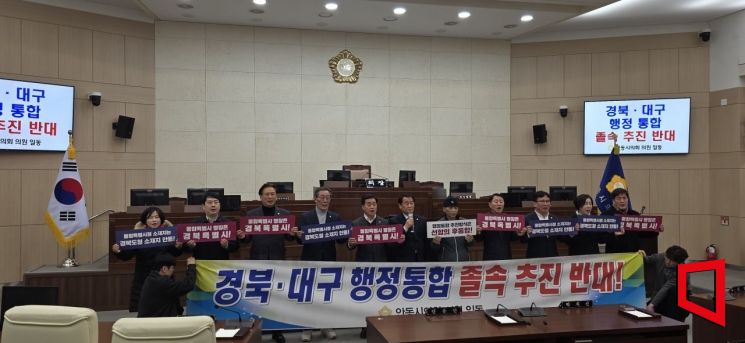 Andong City Council Declares Full Opposition to Daegu-Gyeongbuk Administrative Integration “Hasty Integration Without Public Debate Is Unconstitutional, Unacceptable Without Survival Measures for the Northern Region” Photo by Byunggeon Kwon
On the afternoon of the 27th, the Andong City Council (Chairman Kim Kyungdo) issued a statement in the main assembly hall, sharply criticizing the current administrative integration initiative as “a hasty administrative move that undermines the fundamental principles of representative democracy and contains procedural unconstitutionality.”
The council asserted, “Any integration unilaterally pursued without sufficient social consensus and citizen agreement cannot secure any legitimacy whatsoever.”
In particular, the council expressed concern that if integration is forced while the new North Gyeongsang Provincial Government Complex-being developed as a key axis of balanced national development-remains incomplete, the northern region of North Gyeongsang could face structural marginalization and a deepening regional divide. The Andong City Council warned, “This could be a self-destructive choice that threatens not development, but the very right of the region to survive.”
Through the statement, the Andong City Council clearly presented “five core principles and preconditions” as prerequisites for any discussion of administrative integration.
First, the council strongly opposed the “integration first, coordination later” approach in the absence of sufficient public debate and social consensus, firmly stating that any push for integration without resident consent is absolutely unacceptable.
They also demanded that the location of the special integrated city government office be clearly stipulated by law as the current North Gyeongsang Provincial Government Complex, so as not to undermine the original intent behind the relocation of the provincial office.
Additionally, the council emphasized that the early completion of the new government complex, the establishment of a national industrial complex in the northern region, and the relocation of key public institutions must precede integration to ensure a sustainable foundation for growth in the northern area.
It also specified that powers and finances transferred from the central government must be substantially allocated to local governments, thereby guaranteeing the autonomy and fiscal independence of the northern region as a core condition.
Finally, the council drew a clear line, stating that unless a strong and permanent legal and institutional framework is established to guarantee balanced regional development-rather than ad hoc special legislation-integration cannot be accepted.
Kim Kyungdo, Chairman of the Andong City Council, stated, “If the government’s promise of financial support remains only at a declarative level without concrete implementation plans, administrative integration will ultimately entrench a ‘Daegu-centered structure’ and further deepen regional imbalance. The Andong City Council will resolutely oppose any hasty integration attempts that threaten the future of the region, representing the will of our citizens.”
As discussions on Daegu-Gyeongbuk administrative integration accelerate, this statement from the Andong City Council succinctly encapsulates the structural marginalization and sense of crisis felt in the northern region of North Gyeongsang. Since integration is being justified in the name of ‘balanced development,’ unless there are real mechanisms to ensure balance and restore local trust, the debate is highly likely to become a variable that amplifies political conflict.
© The Asia Business Daily(www.asiae.co.kr). All rights reserved.

















