Competition for Market Leadership Intensifies Between Samsung Electronics and SK Hynix
Securing New Growth Drivers Beyond Nvidia
Fierce Rivalry Extends from HBM3E to HBM4
SK Hynix has reportedly become the exclusive supplier of high-bandwidth memory (HBM) for Microsoft's latest artificial intelligence (AI) chip, the 'Mia 200.' As demand for HBM expands not only from Nvidia and AMD but also from companies using their own application-specific integrated circuit (ASIC)-based AI semiconductors-such as Google, Microsoft, and Amazon Web Services (AWS)-the competition for market leadership between Samsung Electronics and SK Hynix is expected to intensify further.
According to industry sources on January 27, SK Hynix is supplying its latest HBM3E (5th generation) exclusively for the Mia 200 AI accelerator, which Microsoft unveiled on January 26 (local time).
The Mia 200, produced using the 3-nanometer (nm; 1 nm = one billionth of a meter) process of Taiwan's TSMC, the world's leading foundry, is designed to enhance the efficiency of AI inference tasks.
The chip incorporates a total of 216GB of HBM3E, with six units of SK Hynix's 12-stack HBM3E installed.
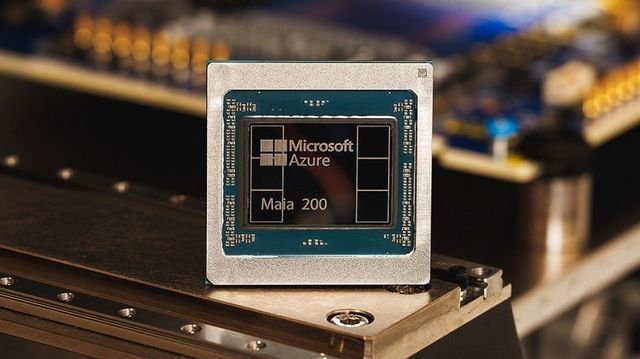
Microsoft has already installed this chip at its data center in Iowa, USA, and is expanding to additional locations such as its data center in Arizona, indicating that its use will continue to grow.
Industry experts note that, in addition to Microsoft, the emergence and expansion of proprietary AI chips-such as Google's 7th-generation Tensor Processing Unit (TPU) 'Ironwood' and Amazon's 3rd-generation 'Trainium'-aimed at reducing reliance on Nvidia, are providing the HBM market with new growth drivers beyond Nvidia's GPUs.
As a result, explosive growth in HBM demand is anticipated, and competition between Samsung Electronics and SK Hynix for additional supply contracts is expected to become even fiercer.
It is also noted that Samsung Electronics and SK Hynix have established themselves as key players in the supply chain for Google's TPU.
The TPU is a chip developed by Google in collaboration with U.S. semiconductor design company Broadcom to power AI, and each TPU incorporates six to eight HBMs.
According to analysis by investment bank UBS, SK Hynix, the 'number one in the HBM market,' maintains a supply advantage for ASIC customers such as Google, Broadcom, and AWS.
Some industry observers suggest that, as of the second half of last year, Samsung Electronics supplied a greater volume of HBM to Google and Broadcom and is expected to continue supplying most of the volume this year as well.
Following HBM3E, the two companies are also expected to compete fiercely over the next-generation HBM4 (6th generation) product.
Samsung Electronics recently passed the final quality tests for HBM4 conducted by Nvidia and AMD and is reportedly set to begin official deliveries next month.
If Samsung Electronics commences official deliveries of HBM4 next month, it will be the first in the industry, putting the company ahead in the race for next-generation HBM market leadership.
SK Hynix established a mass production system for HBM4 as early as September last year and has been supplying large quantities of paid samples to Nvidia, effectively starting mass production from September. The HBM optimization process with Nvidia has entered the final quality stage, and mass production of the final product is expected to begin soon.
© The Asia Business Daily(www.asiae.co.kr). All rights reserved.

















