Ruling Party: "The Special Act on U.S. Investment Should Be Processed Swiftly"
Opposition: "Government Clarification Needed... Parliamentary Ratification Process Required"
National Assembly Speaker Woo Won-sik expressed deep regret on January 27 over President Donald Trump's threat to raise tariffs on certain Korean products from 15% to 25%, citing delays in the passage of the Special Act on U.S. Investment by the Korean National Assembly. Woo stated, "I am very sorry that this sudden announcement via social networking services has caused concern among our people."
Speaker Woo added, "The National Assembly is proceeding with legislation according to normal procedures, so there is no need to worry. The authorities are allies of the United States. We hope that the trust between the two countries will be maintained."
During a meeting with floor leaders from both parties at the National Assembly that afternoon, Woo said, "Our National Assembly has already begun drafting relevant laws for strategic investment management between Korea and the United States, in accordance with the memorandum of understanding (MOU) agreed upon by both countries."
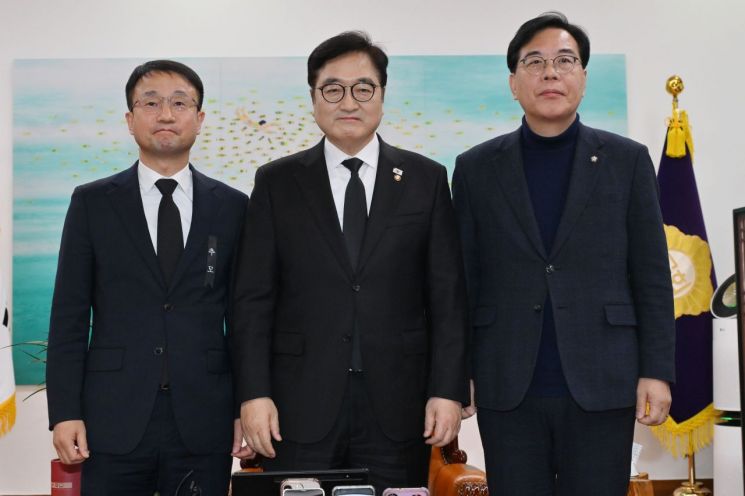 (Seoul=Yonhap News) Reporter Hwang Kwangmo = Han Byungdo, Floor Leader of the Democratic Party of Korea (left), and Song Eon-seok, Floor Leader of the People Power Party (right), are taking a commemorative photo during a meeting of floor leaders of the ruling and opposition parties chaired by National Assembly Speaker Woo Won-sik at the National Assembly on January 27, 2026. [Joint Coverage]
He also urged both parties, "Since this is a matter directly related to the national interest, I ask that you focus on reviewing the relevant laws rather than engaging in excessive debate."
The floor leaders of both parties each expressed their positions on President Trump's tariff pressure in their opening remarks.
Han Byungdo, Floor Leader of the Democratic Party of Korea, drew a line, stating that President Trump’s pressure was intended to urge faster legislation, not to demand parliamentary ratification.
Han said, "The Korea-U.S. Strategic Investment MOU is an administrative agreement without binding force under international law, so it does not require ratification by the National Assembly. President Trump also used the term 'enact.' I believe he is focusing on the legislative process of our National Assembly, not ratification."
He emphasized, "We should put an end to the unproductive ratification debate and instead focus on improving the completeness of the Special Act on U.S. Investment to resolve uncertainties for local investors."
Addressing the People Power Party, he requested, "Please hold public hearings, allow the National Assembly's Strategy and Finance Committee to fully review the bill, and cooperate in a bipartisan manner to process the bill swiftly."
The People Power Party maintained its position that parliamentary ratification is necessary, raising concerns that "there may be other agreements or undisclosed side arrangements that the government has not accurately informed the National Assembly about."
Song Eon-seok, Floor Leader of the People Power Party, said, "Just a few months ago, the government said the negotiations were so successful that there was no need to even write a formal agreement, but now that agreement has become completely void."
Song continued, "It seems there are other matters the government has not properly disclosed to the public or the National Assembly, or that it has neglected its duties. I ask Speaker Woo, as the representative of the National Assembly, to demand a clear explanation from the government on this matter."
He added, "This incident has revealed just how fragile this agreement is. It would be preferable to proceed with the parliamentary ratification process together."
He also called for "an urgent inquiry into the matter, whether at the committee or plenary session level."
Previously, the ruling party and the government had argued that since the Korea-U.S. tariff negotiations resulted in an MOU rather than a treaty, there is no legal binding force and thus no need for parliamentary ratification.
However, both parties agreed to continue discussions on the issue. Chun Jun-ho, Senior Deputy Floor Leader for Operations of the Democratic Party, told reporters after the meeting, "We agreed to listen thoroughly to the government's position, clarify the facts, and then proceed with discussions between the parties."
On this day, both parties met to discuss livelihood bills to be handled at the National Assembly plenary session on January 29. Speaker Woo urged both parties to reach a prompt agreement on 176 pending livelihood bills, including the amendment of the National Referendum Act.
In this regard, the parties agreed to continue discussions on January 28. Yoo Sangbeom, Senior Deputy Floor Leader for Operations of the People Power Party, said, "There are differences between the two parties regarding how many non-contentious bills to bring to the plenary session. Tomorrow, the senior floor leaders will hold additional discussions to reach an agreement on which bills to put forward."
Chun added, "We agreed on the direction of holding the plenary session on the 29th and making the utmost effort to pass as many livelihood bills as possible. We will try to process as many bills as we can."
© The Asia Business Daily(www.asiae.co.kr). All rights reserved.

















