Market Reacts to Trump’s Tariff Shock Concerns
Hyundai Motor and Kia Narrow Losses
KOSPI Returns Above 5,000, KOSDAQ Surpasses 1,000
The KOSPI index started lower on the 27th following U.S. President Donald Trump's statement that he would revert tariffs on Korean products to pre-trade agreement levels. However, it managed to recover all of its recent losses during the session and broke through the 5,000 mark once again.
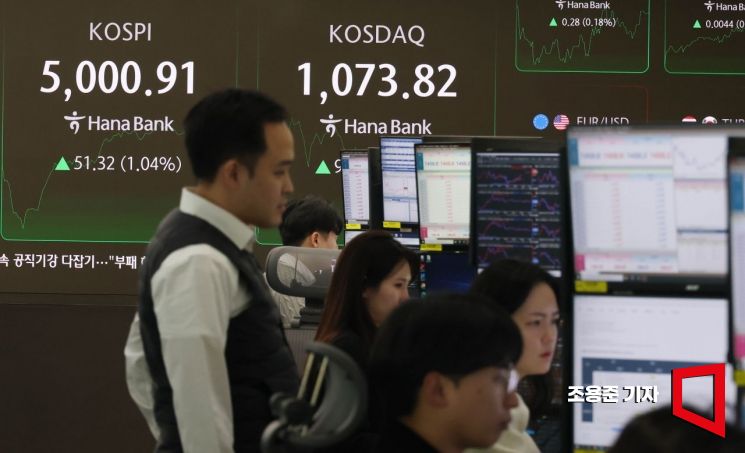 Despite the KOSPI starting lower following U.S. President Donald Trump's statement about reverting tariffs on Korean products to pre-trade agreement levels, it successfully rebounded and recovered the 5000 mark during the session on the 27th. Employees at the Hana Bank headquarters dealing room in Jung-gu, Seoul, are checking the KOSPI and exchange rates. Photo by Jo Yongjun
As of 11:11 a.m. on January 27, the KOSPI index was trading at 5,013.36, up 63.77 points (1.29%) from the previous trading day. The index opened at 4,932.89, down 16.70 points (0.34%), and even fell to the 4,890 range, but gradually pared its losses and turned upward. While foreign investors net sold 118.6 billion won, institutional investors net bought 139.1 billion won. Individual investors net bought 4.2 billion won.
By sector, telecommunications (6.86%), securities (2.86%), IT services (2.77%), finance (2.34%), electrical and electronics (2.24%), and insurance (1.96%) rose. On the other hand, metals (-2.74%), pharmaceuticals (-1.07%), transportation equipment and parts (-0.90%), and textiles and apparel (-0.82%) declined.
Among the top stocks by market capitalization, SK Square (7.94%), NAVER (5.32%), KB Financial Group (4.72%), SK hynix (4.62%), Shinhan Financial Group (3.40%), Samsung Life Insurance (1.98%), Doosan Enerbility (1.85%), and Samsung Electronics (1.58%) advanced. In contrast, HD Hyundai Heavy Industries (-3.80%), Celltrion (-2.33%), LG Energy Solution (-1.56%), Hanwha Aerospace (-1.51%), and Samsung C&T Corporation (-1.51%) were weak. Notably, automakers such as Hyundai Motor (-0.20%) and Kia Corporation (-1.29%) managed to recover much of their initial losses of around 4% seen right after the market opened.
On this day, investors were on high alert over President Trump's tariff comments even before the KOSPI opened. On January 26 (local time), President Trump stated on social media platform Truth Social, "The Korean National Assembly is not fulfilling the agreement with the United States," and added, "Since the Korean National Assembly has not legislated the historic trade agreement, which is their authority, I am raising all mutual tariffs on Korea-including automobiles, lumber, pharmaceuticals, and all other products-from 15% to 25%."
At the same time, the KOSDAQ index was up 8.73 points (0.82%) at 1,073.14 compared to the previous session. While foreign investors were net selling 168.6 billion won, institutional investors were net buying 1,083.9 billion won. Individual investors were net selling 871.3 billion won.
Among the top KOSDAQ stocks by market capitalization, Leeno Industrial (10.23%), Kolon TissueGene (5.96%), HLB (3.80%), Robotis (3.57%), LigaChem Biosciences (2.86%), Peptron (2.86%), WONIK IPS (2.82%), Ecopro (2.69%), Sam Chun Dang Pharm (2.30%), EO Technics (2.01%), and ABL Bio (1.87%) rose. On the other hand, Rainbow Robotics (-2.80%), Classys (-2.16%), and PharmaResearch (-1.20%) declined.
Meanwhile, experts noted that although the KOSPI, which had risen sharply, could see a correction due to this situation, if the National Assembly quickly approves the trade agreement, the impact is likely to be only short-term.
On this day, Han Ji-young, a researcher at Kiwoom Securities, said, "This will be a burden for the stock market, especially for automakers," but added, "Given that the National Assembly's approval is a matter of time, this mutual tariff hike should be viewed as a noise factor with only limited impact on the market trend."
© The Asia Business Daily(www.asiae.co.kr). All rights reserved.

















