Gwanghwamun Comeback Show in March Spurs Surge in Seoul Hotel Bookings
Overseas Searches Up 2,375% as Tour Revenue Tops $1 Billion
First Korean Artist to Perform at Stanford Stadium and More
"Tourism and Economy Booming... Trickle-Down Effe
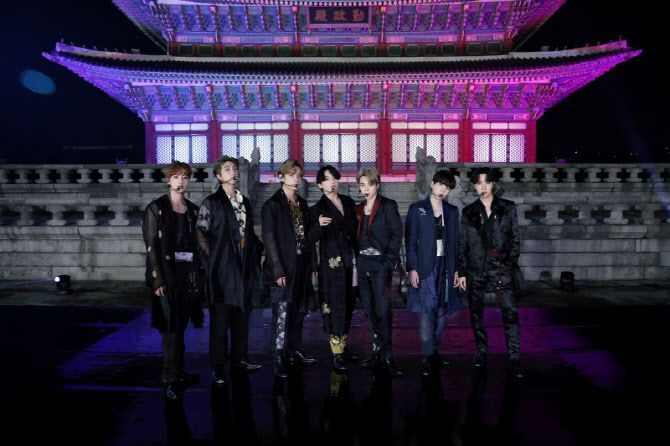
The full return of BTS is having an immediate impact on the global real economy. With the announcement of their world tour, demand for accommodation and transportation in major cities has surged, and even heads of state have made unprecedented requests for additional concerts. The so-called "BTS effect," which stimulates not only cultural content but also domestic consumption, tourism, and financial markets simultaneously, is once again becoming a reality.
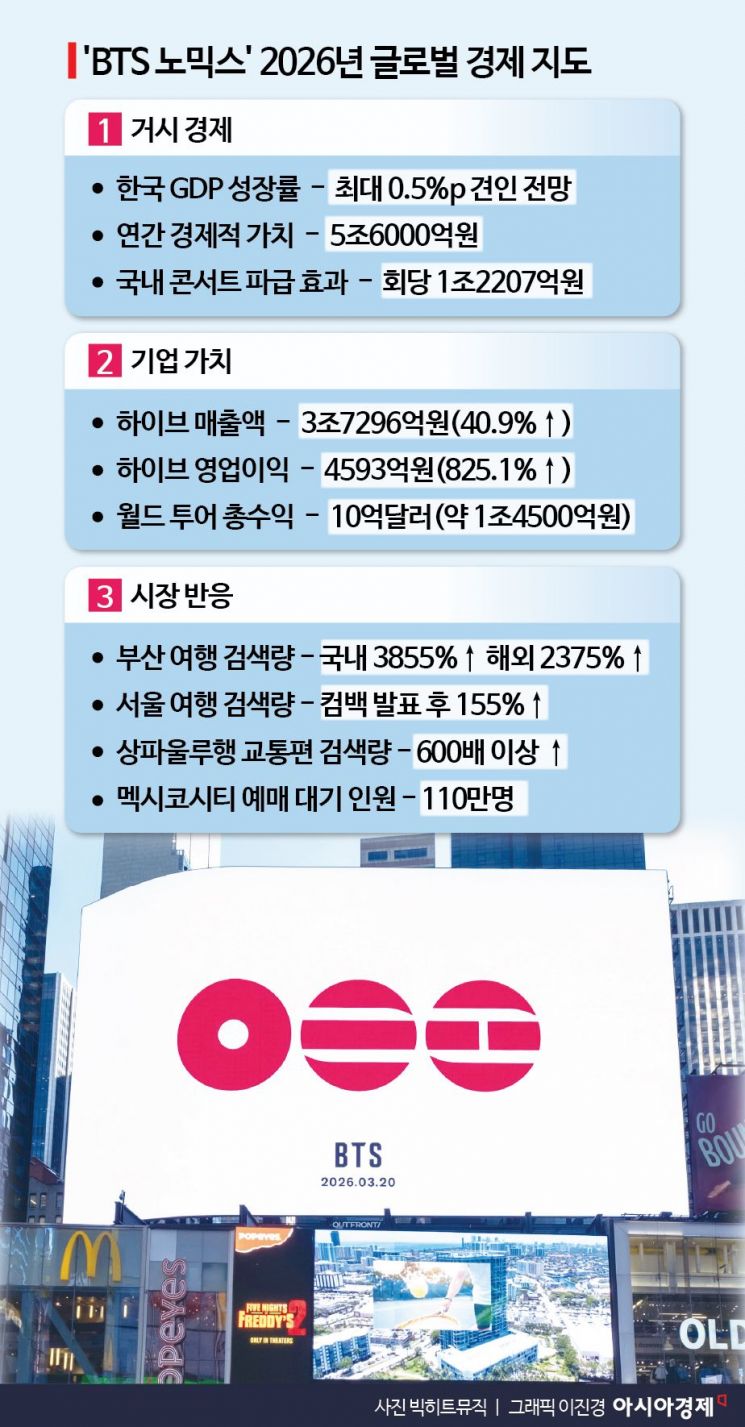
According to their agency Big Hit Music on January 28, all stadium seats for the North American and European legs of "BTS WORLD TOUR ARIRANG" sold out immediately after ticket sales opened on January 24. Notably, 150,000 tickets for the three scheduled concerts in Mexico City sold out in just 37 minutes. The sellout streak continued as fans from neighboring countries such as Peru, Colombia, and Chile, as well as Mexico, rushed to buy tickets.
On January 26, Mexican President Claudia Sheinbaum announced during a regular briefing that she had sent an official letter to President Lee Jaemyung, requesting additional BTS concerts in Mexico. President Sheinbaum explained, "1.1 million people tried to book tickets for the Mexico City concert, resulting in an instant sellout," adding, "We made a diplomatic request because there are still many young people eager to attend." It is rare in global concert history for a head of state to officially request the expansion of a specific artist's performances at the government level.
This tour is rewriting the records of the concert industry itself. The U.S. music magazine Billboard predicted that BTS would generate over 1 billion dollars (about 1.45 trillion won) in revenue from ticket and merchandise sales during this tour. Their solo concert at Stanford Stadium marks only the second time a global artist has performed there after Coldplay, and at El Paso Sun Bowl Stadium and Baltimore's M&T Bank Stadium, BTS will be the first Korean artist to take the stage.
The domestic real economy also responded immediately. Ahead of "BTS 2026 Comeback Show @ Seoul" on March 21, all accommodations near Gwanghwamun Square in Seoul were already fully booked. On January 22, the Seoul Metropolitan Government granted permission for the use of Gwanghwamun Square, with the condition of enhanced safety management. This is the first time a specific artist will hold a solo concert at this venue.
According to the global accommodation platform Hotels.com, travel searches to Seoul from overseas increased by 155% in the 48 hours following the tour announcement on January 14, compared to the previous week. For Busan, where a concert is scheduled in June, domestic searches surged by 3,855% and overseas searches by 2,375%. Brazilian transportation sales platform ClickBus reported that searches for bus tickets to Sao Paulo increased more than 600 times after the tour announcement.
International media outlets have also responded. CNN in the United States reported, "BTS, who elevated K-pop to a global cultural phenomenon, has returned," while Forbes analyzed, "This will be one of the most extensive tours in history, setting a new standard for world tours by Korean artists." The Guardian in the UK described the tour as "a mega-event capable of paralyzing the economies of North American cities," predicting an even greater impact than Taylor Swift's 'Eras Tour.'
The economic analysis firm Tourism Economics stated, "The typical economic multiplier effect for concerts does not apply to BTS," explaining, "Their length of stay and consumption scale are so large that it is difficult to even measure the effect." Financial services company Bread Financial projected that for every one dollar spent on a concert ticket, there would be at least three dollars of local spending.
Securities analysts estimated that Big Hit Music's consolidated revenue for 2026 would increase by 40.9% year-on-year to 3.7296 trillion won, with operating profit surging by 825.1% to 459.3 billion won. DS Investment & Securities and others projected that revenue from the world tour and merchandise sales alone would exceed 1.5 trillion won, raising their target stock price to 450,000 won.
The Korea Culture & Tourism Institute analyzed that a single BTS concert in Korea could generate up to 1.2207 trillion won in economic impact per show. Hyundai Research Institute estimated the annual economic value of BTS activities at 5.6 trillion won. Academia and the market expect that the so-called "BTS Nomics" could drive domestic consumption and improve the tourism balance, potentially boosting South Korea's GDP growth rate by up to 0.5 percentage points in 2026.
BTS will officially resume activities with the release of their fifth full-length album "ARIRANG" at 1 p.m. on March 20. Starting with the main stadium at Goyang Sports Complex on April 9, they will embark on a world tour spanning 82 shows in 34 cities across Japan, North America, Europe, and more. This marks the largest single tour in K-pop history. Having been named the top figure positively influencing Korea's image in the Ministry of Culture, Sports and Tourism's "2025 National Image Survey," BTS is once again set to reshape the global tourism and consumer market landscape.
© The Asia Business Daily(www.asiae.co.kr). All rights reserved.


















