Trump Announces Tariff Hike on Korean Goods from 15% to 25%
Publicly Raises Issue of Legislative Ratification
Government: "Identifying US Intentions Is the Priority"
Experts: "Combining Investment Pressure with Domestic Performance"
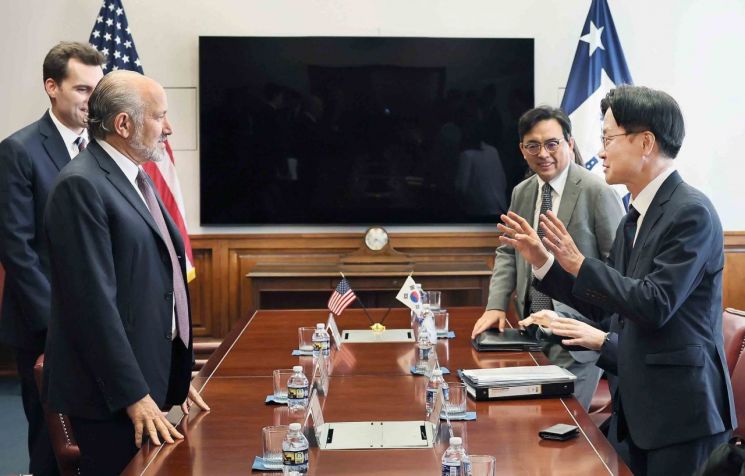 Kim Jung-Kag, Minister of Trade, Industry and Energy, held a meeting with Howard Lutnick, Secretary of Commerce, on July 24 last year (local time) at the U.S. Department of Commerce conference room in Washington D.C., discussing progress in Korea-U.S. tariff negotiations and ways to strengthen cooperation in the industrial sector. Ministry of Trade, Industry and Energy
U.S. President Donald Trump announced via his social media that he would raise tariffs on major South Korean products from 15% to 25%, publicly targeting the National Assembly's delay in implementing the investment agreement. With the Korea-U.S. investment agreement stalled at the parliamentary approval stage, Trump has reshaped the negotiation landscape by using tariffs as a trade tool to exert pressure on the political and legislative domains. In response, the Korean government urgently dispatched Minister of Trade, Industry and Energy Kim Jeong-Kag to Washington, D.C. on the 27th (local time), but it is expected to be difficult to fully grasp the scope and intent of this measure in the short term.
According to the Ministry of Trade, Industry and Energy on the 27th, Minister Kim is scheduled to meet with U.S. Secretary of Commerce Howard Lutnick in Washington to discuss trade and investment-related issues. The ministry stated, "We are currently assessing the situation regarding the U.S. announcement and will discuss response measures through a meeting of relevant ministries chaired by the Chief Presidential Policy Officer." The ministry added, "Although the minister's trip to the U.S. was previously scheduled, the agenda has changed since the tariff announcement," and emphasized, "The priority is to confirm the U.S. position and the actual scope of the measures on the ground."
The government plans to confirm the intent behind the U.S. actions and, moving forward, share the National Assembly's legislative process with the U.S. administration as part of its trade response. The Ministry of Economy and Finance stated, "We are currently trying to understand the U.S. intentions and will continue communication by explaining the status of legislative discussions in the Korean National Assembly to the U.S. side." The ministry continued, "Originally, there was a plan to request parliamentary cooperation regarding the special bill through a meeting between the Deputy Prime Minister and the Chair of the National Assembly's Finance Committee scheduled for this afternoon," adding, "Including this meeting, we will continue to actively consult with the National Assembly going forward."
Experts interpret this move not simply as a 'tariff hike' but as a means to pressure the implementation of the investment agreement. Kang Insu, professor of economics at Sookmyung Women's University, said, "President Trump's action is explicit pressure on the Korean National Assembly," and explained, "With the investment agreement stalled in the National Assembly, the U.S. is using tariffs as leverage."
Professor Kang specifically mentioned the exchange rate variable. He noted, "Deputy Prime Minister Koo Yooncheol has already visited the U.S. Treasury Department to explain Korea's exchange rate situation, but while the U.S. may 'understand,' it has never actually allowed policy flexibility." He analyzed, "The U.S. may in fact regard delays in investment implementation due to exchange rate concerns as intentional procrastination." He added, "Trump needs to show domestically that 'results are being achieved' by linking investment pressure and tariff measures. Since this is also tied to the risk of a Supreme Court ruling on tariffs, it is important to signal that actual money is coming in."
There is further analysis that this move is also tied to President Trump's domestic political needs. As the Supreme Court is reviewing the constitutionality of tariff policies, Trump's key policy agendas-such as immigration enforcement, attracting foreign direct investment (FDI), and reshoring manufacturing-are all in play simultaneously. Some believe President Trump is trying to manage these initiatives as a 'portfolio of achievements.'
Some observers are also noting that President Trump's social media message came just before a major diplomatic and trade event. In August of last year, right before President Lee Jaemyung's visit to the U.S., Trump also stirred controversy by mentioning the Korean political situation on social media, saying it "looks like a purge or a revolution." At that time, much of the early summit meeting was spent on explanations and clarifications, which led to the assessment that the U.S. was able to set the negotiation frame from the outset.
Minister Kim Jeong-Kag's U.S. trip was originally planned to discuss trade issues such as FDI, supply chains, semiconductors, critical minerals, and digital regulations, with Secretary Lutnick as a key counterpart. However, a Ministry of Trade, Industry and Energy official said, "There were already many pending trade issues between Korea and the U.S., so lengthy discussions were scheduled in advance," adding, "The response to the tariff announcement has now been added as a new agenda item."
Analysts also point out that if the tariff measures actually take effect, the burden on Korea's automotive, pharmaceutical, lumber, and parts industries will increase, and there is a possibility that these measures could be linked to FDI and supply chain investment plans within the U.S. The government is expected to finalize its follow-up response after Minister Kim's visit to the U.S.
© The Asia Business Daily(www.asiae.co.kr). All rights reserved.

















