SNS: "Korean National Assembly Failing to Implement Agreement"
Reference to Delay of Special Act on U.S. Investment
Blue House Holds Emergency Countermeasure Meeting with Relevant Ministries
Minister Kim Jeongkwan Dispatched to the U.S.
Bloomb
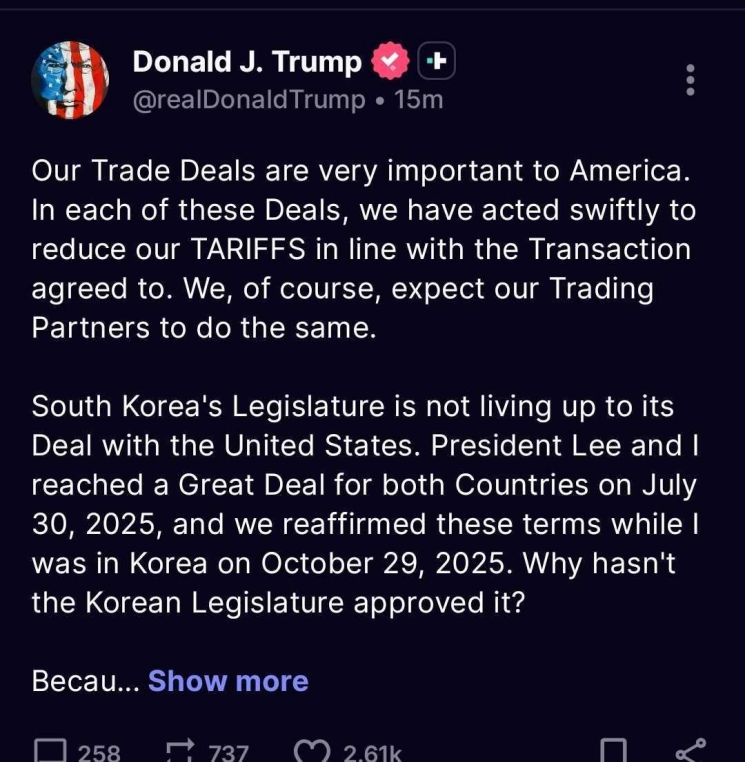
"We will raise all reciprocal tariffs (country-specific tariffs) on (South Korean) automobiles, lumber, pharmaceuticals, and all other goods from 15% to 25%."
On January 26 (local time), U.S. President Donald Trump posted this statement on his social media platform, Truth Social, claiming, "The South Korean National Assembly is not properly implementing its agreement with the United States."
President Trump emphasized, "Our trade agreement is extremely important to the United States," adding, "We acted swiftly to lower tariffs in accordance with the agreed deal. Naturally, we expect America's trade partners to do the same."
He continued, "President Lee Jaemyung and I made a great agreement for both countries on July 30, 2025, and I reaffirmed those terms when I was in South Korea on October 29, 2025," asking, "Why hasn't the Korean legislature ratified the agreement?"
The Blue House responded with an emergency measure. Within an hour of President Trump's post, it announced, "A countermeasure meeting will be held this morning, presided over by the Policy Chief and attended by relevant ministries."
Although the meeting appears to have discussed the circumstances and future response, the Blue House explained, "There has not yet been any official notification or detailed explanation from the U.S. government."
Surface-Level Mention of 'Special Act on U.S. Investment' Delay
President Trump's criticism of the South Korean National Assembly's delayed ratification is interpreted as a call to accelerate investments into the United States. To proceed with U.S.-bound investments, the "Special Act for Strategic Investment Management between Korea and the U.S." (Special Act on U.S. Investment), currently pending in the National Assembly's Planning and Finance Committee, must be passed.
However, the ruling Democratic Party and the opposition People Power Party have not reached an agreement on this law. The Democratic Party argues that the U.S. investment agreement is a memorandum of understanding (MOU), so there is no need to formalize it as a treaty like the Korea-U.S. Free Trade Agreement (FTA). In contrast, the People Power Party insists that the National Assembly must review and ratify the agreement.
Recently, the South Korean government’s delay in executing U.S.-bound investments, citing exchange rate issues, may have provoked President Trump. On January 16, Deputy Prime Minister and Minister of Economy and Finance Koo Yoonchul told Reuters, "Given the current foreign exchange situation, it will be difficult to make significant investments at least this year," indicating that the timing of U.S.-bound investments could be postponed.
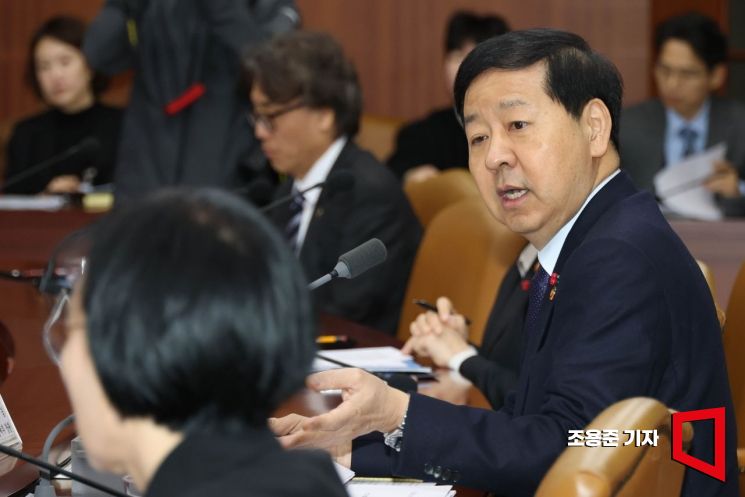 Deputy Prime Minister and Minister of Economy and Finance Koo Yoonchul is speaking on January 21 at the Economic Ministers' Meeting held at the Government Seoul Office in Jongno-gu, Seoul, discussing strategies for win-win growth between large and small-medium enterprises and measures to strengthen strategic export finance support. Photo by Yongjun Cho
Bloomberg also reported on January 20 that South Korea is delaying the timing of its annual $20 billion investment in the United States. Choi Jiyeong, Director General for International Economic Affairs at the Ministry of Economy and Finance, stated at a recent press briefing following U.S. Treasury Secretary Scott Bessent’s verbal intervention in the currency market, "We conveyed the opinion that if volatility and instability in the foreign exchange market increase, it could limit the implementation of U.S.-bound investments."
The "Memorandum of Understanding on Korea-U.S. Strategic Investment" agreed upon last year between South Korea and the United States includes a clause stating that "if concerns about instability in the foreign exchange market arise, (South Korea) may request adjustments to the timing or scale of payments" for up to $20 billion in annual U.S.-bound investments.
From the Trump administration's perspective, with the U.S. midterm elections coming up in November this year, the delay in ratification by the South Korean National Assembly is a source of frustration. President Trump’s political standing has recently been shaken by domestic issues, such as deaths resulting from a forceful entry by U.S. Immigration and Customs Enforcement (ICE) and rising living costs.
Blue House Dispatches Minister Kim Jeonggwan to the U.S.
Minister of Trade, Industry and Energy Kim Jeonggwan is expected to travel to the United States soon. He is currently visiting Canada as part of a presidential special delegation supporting Hanwha Ocean and HD Hyundai Heavy Industries in securing Canadian submarine contracts.
The key issue is whether President Trump's attempt to raise tariffs can be blocked based on the agreement reached between the leaders of South Korea and the United States. According to the MOU, the standard for tariff reduction is the "date of submission" of the bill, not the "date of passage." Since the Democratic Party submitted the bill on November 26 last year, tariffs should retroactively be reduced from November 1 in accordance with the agreement. The United States actually lowered tariffs about a month later, on December 4, through an official gazette announcement.
About two weeks after the Korea-U.S. summit held in Gyeongju on October 29 last year, the two countries released a joint fact sheet on November 13 summarizing the leaders' agreements in security and trade. The document stated that the United States would lower tariffs on South Korean automobiles and other goods in exchange for South Korea making $350 billion in investments in the United States. It also included provisions for the U.S. to support or approve South Korea’s uranium enrichment, spent nuclear fuel reprocessing, and the introduction of nuclear-powered submarines.
Meanwhile, the U.S. Supreme Court is currently reviewing the Trump administration’s reciprocal tariffs. The policy was previously ruled illegal in both the first and second trials. If the Supreme Court also rules it illegal, reciprocal tariffs on South Korea will be nullified. Bloomberg interpreted President Trump’s pressure to raise tariffs on South Korea as a "preemptive move ahead of the Supreme Court ruling."
© The Asia Business Daily(www.asiae.co.kr). All rights reserved.


















