President Lee Presides Over Cabinet Meeting
Signals Active Control of Real Estate Bubble, Citing Japan as a Cautionary Example
"Undermines Growth Potential and Inflicts Serious Damage on the National Economy"
"Heavy Capital Gains Tax on Multiple Homeowners Is Not New... Simply Not Extending the Suspension"
Calls for Swift Improvement of Unreasonable Systems Hindering Capital Market Normalization
On January 27, President Lee Jaemyung emphasized, "We must correct the distortion in resource allocation in our society caused by the abnormal concentration on real estate." As he had previously announced the end of the temporary suspension of the heavy capital gains tax on multiple homeowners, set to expire on May 9, he reiterated his commitment to using policy tools to control the real estate bubble.
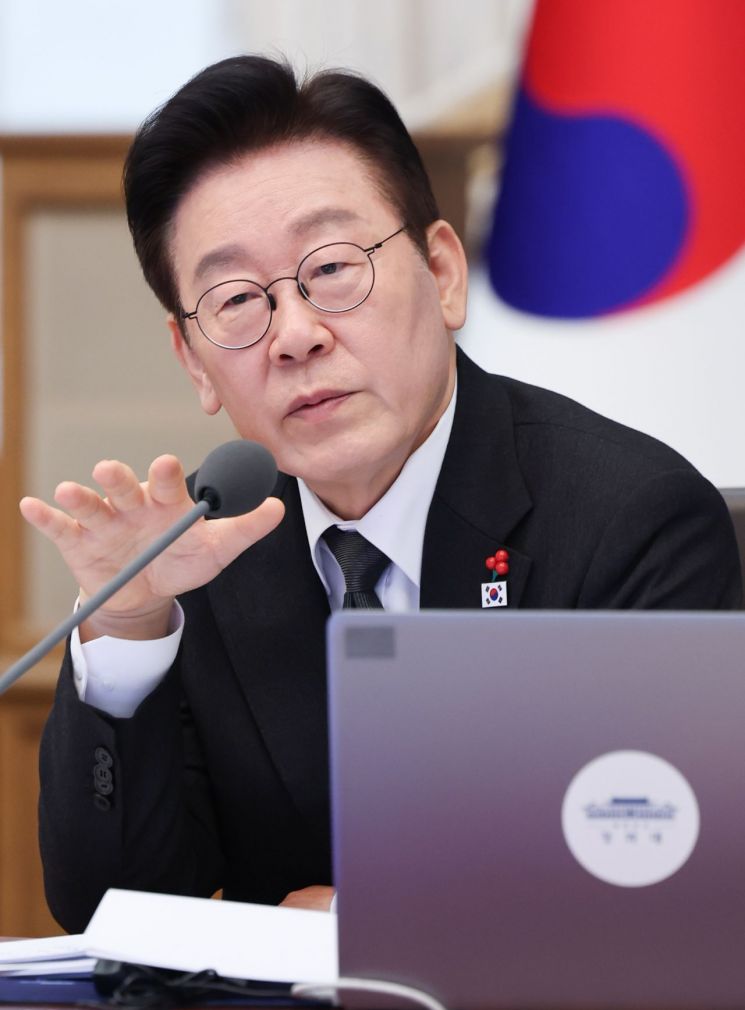
On this day, President Lee presided over a Cabinet meeting at the Blue House, stating, "Recently, real estate issues have become a topic of controversy." He added, "The excessive and unproductive expansion of real estate inevitably leads to a bubble. This not only undermines our growth potential but could also inflict serious damage on the overall national economy."
President Lee's remarks are related to the recent controversy sparked by the decision not to further extend the temporary suspension of the heavy capital gains tax on multiple homeowners. He explained, "When we extended it last year, it was always intended to be for just one year." He criticized, "Yet, people naturally expect another extension. When it was announced that there would be no further extension, some attacked the policy as if a new heavy capital gains tax was being imposed on real estate."
He continued, "This may be due to a misunderstanding of real estate policy, but it could also be an unfair attack," strongly warning, "We must not be swayed by such things."
Regarding the abnormal real estate market, President Lee pointed out, "It will undermine the trust of our society's members and even threaten the stability of our community." He stressed, "We must take to heart the painful lesson from a neighboring country that suffered through a lost 20 or 30 years and great turmoil because they failed to properly control their real estate bubble." This appears to be a reference to Japan, which fell into a prolonged recession after its real estate bubble burst in the early 1990s.
President Lee also expressed his intention to continue real estate stabilization policies. He said, "To avoid such difficulties, we must pursue effective policies consistently and stably, based on strong determination." He urged, "We must never tolerate unfairness and abnormality simply because we fear immediate pain and resistance." However, President Lee also explained, "We must simultaneously pursue proactive measures that the market desires."
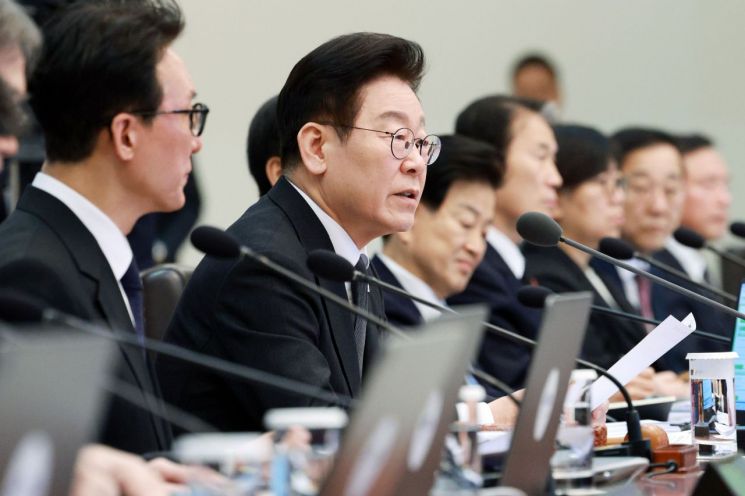
He also called for the swift improvement of unreasonable systems that hinder the normalization of capital markets, in order to accelerate the transition toward productive finance. He emphasized that for the upward trend in the stock market to lead to structural changes in the economy, the stable growth of the real economy-which is directly connected to people's lives-must be supported, and that the opportunities and benefits of growth must be widely distributed throughout the national economy.
President Lee stated, "Our capital market, which has long been neglected, is now becoming a solid foundation for the growth of future innovative industries and for the sound accumulation of assets by the people." He added, "The government should focus its policy capabilities on strengthening the foundation for mutual growth among large, medium, and small enterprises, revitalizing venture startup creation, and building an ecosystem that supports second-chance entrepreneurship."
He further commented, "We must also continue to pursue balanced regional development, which can be considered the most serious issue facing our society." He elaborated, "The path to growth for everyone in the nation will be broader and stronger when all economic actors participate, not just a few large corporations or specific regions and sectors."
Following his opening remarks, a discussion was held on the basic social policy framework and directions prepared by the Ministry of the Interior and Safety and other relevant ministries. Items reported by ministries included the Ministry of Economy and Finance's measures for public safety during the Lunar New Year, the Fair Trade Commission's rationalization of economic sanctions, the Ministry of Justice's plans to expand the introduction of special judicial police, and the National Tax Service and Ministry of the Interior and Safety's management measures for tax arrears and non-tax revenue. In addition, cooperation items included encouraging blood donation (Ministry of Health and Welfare), an all-government response to spring wildfires (Korea Forest Service), preparations for the 2026 Winter Olympics (Ministry of Culture, Sports and Tourism), operation of K-Food hub diplomatic missions (Ministry of Agriculture, Food and Rural Affairs), and plans to host the Korea-Central Asia Summit (Ministry of Foreign Affairs).
© The Asia Business Daily(www.asiae.co.kr). All rights reserved.


















