US-Japan FX Policy Coordination: US Action and Vigilance for Potential Japanese Intervention
Strong Yen Expected to Persist in the Mid-150 Yen Range
Government Demonstrates Strong Commitment to FX Market Stability
Focus on Possible Asset Al
On January 26, the won-dollar exchange rate opened sharply lower, driven by the yen’s surge following signs of coordinated foreign exchange policy between the United States and Japan. Experts noted that the extent of further yen appreciation will be the key factor determining whether the won-dollar exchange rate continues to decline in the near term. In addition, with the government’s strong commitment to stabilizing the foreign exchange market, whether the National Pension Fund Management Committee will revise its asset allocation strategy is also expected to be a critical variable.
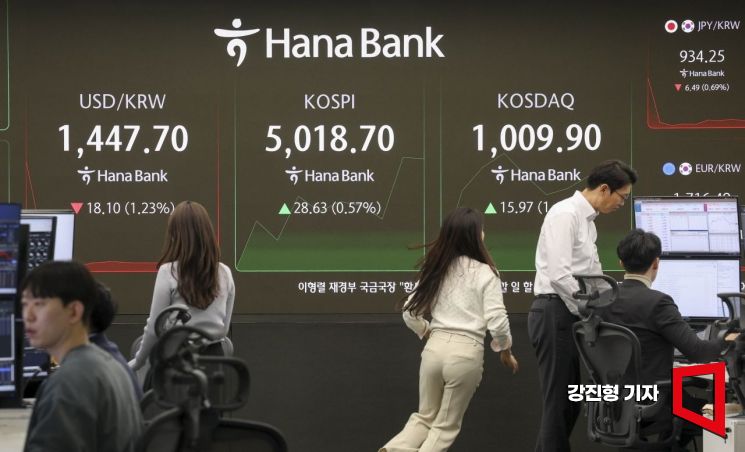 On the 26th, dealers are working in the dealing room at the Hana Bank headquarters in Jung-gu, Seoul.
On January 26, the won-dollar exchange rate opened at 1,446.1 won in the Seoul foreign exchange market, down 19.7 won from the previous trading day. This is the lowest level since January 6, when it opened at 1,445 won. The won-dollar exchange rate has been on a downward trend for four consecutive trading days, following President Lee Jaemyung’s statement on January 21 that “the exchange rate will fall to around 1,400 won within a month or two.” As of 10:09 a.m. on this day, the exchange rate had fallen to 1,443.2 won, and as of 10:26 a.m., it was fluctuating around the 1,446 won level.
The sharp drop in the won-dollar exchange rate was largely due to the significant rise in the yen’s value over the weekend. On January 23, the Federal Reserve Bank of New York conducted a rate check survey with London foreign exchange market dealers. In a situation where 24-hour foreign exchange market quotes are released in real time, such rate checks are either to confirm the effectiveness of intervention just before it occurs or to signal the authorities’ intentions to the market. As a result, the yen-dollar exchange rate, which had approached 160 yen last week, plunged on January 23 and fell to the low 155-yen range on this day. Kwon Amin, a researcher at NH Investment & Securities, commented, “There was caution about intervention by Japanese authorities around the 160-yen level, but its effectiveness was limited. Ultimately, the fact that the Federal Reserve Bank of New York, which can be seen as the U.S. foreign exchange market execution channel, was involved indicates either clear policy coordination between the two countries or, at the very least, an implicit intention from the United States.”
Experts believe that the duration of further yen appreciation following the U.S.-Japan foreign exchange policy coordination signals will be a key variable for the direction of the won-dollar exchange rate. Researcher Kwon noted, “Japan is the largest holder of U.S. Treasuries, and since COVID-19, the share of U.S. assets in its overall overseas investments has increased significantly. If the U.S. intervenes directly, there is a possibility that Japanese funds could return home. However, rather than direct U.S. intervention, it is more likely that, as in 2022 and 2024, the Bank of Japan will remain vigilant about intervention amid U.S. actions.” In this scenario, a strong yen in the low to mid-150-yen range is expected to persist, which would also have an impact on the downward trend of the won-dollar exchange rate in tandem.
The easing of “Sell America” concerns, following conciliatory gestures by U.S. President Donald Trump regarding the Greenland issue, also contributed to the weakening of the dollar. Park Sanghyun, a researcher at iM Securities, stated, “If the yen strengthens further, the sentiment for additional dollar weakness will spread. This week, the foreign exchange market is expected to focus more on the appointment of the next Federal Reserve Chair and the possibility of another federal government shutdown, rather than the first Federal Open Market Committee (FOMC) meeting of the year.”

The outcome of the National Pension Fund Management Committee meeting will also be a major variable affecting the won-dollar exchange rate. On this day, the National Pension Service will hold its first Fund Management Committee meeting of 2026 to review its fund management strategy. It is reported that the committee will discuss proposals to reduce the proportion of overseas investments and increase domestic investments, as well as to raise the hedge ratio. Moon Hongcheol, a researcher at DB Securities, explained, “The previously set asset allocation target for the end of 2026 was 14.4% (plus or minus 5 percentage points) for domestic stocks, but it is highly likely that the upper limit has already been exceeded. Given that the President’s commitment to stabilizing the foreign exchange market has been confirmed, if the committee decides to increase the domestic asset allocation ratio at this meeting, it will have a significant impact on stabilizing the won-dollar exchange rate, in addition to the U.S.-Japan coordinated intervention in the yen-dollar market.”
© The Asia Business Daily(www.asiae.co.kr). All rights reserved.
![Clutching a Stolen Dior Bag, Saying "I Hate Being Poor but Real"... The Grotesque Con of a "Human Knockoff" [Slate]](https://cwcontent.asiae.co.kr/asiaresize/183/2026021902243444107_1771435474.jpg)












