"An Unprecedented Economic Criminal Penalty Worldwide"
Breach of Trust Law Reform Requires Clear Definition of Elements
Exceptions Needed for Mandatory Cancellation of Treasury Shares
The business community has expressed concerns regarding the mandatory cancellation of treasury shares and has strongly urged the National Assembly to implement an “unconditional and comprehensive overhaul of breach of trust laws.” It also emphasized the need to reconsider the bill currently being promoted in the National Assembly that would mandate the cancellation of treasury shares.
The eight major economic organizations released an appeal calling for improvements to breach of trust laws and, on January 26, submitted a proposal for “measures to improve breach of trust laws” to the National Assembly and the Ministry of Justice. The eight organizations include the Korea Employers Federation, Korea Chamber of Commerce and Industry, Korea Enterprises Federation, Korea International Trade Association, Korea Federation of SMEs, Korea Association of Mid-sized Companies, Korea Listed Companies Association, and KOSDAQ Association.
In their appeal, the business community described the breach of trust law as an “economic criminal penalty” that is virtually unprecedented globally. They pointed out that the scope of punishment and the elements constituting the crime are ambiguous, exposing even normal business activities to the risk of criminal prosecution.
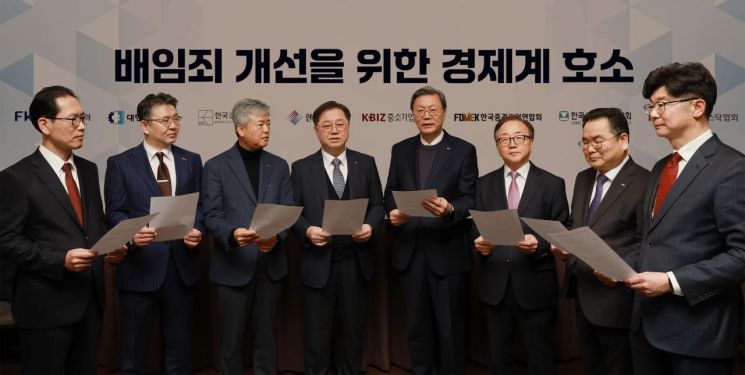 Vice presidents of eight economic organizations are taking a commemorative photo after discussing issues related to breach of trust at the Dragon City Hotel in Yongsan-gu, Seoul. From the left in the photo are Kim Chun, Head of Policy Division 1 at the Korea Listed Companies Association; Oh Kiwoong, Vice President of the Korea Federation of Small and Medium Business; Lee Inho, Vice President of the Korea International Trade Association; Park Iljun, Vice President of the Korea Chamber of Commerce and Industry; Kim Changbeom, Vice President of the Korea Entrepreneurs Federation; Lee Donggeun, Vice President of the Korea Employers Federation; Park Yanggyun, Head of Policy Division at the Korea Association of Small and Medium Enterprises; and Kim Junman, Executive Director of the KOSDAQ Association.
Through the appeal, they noted that, despite the passage of a series of bills last year that increased the burden on companies-such as the expansion of negotiation subjects, mandatory cumulative voting, and the expansion of separate election of audit committee members-there has been no progress on the breach of trust law reform that the National Assembly had promised. They called for a prompt overhaul of the breach of trust law.
Regarding punitive damages and the discovery system, which have been discussed as supplementary measures for the overhaul of breach of trust laws, they made clear their position that such discussions should be avoided, as these measures could further increase the burden on companies.
The business community also pointed out that the bill to mandate the cancellation of treasury shares, which is currently being discussed in the National Assembly, requires careful review. While they understand the intent of the amendment, such as preventing the expansion of control by major shareholders, they emphasized the need for exceptions, arguing that it is not desirable to include treasury shares that are inevitably acquired during business processes such as mergers in the scope of mandatory cancellation.
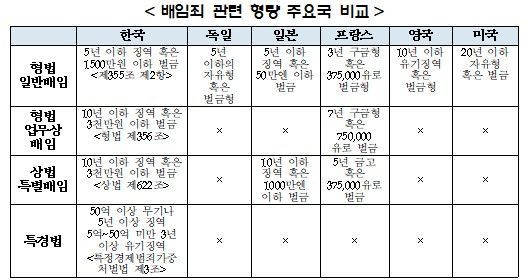
Through their proposal, the business community suggested a comprehensive and unconditional overhaul of breach of trust laws in the Criminal Act, Commercial Act, and the Act on the Aggravated Punishment of Specific Economic Crimes, and proposed that, as in the United States or the United Kingdom, such cases should be punished as fraud or embezzlement, or resolved through civil litigation. If, instead of a full overhaul, alternative legislation is prepared under individual laws, they requested that the elements constituting the crime-such as the scope of application and punishable acts-be clearly defined, as is the case in Germany or Japan. They argued that if businesspeople are charged with breach of trust simply for failed business decisions, bold entry into new industries or large-scale investment decisions will be discouraged, ultimately leading to significant social losses.
The business community proposed that the intent to seek benefits for oneself or a third party, or to cause harm to the principal, should be added as an element of breach of trust, so that only “intentional illegal acts” are subject to punishment. They also requested that the punishment standard of “property damage” be clearly defined as “actual damage incurred,” since there have been frequent cases of prosecution solely on the grounds that “damage is anticipated.”
Alongside a comprehensive overhaul of breach of trust laws, the business community also recommended that the business judgment rule be explicitly stipulated in the Commercial Act and the Criminal Act. They argued that, as the first amendment to the Commercial Act expanded the duty of loyalty of directors to include shareholders, increasing legal risks for directors, legislative measures are needed to recognize the professional business judgment of entrepreneurs and to reduce unnecessary litigation risks.
They claimed that establishing clear legal standards through the overhaul of breach of trust laws and explicit stipulation of the business judgment rule, as well as ensuring predictable law enforcement, would invigorate business management and help enhance the potential growth rate through increased investment and innovation.
© The Asia Business Daily(www.asiae.co.kr). All rights reserved.
![User Who Sold Erroneously Deposited Bitcoins to Repay Debt and Fund Entertainment... What Did the Supreme Court Decide in 2021? [Legal Issue Check]](https://cwcontent.asiae.co.kr/asiaresize/183/2026020910431234020_1770601391.png)

















