Sponsorship Amounts Soar to One Million Won Amid Fierce Competition
Recently, so-called "auction blind dates," where sponsorship amounts are auctioned for women's contact information on platforms like YouTube, have become popular and sparked controversy. In these auctions, a YouTube host displays a woman's photo along with her age, height, and other profile details, then holds an auction where the highest sponsor receives her contact information and a chance for a date.
According to a Yonhap News report on the 25th, on January 22, a YouTube broadcaster (BJ) watched a countdown timer on screen and shouted, "20 seconds left. Starting the count." The screen reportedly showed a revealing photo of a woman, along with her age, height, weight, and place of residence. Viewers who wanted a blind date with the woman had to send sponsorship money to the BJ's account within the time limit.
In one broadcast held on January 22, viewers competed in real time to send sponsorships, creating an auction atmosphere similar to an open chat room on a messenger app.
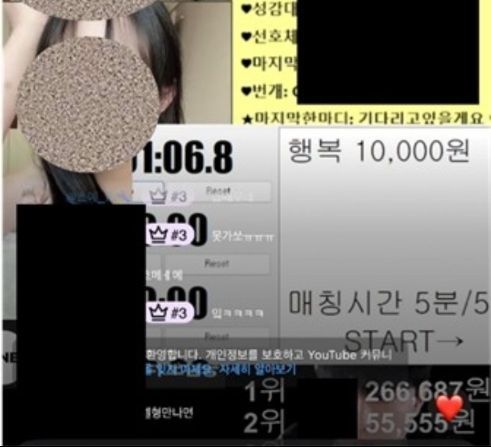
The host encouraged sponsorships by saying, "She looks even prettier in person," and the rankings changed constantly depending on the amount of money viewers sent. Ultimately, the highest bidder, who sent 150,000 won, received the woman's contact information. There were also cases where the "date right" obtained in this process was transferred to a third party.
When one viewer sent 20,000 won, the BJ said, "You're currently in the lead." Another viewer quickly changed the rankings by sponsoring 50,000 won. In the chat room, viewers cheered, saying things like, "Finally, someone is spending money," and "That's satisfying."
As the sponsorship amounts soared and the rankings fluctuated, the viewer who sent 150,000 won ultimately took first place. The BJ delivered the woman's contact information to this viewer. The acquired date right could either be used by the winner or "transferred" to a third party like a commodity.
This is the reality of auction blind dates that have recently become popular on YouTube and similar platforms. While the format resembles an auction, unlike a real auction, participants who do not win receive no refund at all. When competition heats up for the contact information, sponsorship amounts can quickly rise to the 1 million won range.
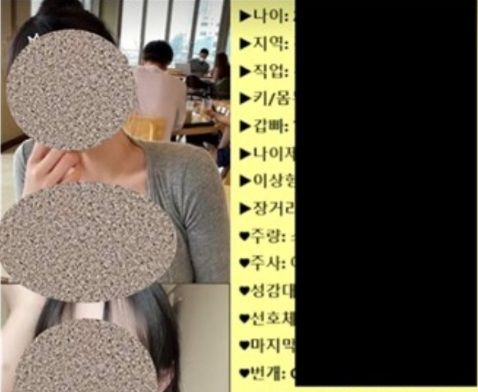
Not only is it inappropriate to auction off opportunities to meet someone of the opposite sex, but there is also a high risk of these broadcasts leading to illicit encounters such as prostitution. In fact, these broadcasts often include explicit details, such as sexual preferences, in the women's profiles. One channel explicitly stated that 20% of the sponsorship money would be "allocated" to the participating women.
Experts have criticized this content for thoroughly objectifying women. Shin Jiyeong, an activist from the National Solidarity for Solving the Prostitution Problem, said, "The problem is that YouTube, as a mainstream platform, normalizes prostitution as an everyday or entertaining activity," adding, "There is also a possibility that these women are entering into unfair contracts or being subjected to confinement or threats, so active police investigation and strong punishment are necessary."
The police have stated that, for now, they will monitor the broadcasts. A police official told Yonhap News, "If the BJ played an intermediary role, there could be grounds for charges of facilitating prostitution," but added, "We need to verify whether money is actually being exchanged and whether there is a quid pro quo."
At the same time, the police plan to request the Korea Communications Standards Commission to block access to such YouTube content if these auction-style blind date broadcasts are deemed "inappropriate content."
© The Asia Business Daily(www.asiae.co.kr). All rights reserved.












