Based on 'America First' Policy
"Should Take Primary Responsibility with More Limited U.S. Support"
No Mention of North Korean Denuclearization
The U.S. administration has released a new National Defense Strategy (NDS) based on President Donald Trump's "America First" policy.
In the new NDS unveiled by the Trump administration on the 23rd (local time), it stated that South Korea is fully capable of taking "primary responsibility" for deterring North Korea, and that this aligns with U.S. national interests.
In the NDS, the Trump administration said, "South Korea is capable of taking primary responsibility for deterring North Korea, while receiving critical but more limited U.S. support."
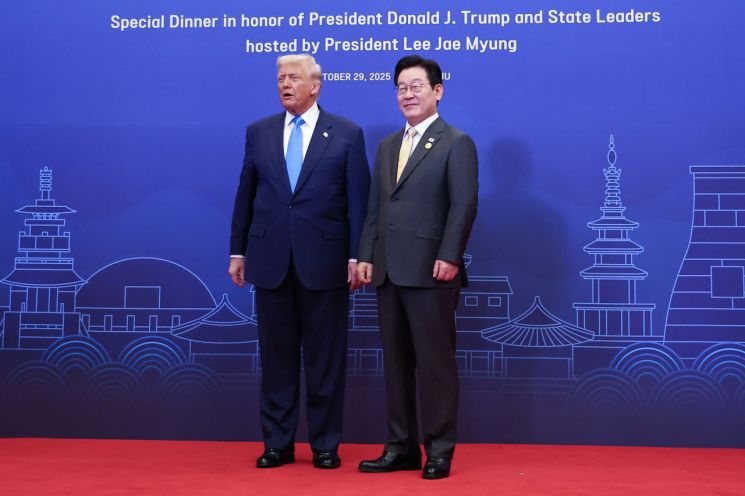 President Lee Jae-myung is welcoming U.S. President Donald Trump ahead of the special summit dinner hosted by the president at the Grand Ballroom of the Hilton Hotel in Gyeongju, Gyeongbuk, on the 29th. Photo by Yonhap News
As reasons for this assessment, the NDS cited South Korea's "powerful military, high level of defense spending, robust defense industry, and mandatory conscription system."
It further noted, "South Korea also has the willingness to do so, given the direct and clear threat posed by North Korea," adding, "Such a rebalancing of responsibilities aligns with U.S. interests in updating the U.S. military posture on the Korean Peninsula."
The administration emphasized, "By doing so, we can ensure a stronger and more mutually beneficial alliance that better aligns with U.S. defense priorities, thereby creating conditions for lasting peace."
In this NDS, the Trump administration repeatedly stressed the importance of burden-sharing for security costs.
It called on not only South Korea, but also Europe and the Middle East, to take primary responsibility for their own defense with "critical but more limited U.S. support."
The Trump administration stated, "Our allies and partners must shoulder their fair share of the burden for our collective defense," specifically identifying Europe and South Korea as allies that have begun to strengthen this role.
It also announced that it would prioritize strengthening "incentives" to encourage allies to take on greater responsibility.
Regarding North Korea, the NDS stated, "While much of North Korea's large conventional forces are outdated or poorly maintained, South Korea must remain vigilant against the threat of invasion from the North," and assessed, "North Korea's missile forces can target sites in South Korea and Japan with conventional and nuclear weapons, as well as other weapons of mass destruction (WMD)."
It further stated, "At the same time, North Korea's nuclear capabilities are increasingly able to threaten the U.S. mainland," and added, "These forces are growing in size and sophistication, posing a clear and present risk of nuclear attack on the U.S. homeland."
This NDS does not mention North Korea's denuclearization.
Under the previous Biden administration, the NDS and Nuclear Posture Review (NPR) were released simultaneously in 2022, and at that time, the NPR explicitly set the goal of achieving a complete and verifiable denuclearization of the Korean Peninsula.
The NDS, which was released last December as a sub-document of the National Security Strategy (NSS), sets the main defense priorities and outlines the broad strategy for deterring major threats facing the United States. It is typically newly drafted after the inauguration of a new administration.
© The Asia Business Daily(www.asiae.co.kr). All rights reserved.
!["The Woman Who Threw Herself into the Water Clutching a Stolen Dior Bag"...A Grotesque Success Story That Shakes the Korean Psyche [Slate]](https://cwcontent.asiae.co.kr/asiaresize/183/2026021902243444107_1771435474.jpg)
















