Seawater Desalination Facility Operating at Half Capacity
Ongoing Hardships Until Regional Water Supply Completion in 2028
Another severe drought has struck Neopdo in Nohwa-eup, Wando County, South Jeolla Province. Since January 22, residents have been forced to rely on transported water. Facing the recurring annual drinking water crisis, Wando County is struggling to devise countermeasures, citing the unique characteristics of island regions and local climate conditions.
According to the National Drought Information Portal on January 23, the rainfall in the Nohwa area of Wando over the past three months (as of January 23, 2025) was only 61.1% of the average for this period. Neopdo, in particular, is in a critical state.
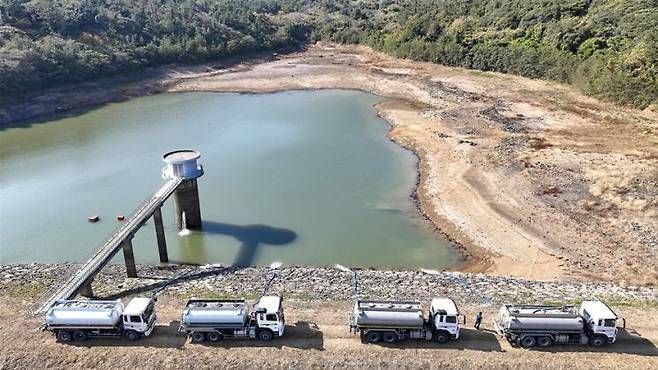 The water supply truck mobilized by Wando County is transporting emergency water. Photo by Wando County
Since January 22, the county has begun transporting water using a car ferry, carrying water from the mainland. Although this method costs hundreds of millions of won each year in rental and transportation fees, it is an unavoidable choice to provide residents with water for daily use. Even so, the current supply is only sufficient for about 72 days.
▲ Island Geography: Lack of Mountains Makes Water Collection Difficult
Due to the island's geographical characteristics, with underdeveloped mountains and valleys, even when rainfall is not low, the amount of water collected in reservoirs is severely insufficient.
On the mainland, rainwater naturally flows along mountains and valleys and is collected in reservoirs. However, on Neopdo, most rainwater escapes to the sea due to the terrain, with little being stored. Conditions for developing groundwater are also poor, and there are no alternative water sources nearby to draw from.
The water retention rate in island regions like Neopdo is estimated at around 50%, which is far below the national average. In effect, half of the hard-earned water supply leaks into the ground through the pipes.
▲ Seawater Desalination Facility Operating at Half Capacity
Insufficient management is also exacerbating the problem. Currently, one seawater desalination facility, using underground brine as its raw source, is in operation. However, due to increased demand, securing raw water has become difficult, and the facility’s daily output has dropped from the original 120 tons to about 60 tons.
Wando County stated that it has responded immediately, but residents are suffering. One resident expressed frustration: "The same situation repeats every year. Even though a desalination facility was built, poor management has reduced its operating rate, and the reservoir keeps leaking. With such unreliable water supply, who would want to live here?"
▲ The Solution: Regional Water Supply System Targeted for Completion in 2028
Wando County has embarked on building large-scale infrastructure to fundamentally resolve the chronic drought. The project aims to establish an emergency supply network connecting the water supply zones of Nohwado and Neopdo.
With a total investment of 67.9 billion won, the plan is to install a 31.1-kilometer water pipeline from the Haenam regional junction to Nohwa-eup by 2028. One reservoir and two pumping stations will also be constructed to establish a stable water supply base for the Bogil and Nohwado areas.
Once this project is completed, water from the mainland’s regional supply system will be delivered to Neopdo through an undersea pipeline, alleviating concerns about drought. However, more than two years remain until completion. Until then, Wando County plans to temporarily install and operate an additional seawater desalination facility using seawater as the raw source starting in February, funded entirely by the county budget.
A Wando County official stated, "It is true that the island region's geographical limitations and climate conditions make it vulnerable to drought. We expect the regional water supply project to provide a fundamental solution, and until then, we will minimize residents’ inconvenience through additional desalination facilities and transported water."
© The Asia Business Daily(www.asiae.co.kr). All rights reserved.

















