Chinese Private Space Firm Unveils Manned Spacecraft Test Module
3 Million Yuan Per Person... 3 to 6 Minutes of Zero-Gravity Experience
A private Chinese space company has unveiled China's first commercial manned spacecraft test capsule. The inaugural flight is scheduled for 2028, with the ticket price set at 3 million yuan (approximately 630 million won) per person.
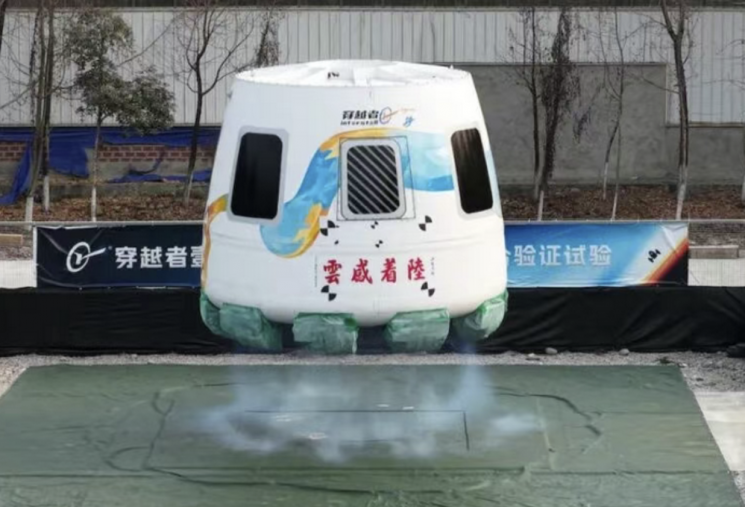
On January 22, Chinese economic media outlet Chailiansuo reported, "China's space tourism era has entered the countdown," adding, "InterstellOr, a Beijing-based space industry startup (Chinese name Chuanweizhe), has unveiled a full-scale experimental module of China's first commercial manned spacecraft, 'Chuanweizhe 1' (CYZ1), and announced plans for a manned flight in 2028."
Founded in January 2023, InterstellOr is the first private company in China to simultaneously pursue the development of reusable manned spacecraft and operate space tourism. According to InterstellOr, more than three spacecraft have been pre-booked so far, and a total of about 20 space tourists have confirmed their participation.
InterstellOr's suborbital (pre-Earth orbit entry) spacecraft boasts a reusability rate of up to 99%, with each space tourism ticket priced at approximately 3 million yuan. Chuanweizhe 1 is designed to transport passengers to the Karman line, about 100 kilometers above the Earth's surface (the edge of Earth's atmosphere), providing a zero-gravity experience for approximately 3 to 6 minutes.
The list of space tourists has also been released. It includes Li Licheng, an academician of the Chinese Academy of Engineering; Zhu Heng, Chief Marketing Officer (CMO) of Ji Yuan Robot; and Wang Jing, founder of the Chinese outdoor brand Toread. In addition, PM01, a humanoid robot from Chinese robotics company Zhongqing Robot, has also been named as a space tourist.
According to the company, the unveiled experimental module has completed comprehensive verification tests for the landing cushioning system, with all indicators meeting target values. In particular, the use of retropropulsion engines and energy absorption structural technology has helped suppress excessive impact overload with the ground during landing.
The company stated that, following SpaceX led by Tesla CEO Elon Musk and Blue Origin founded by Amazon's Jeff Bezos, InterstellOr is the third company globally to possess this technology.
According to Chinese market research firm QY Research, the size of China's space tourism market is expected to reach approximately 894 million dollars (1.3108 trillion won) by 2032. The average annual growth rate from 2026 to 2032 is projected to be 13.6%.
© The Asia Business Daily(www.asiae.co.kr). All rights reserved.
![Clutching a Stolen Dior Bag, Saying "I Hate Being Poor but Real"... The Grotesque Con of a "Human Knockoff" [Slate]](https://cwcontent.asiae.co.kr/asiaresize/183/2026021902243444107_1771435474.jpg)
















