Controversy Continues After Wind Pension Payments on Jaeundo
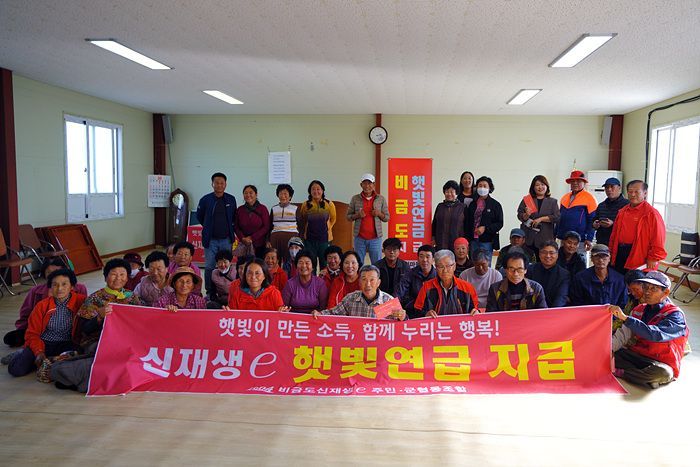 In October, residents of Bigeum-myeon, Sinan County received their solar pension payments. Photo by Seunghyun Jung
"The sunlight and wind of the region belong to all local residents."
This has been the policy principle promoted by Sinan County since October 2018, when it enacted the "Sinan County Ordinance on Sharing the Benefits of New and Renewable Energy Development." The intent is to return the profits generated from the development of new and renewable energy, such as solar and wind power, to the residents as income, rather than to specific business operators.
The county has been recognized as the first case in the country to transform new and renewable energy from a simple power generation facility into a "source of resident income." However, there has been ongoing controversy over the scope of benefits and the payment methods during the implementation process.
▲Concerns over benefit concentration... Introduction of the "Sunlight Child Allowance"
According to the county, until 2023, only residents of island areas where solar power plants were installed received the "solar pension." As a result, residents in areas without power generation facilities raised concerns, arguing that "although the ordinance clearly states that the benefits should be shared by all county residents, only certain areas are receiving them."
In response, the county amended the ordinance in October 2022 to introduce the "Sunlight Child Allowance." Depending on the generation capacity, 10% to 50% of the resident participation profits are distributed as a county-wide child allowance. This measure was taken to distribute the profits, which had been concentrated in specific areas, across the entire county.
▲First "Wind Pension" in the country... Controversy on Jaeundo
In October last year, the county paid out the nation's first "wind pension." This system returns the profits from offshore wind power generation to residents as income, expanding the resident participation profit structure from solar to wind power as well.
The first wind pension paid on Jaeundo amounted to approximately 340 million won. Children under the age of 18 received 1.2 million won per person annually, while adults received between 100,000 and 300,000 won per quarter. For a family of four with two children, this amounts to at least 3 million won per year.
However, some residents raised concerns, stating, "It is reported that resident participation income exceeds 2.3 billion won, but the actual amount paid falls short of expectations."
In response, the county explained, "As this is the initial stage of power generation, grid issues and wind variability have resulted in unstable generation output." The unpaid portion has been deposited in the cooperative's account, and the county plans to recalculate the payment amount in the future, reflecting operating profits and changes in the number of residents.
▲Disagreement over the source of funding for the child allowance
Another point of contention is who should bear the burden of the advance payment of the Sunlight Child Allowance. Some residents have questioned the structure in which the Jaeundo cooperative bears these costs.
The county judged that, considering the characteristic of offshore wind power being installed on public waters, expanding the recipients to all county residents could excessively lower the per capita payment. Accordingly, in April 2024, the ordinance was amended so that for offshore wind power projects under 100MW, residents of the nearest town or township are eligible for participation, but 40% of the resident participation profits must be returned as a county-wide child allowance.

▲Cooperative formation method also under debate
The method of forming the cooperative has also become a point of controversy. Some residents have questioned whether establishing the cooperative centered around 10 members aligns with the intent of the "Framework Act on Cooperatives."
The county explains that the cooperative in question serves as a practical organization entrusted with resident participation and the distribution of compensation. The cooperative members are composed of individuals with regional representation, such as the head of the residents' self-governing committee, the head of the village leaders' association, the youth association president, and the women's association president. General residents participate as "members," receiving profit distributions without any capital contribution burden.
▲"Lack of communication, not the system's intent, is the cause"
Some residents of Jaeundo expressed concern that "if this controversy leads to the system being weakened or suspended, it could ultimately be detrimental to all Sinan County residents in the long run."
Experts believe that this controversy stems more from a lack of explanation and communication than from problems with the system itself. They point out that, in addition to policy design, sufficient explanation and adjustment processes are needed to enhance residents' understanding.
Sinan's policy experiment to return the profits from sunlight and wind to residents as income continues. However, in order to secure the sustainability of the system, transparent provision of information on the payment structure and operation methods, as well as communication with residents, remain future challenges.
© The Asia Business Daily(www.asiae.co.kr). All rights reserved.


















