"Carbon-Free Baseload Power Is Not a Choice, but an Essential Survival Strategy"
German Chancellor Criticizes "The Most Expensive Energy Transition in the World" after Nuclear Phase-Out
Society Also Calls for Introduction of 'Total System Cost of Electricity' in Power Generation Costs
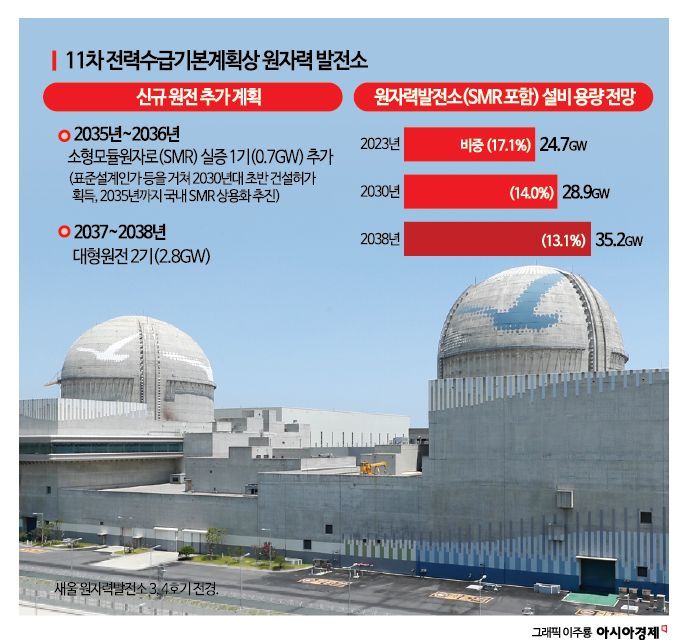
The Korean Nuclear Society has argued that, in addition to the two large nuclear power plants included in the 11th Basic Plan for Electricity Supply and Demand, the 12th Basic Plan for Electricity should also reflect the construction of additional nuclear power plants. The Society also pointed out that, when evaluating the economic feasibility of each power generation source, the total system cost of electricity (SCBOE) should be assessed in addition to the currently used Levelized Cost of Electricity (LCOE).
On January 23, the Korean Nuclear Society distributed its "Position and Recommendations on the Formulation of the 12th Basic Plan for Electricity," stating, "In order to respond to the surging power demand from AI and data centers and to achieve the 2050 carbon neutrality goal, the 12th Basic Plan for Electricity must include 'additional new nuclear power plant construction' beyond the current plans."
The Society diagnosed that "Korea is currently facing the 'Energy Trilemma' of carbon neutrality (environment), economically viable energy supply (economic feasibility), and energy security (stability)."
It continued, "Especially as the AI revolution is causing power demand to soar beyond forecast ranges, relying solely on highly intermittent renewable energy sources clearly has limitations in ensuring grid stability and meeting demand. Therefore, expanding the role of nuclear power, a 'carbon-free baseload power source,' is not a choice but an essential survival strategy."
The Society added that major countries such as the United States and France are already significantly expanding their use of nuclear power, and even Germany, which once led the phase-out of nuclear energy, has recently acknowledged through a statement by its chancellor that "the nuclear phase-out was a strategic failure."
On January 15, German Chancellor Friedrich Merz criticized, "The previous government's hasty shutdown of the last nuclear power plants was a serious strategic mistake," adding, "We are now undergoing the most expensive energy transition in the world."
Regarding the results of a public opinion poll released by the Ministry of Climate, Energy and Environment on January 21, which showed that over 60% of the public supports the promotion of new nuclear power plants and over 80% responded that "nuclear power is necessary," Sungmin Kim, President of the Korean Nuclear Society (KAIST Professor), evaluated this as "very encouraging" and emphasized that "such public support should be reflected in the formulation of the 12th Basic Plan for Electricity."
The Society argued, "Considering the time required to construct new nuclear power plants, to prevent a power supply gap after 2040, the 12th Basic Plan for Electricity must immediately include plans for additional new nuclear power plants targeted to begin operation in 2039-2040."
The Society assessed that, in order to maintain the 35% nuclear power share target for 2050 as set in the 11th Basic Plan for Electricity for 2038, it is necessary to construct 20 new large nuclear power plants and 12 small modular reactors (SMRs).
The Society pointed out, "The currently used Levelized Cost of Electricity (LCOE) only calculates the costs within the power plant boundaries and does not account for 'hidden costs' such as backup facilities for intermittency, grid reinforcement, and costs to resolve supply-demand imbalances."
Furthermore, the Society stated, "According to a recent report by the United Nations Economic Commission for Europe (UNECE), variable renewable energy sources incur not only simple generation costs but also grid expansion costs, flexibility resource procurement costs, and profile costs (value reduction and output control), resulting in actual system costs that can surge to more than twice the LCOE. The government should therefore establish an energy mix that minimizes the public burden based on the 'System Cost Breakdown of Electricity (SCBOE).'”
The total system cost of electricity refers to a concept that includes all additional costs required to reliably supply electricity to consumers, such as grid connection, securing reserves, and output control losses.
© The Asia Business Daily(www.asiae.co.kr). All rights reserved.

















