Survey on the Percentage Viewing Five Issues as Major Threats in 25 Major Countries
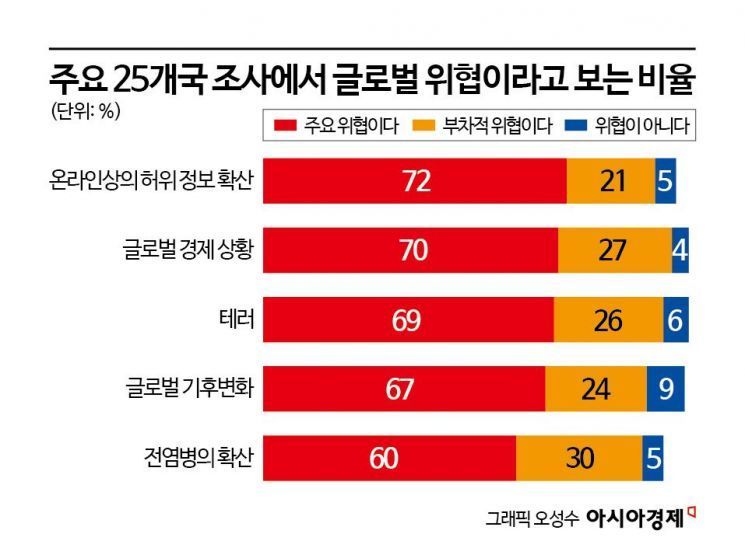
According to a survey conducted by the Pew Research Center targeting adults in 25 major countries, the issues perceived as the most significant threats were the "spread of false information online," the "global economic situation," and "terrorism." In most countries, about 7 out of 10 respondents identified these three as major threats.
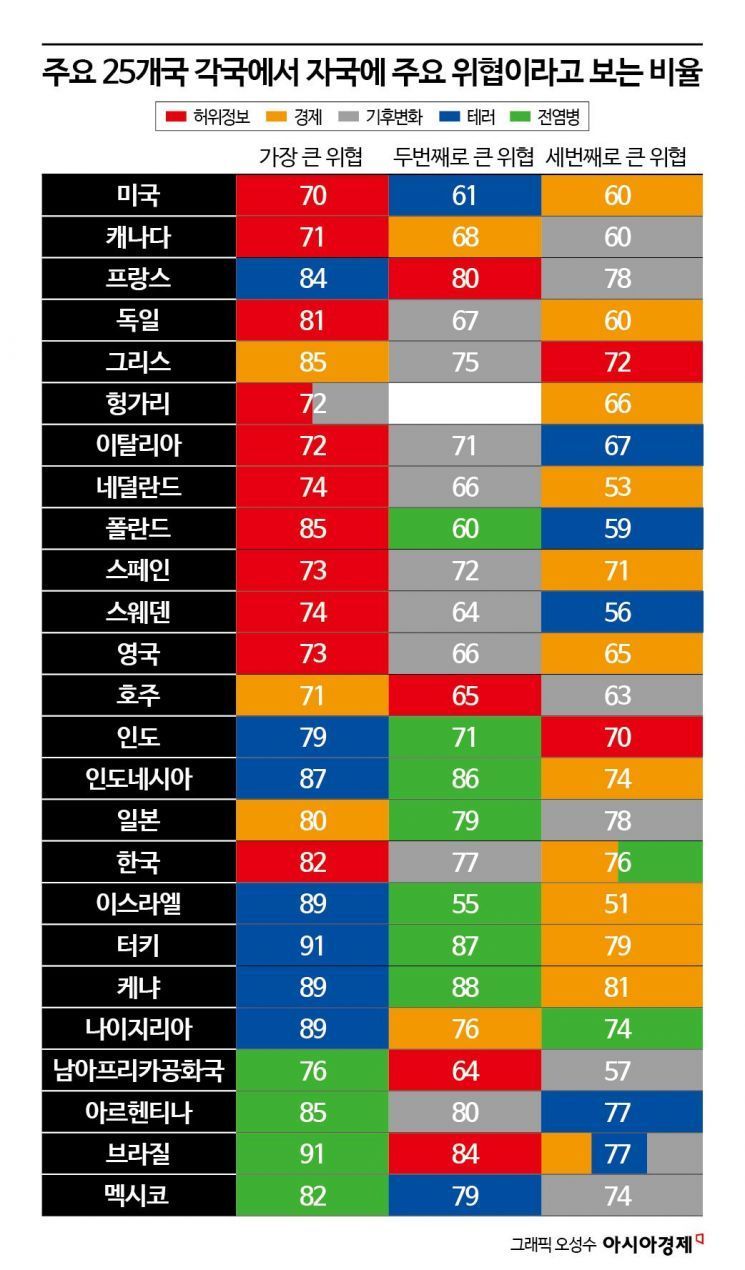
In South Korea as well, the "spread of false information online" was cited as the top threat by 82% of respondents. However, the second most common response was "climate change" at 77%, while the "global economic situation" and "infectious diseases" each followed at 76%.
According to the Pew Research Center, a leading U.S. think tank, on January 23, 2026, the 2025 survey asked respondents to classify five issues-"spread of false information online," "global economic situation," "terrorism," "climate change," and "infectious diseases"-as a major threat, a minor threat, or not a threat. The results reflected these perceptions. The Pew Research Center previously conducted similar surveys in 2013, 2016, 2017, 2018, 2020, and 2022.
Notably, in nine major countries-the United States, the United Kingdom, Germany, France, Italy, Spain, Canada, Japan, and Australia-the percentage of respondents identifying the "global economic situation" as a major threat rose from just 42% in 2017 to 68% in 2025. In 2017, the first Trump administration began and the U.S. initiated tariff threats against China, marking the start of intensified U.S.-China rivalry. As is well known, the Trump administration's second term began in 2025, and the U.S. imposed tariffs on countries around the world. In Japan and Australia, the "global economic situation" was identified as the greatest threat.
Concerns about the global economy are generally linked to perceptions of the domestic economy. In 23 countries, respondents who viewed their own country's economic situation negatively were more likely to perceive the global economic situation as a major threat. The proportion of those viewing the global economic situation as a major threat increased significantly in many high-income and middle-income countries.
The "spread of false information online" was first included in the 2022 survey, and even then, 72% of respondents already recognized it as a major threat. In the 2025 survey, this figure rose to 73%. Notably, in Germany and Poland-both of which recently held nationwide elections-the "spread of false information" was identified as the number one threat, outpacing other issues by a significant margin.
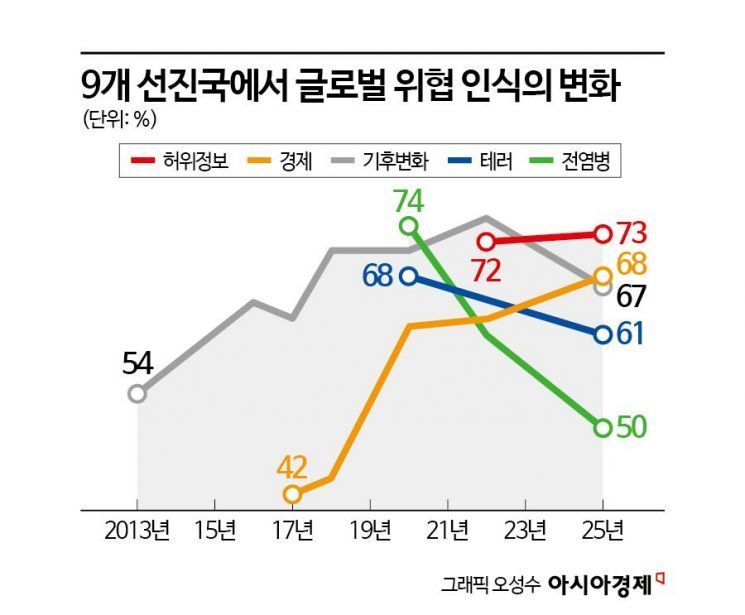
The percentage of respondents citing "terrorism" as a major threat declined from 68% in 2020 to 61% in 2025. In four countries-India, Israel, Nigeria, and Turkey-"terrorism" was identified as the greatest threat among the five issues surveyed. In particular, concern about terrorism in Israel far outweighed all other issues. Among Jewish Israelis, 96% regarded terrorism as a major threat, compared to 61% of Arab Israelis. This survey was conducted about a year and a half after the Hamas attack on Israel on October 7, 2023.
Middle-income countries were more likely to perceive "terrorism" as a major threat than high-income countries, with rates of 79% and 60%, respectively. Additionally, concern about terrorism tended to be higher among older adults, those with lower levels of education, those with right-wing ideological leanings, and especially among supporters of right-wing populist parties.
The proportion of respondents citing "climate change" as a major threat, which once exceeded 70%, fell to 67% in 2025, making it a slightly lower priority than the "global economic situation." In no surveyed country was "climate change" identified as the single greatest threat. However, overall concern about "climate change" has increased in both advanced and middle-income countries compared to 2013. The proportion of respondents viewing it as a major threat rose significantly in France (+24 percentage points), Turkey (+23 points), Mexico (+22 points), the United Kingdom (+18 points), Kenya (+15 points), Nigeria (+13 points), Israel (+12 points), Australia (+11 points), the United States (+11 points), Germany (+11 points), and Poland (+10 points). As in previous surveys, respondents with left-leaning ideologies expressed greater concern about "climate change" than those with right-leaning views.
In the nine major countries, the proportion of respondents identifying "infectious diseases" as a major threat reached 74% during the COVID-19 pandemic in 2020, but dropped to 50% in 2025. Just a few years after the COVID-19 pandemic, 60% of adults across 25 countries viewed the spread of infectious diseases as a major threat, while 30% saw it as a minor threat, and 5% said it was not a threat.
In three countries-Argentina, Brazil, and South Africa-infectious diseases were identified as the greatest threat among the five issues surveyed. In Kenya (88%), Turkey (87%), Indonesia (86%), and Mexico (82%), more than 8 out of 10 adults regarded infectious diseases as a major threat.
Overall, respondents in middle-income countries tended to be more concerned about the spread of infectious diseases than those in advanced economies. In fact, in the nine advanced economies where the survey has been conducted continuously since the COVID-19 pandemic, the proportion viewing infectious diseases as a major threat steadily declined from 74% in 2020 to 61% in 2022, and then to 50% in 2025.
© The Asia Business Daily(www.asiae.co.kr). All rights reserved.
!["The Woman Who Threw Herself into the Water Clutching a Stolen Dior Bag"...A Grotesque Success Story That Shakes the Korean Psyche [Slate]](https://cwcontent.asiae.co.kr/asiaresize/183/2026021902243444107_1771435474.jpg)


















