Over 56,000 counterfeit K-beauty products hidden in a warehouse on the outskirts of Guangdong Province, China, have been uncovered. This was the result of a crackdown last year by employees of the intellectual property (IP) enforcement agency 'IP SPACE' and local Chinese police. The seized counterfeit goods from this warehouse are valued at approximately 1 billion won. Due to the large volume, it took the small enforcement team a full two days to clear out the warehouse.
China is considered a major production hub for counterfeit goods. Among these, K-beauty products have recently been identified as the most frequently seized counterfeit items. Field enforcement officials consistently report that warehouses stockpiling tens of billions of won worth of counterfeit K-beauty products are now commonly found in China.
Counterfeit K-beauty products manufactured in China are often shipped to Southeast Asia, the United States, and the Middle East. This explains why K-beauty products are available on Southeast Asian e-commerce platforms such as Lazada and Shopee, where Korean brands have no official presence.
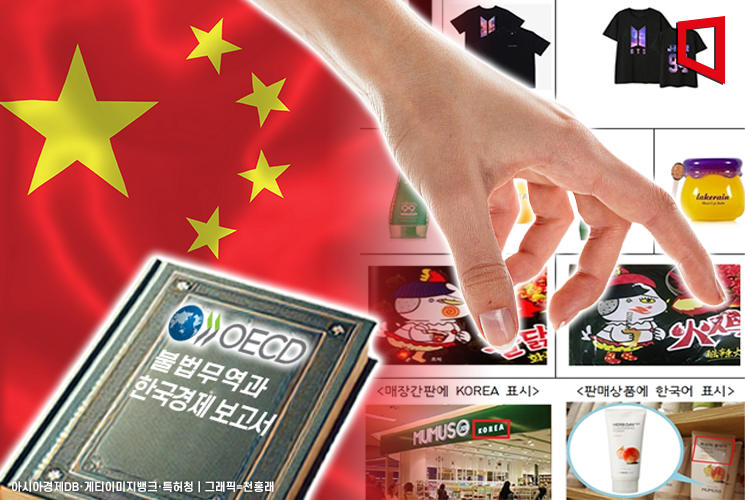
Since its launch in 2021, the Intellectual Property Office's "Overseas Online Counterfeit Product Remote Monitoring Team" has detected and blocked over 144,000 online listings for counterfeit products, including K-beauty, in just five months (with the total estimated damage prevention effect at 426.3 billion won). Among the products listed in the detected posts, K-pop merchandise, fashion accessories, and cosmetics accounted for nearly 70%. Continuing these efforts, the Intellectual Property Office, through the remote monitoring team and other initiatives, identified and blocked a total of 142,976 counterfeit K-beauty product listings from 2021 to last year. This represents 13.4% of the total 1,063,055 counterfeit product listings detected and blocked during the same period.
Recently, the surge in the Korean Wave, including K-pop, has led to an even greater proliferation of counterfeit K-products. As this trend undermines the Korean Wave, the government is activating a pan-governmental public-private partnership system to curb such opportunistic activities.
On the 23rd, the Intellectual Property Office held a meeting of the "Counterfeit Cosmetics Response Agency Council" with the Ministry of Food and Drug Safety, the Korea Customs Service, and the Korea Cosmetics Association. The participants agreed to strengthen cooperation between the government and the private sector to prevent damage to companies and consumers resulting from the distribution of counterfeit K-beauty products.
This meeting was organized as part of the "Measures to Enhance the Safety and Quality Competitiveness of K-beauty," which was announced at the 6th National Policy Coordination Meeting chaired by the Prime Minister in November last year. The aim is to protect the IP of K-beauty products, which are enjoying global popularity, and to prevent damage caused by the distribution of counterfeit cosmetics.
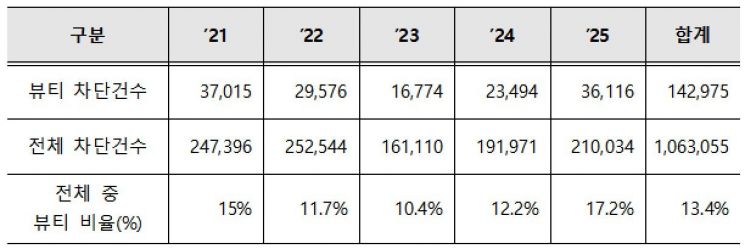 Status of Blocking Overseas Online Listings of Counterfeit K-Beauty Products. Provided by the Intellectual Property Office
As of last year, the total trade volume of counterfeit goods infringing on Korean companies' IP rights was 11.1 trillion won. Of this, counterfeit cosmetics accounted for 1.1 trillion won, representing 10% of the total.
Given the continued export boom, with exports of genuine K-beauty products rising from 8.46 billion dollars in 2023 to 11.43 billion dollars last year, there are concerns that the distribution of counterfeit goods will undermine consumer trust in K-beauty and negatively impact both the country and businesses.
In response, during the meeting, the Intellectual Property Office and participating agencies and associations agreed to cooperate on the following: monitoring the overseas distribution of counterfeit cosmetics; introducing anti-counterfeiting technologies and expanding IP dispute doctor training for K-beauty; blocking counterfeit cosmetics through customs-stage information analysis and strengthening cooperation with customs authorities in major overseas countries; and intensifying crackdowns on domestic distribution of counterfeit cosmetics and consumer protection measures. They also emphasized the need to sign a business agreement to solidify and establish a long-term pan-governmental public-private cooperation system.
Park Jin-hwan, Director General of the Intellectual Property Dispute Response Bureau, stated, "Protecting K-brands is not just about securing rights, but is directly linked to overseas expansion and strengthening the competitiveness of K-beauty companies. The Intellectual Property Office will continue to work closely with relevant agencies such as the Ministry of Food and Drug Safety and the Korea Customs Service, as well as with the private sector, to further enhance customized support for companies and local responses."
© The Asia Business Daily(www.asiae.co.kr). All rights reserved.


















