Record Number of Construction Firm Closures for Two Consecutive Years
No Breakthrough in Sight for the Industry
Government Roundtable Meeting Announced
The prolonged slump in the construction industry has broken historical records, weighing heavily on the South Korean economy. Construction output (completed work) has declined for 19 consecutive months, and employment has fallen for 20 consecutive months compared to the previous year. Experts predict that escaping this downturn will remain difficult throughout this year.
According to the Bank of Korea’s announcement on January 22, 2026, the real gross domestic product (GDP) growth rate for the fourth quarter of 2025 was -0.3%, with an annual growth rate of just 1.0%. Construction investment in the fourth quarter fell by 7.4% year-on-year, with both building and civil engineering sectors contracting by 3.9% compared to the same period the previous year. The Bank of Korea estimated that if construction investment had remained neutral, the annual growth rate would have reached 2.4%. In other words, the construction sector dragged down growth by nearly 1.4 percentage points.
The decline in project starts that began in 2022 is now being fully reflected in completed work, while high interest rates and strengthened regulations have extended construction periods, further slowing the pace of recovery. A representative from a major construction company stated, “After a rapid deterioration in business conditions due to high interest rates and rising costs (including raw materials, equipment operation, and labor), the situation has become entrenched.”
In fact, construction output (completed work) has decreased year-on-year for 19 consecutive months since May 2024, marking the longest decline on record. According to the Korea Research Institute for Construction Policy, the completed work amount in November 2025 was 11.6 trillion won, down 15.6% from the same month a year earlier and 3.1 trillion won lower than the three-year November average. The private sector was hit particularly hard. Cumulative private sector completed work in November 2025 totaled 104 trillion won, an 18.7% decrease from the same period the previous year.
The symbolic “2 million” construction jobs have also disappeared. According to the National Data Office’s recent “Employment Trends for December 2025 and the Year,” the annual number of people employed in construction last year was 1.94 million, a decrease of 125,000 (-6.1%) from the previous year. This is the largest drop since the industrial classification revision in 2013. On a monthly basis, employment has declined for 20 consecutive months through December 2025. Lee Ji-hye, a researcher at the Korea Research Institute for Construction Policy, said, “As the slump in completed work drags on, structural workforce adjustments are underway. If the outflow of skilled workers accelerates, even if the market recovers, there could be problems with productivity and safety.”
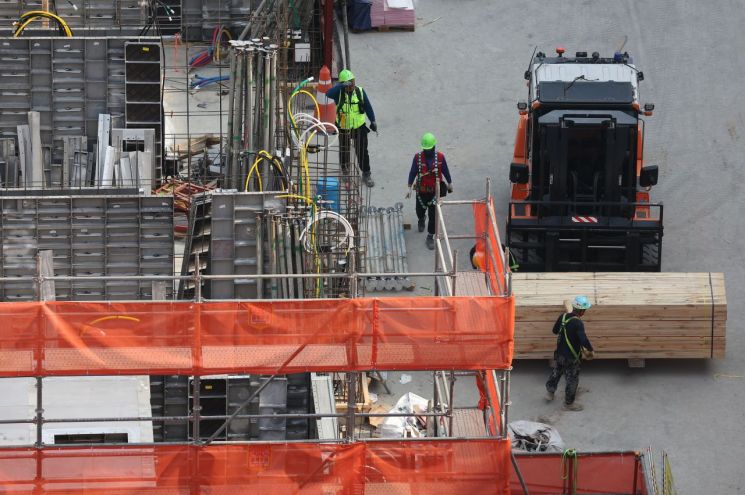
The number of construction companies closing their doors has set new records for two consecutive years. According to the Ministry of Land, Infrastructure and Transport’s Construction Industry Information System, there were 675 closures of general construction firms last year, surpassing the previous record of 641 in 2024, the highest since statistics began in 2005.
Order performance, as of the cumulative total for November 2025, was 181.7 trillion won, a decrease of only 1.8% from the same period the previous year. Public sector orders fell by 26.8% year-on-year, while private housing orders increased by 29.6%, offsetting the decline. However, the increase in orders was concentrated in redevelopment and reconstruction projects, and recovery in public and civil engineering orders has been delayed.
The accumulation of “toxic unsold units,” where funds cannot be recovered, continues to grow. As of the end of November 2025, there were 68,794 unsold housing units, a 0.4% decrease from the previous month. However, unsold units after completion reached 29,166, a 3.9% increase from the previous month and the highest level since March 2012. Unsold units after completion represent inventory for which construction companies have already incurred costs but have not recovered funds, directly leading to financial burdens.
Major research institutes forecast that the construction market will see a slight rebound this year, but a full recovery will take time. The Korea Research Institute for Construction Policy and the Korea Construction Policy Research Institute project that construction investment will increase by about 2% year-on-year to approximately 270 trillion won. However, this is mainly a base effect following last year’s sharp decline (-8.8%), and when accounting for inflation, the real magnitude of recovery will be limited. While expanded public sector orders are expected to support the market, recovery in the private sector is likely to remain sluggish due to high interest rates and regulatory burdens.
Han Seung-gu, Chairman of the Construction Association of Korea, said, “Large construction companies are seeking opportunities overseas, but the vast majority of our 12,600 member firms do not have that capability. They are focused solely on the domestic market, but the amount of work is shrinking and interest burdens are growing.” Han added, “There is consensus that the construction industry is struggling, but there are significant differences in opinion on how to solve these issues. The government and the National Assembly should continue to create opportunities for dialogue to hear from the field and find common ground.” It is reported that Minister of Land, Infrastructure and Transport Kim Yoon-deok will soon meet with the construction industry to listen to their on-site challenges.
© The Asia Business Daily(www.asiae.co.kr). All rights reserved.

![Clutching a Stolen Dior Bag, Saying "I Hate Being Poor but Real"... The Grotesque Con of a "Human Knockoff" [Slate]](https://cwcontent.asiae.co.kr/asiaresize/183/2026021902243444107_1771435474.jpg)














