Gwangju-Jeonnam Education Integration Public Hearing for Education Community
Differences with Jeonnam over Personnel Exchanges and Joint School Districts
Calls for Removal of Special Provisions for Gifted Schools
Dissatisfaction with Top-Down and Rapid Integration Process
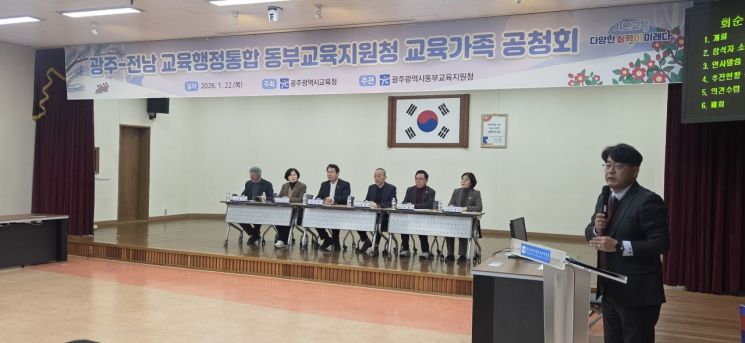 On the 22nd, the Gwangju-Jeonnam Education Administration Integration Family Public Hearing is being held at the Dongbu Office of Education. Photo by Min Chanki
At the first public hearing held to gather opinions from members of the education community regarding the proposed integration of the Gwangju and Jeonnam education systems, concerns were raised about potential negative effects such as job insecurity, the strengthening of privileged education, and the implementation of a joint school district system. Critics also pointed out that it is difficult to fully assess the specific advantages, disadvantages, and impacts of the education integration, as the process is being carried out in a top-down manner, with political circles determining the outcome in advance and only later seeking input from stakeholders.
On January 22, more than 100 participants-including Lee Jeongseon, Superintendent of Gwangju Metropolitan Office of Education, Choi Seungbok, Deputy Superintendent, parents, faculty, and education-focused civic groups-attended the public hearing for the integrated education administration of Gwangju and Jeonnam education families at the Dongbu Office of Education in Gwangju. The purpose of the hearing was to collect public feedback on the education integration being promoted alongside administrative integration.
During the hearing, it became apparent that there are differing opinions between the Gwangju and Jeonnam Offices of Education regarding the principle of assigning staff to work within their existing jurisdictions, which had been proposed as a measure to address job insecurity among faculty and staff in the early stages of the integration discussion.
The Gwangju Office of Education holds the position that the principle should be applied to all staff regardless of rank, while the Jeonnam Office of Education is reportedly suggesting that personnel exchanges should be allowed for certain senior positions, such as those at grade 4 or above and school principals.
Regarding special provisions that appear to strengthen privileged education, some voiced concerns that these amount to preferential treatment. One parent stated, "Any legislation that strengthens privileged education, such as for gifted schools and special-purpose high schools, should be removed. If the functions of privileged schools are enhanced, general schools will inevitably suffer in terms of curriculum and finances."
A teacher from the Gwangju Practical Education Teachers' Association also commented, "The special law for the administrative integration of Gwangju and Jeonnam has essentially copied the special laws for Jeju Special Self-Governing Province and Daejeon-Chungnam. As a result, the law allows for foreign admissions and transfers at gifted and special-purpose schools, which will strengthen the authority of these institutions. Furthermore, the law lacks provisions for strengthening democratic citizenship education. Legislation tailored to the local context is needed."
Superintendent Lee Jeongseon explained, "The provisions intended for inclusion in the special law are not about establishing privileged schools, but rather about transferring the authority to approve such schools from the Ministry of Education to the superintendent. Transferring this authority does not make it easier to establish privileged schools. In addition, social consensus is required to create such schools."
Concerns were also raised about the 'joint school district system' that could follow the education integration. One parent said, "In Gwangju, there are already many cases where students cannot attend schools in their residential area. Jeonnam authorities say they want to increase choice, but this will only further deteriorate the educational environment."
Superintendent Lee stated, "If the integration of school districts deviates from the principle of residential assignment, it may not align with the integration's goal of preventing regional decline. Gwangju may experience concentration, while Jeonnam may face further regional depopulation." He thus made clear his opposition to the joint school district system.
There was also dissatisfaction with the approach of having the political establishment take control first and then seeking input from the educational community. One teacher lamented, "They are pushing ahead with integration, which will affect education for the next hundred years, without any proper analysis or research. We do not fully understand the advantages, disadvantages, or impacts of education integration."
The teacher added, "Since the decision to integrate was made first and then opinions were gathered, the main response has been, 'Nothing has been decided yet,' repeated over and over. Although the current special law stipulates that staff should remain at their existing workplaces, laws can always change. This raises concerns about potential personnel lawsuits and conflicts."
Superintendent Lee concluded, "Currently, the education integration process involves establishing a framework and gradually filling in the details. Since there are aspects of the integration where some are excluded or their opinions are not reflected, we will listen to and incorporate the views of the education community."
© The Asia Business Daily(www.asiae.co.kr). All rights reserved.

















