Projection Committee: "Shortage of 2,530 to 4,800 Doctors Expected by 2037"
Civil Society and Medical Community Question Validity of Projections, Call for Fundamental System Reform
As discussions on medical school enrollment quotas after 2027 intensify, some argue that the entire increase in admissions should be subject to the regional doctor system in order to secure medical personnel for local and essential healthcare. Civil society and the medical community have questioned the reliability of physician workforce estimates and are calling for fundamental changes to the healthcare system.
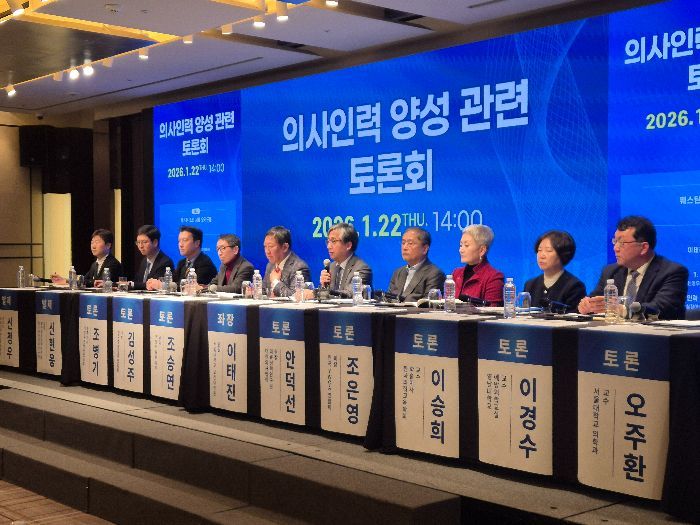 Panels attending the "Discussion on the Training of Medical Personnel" held by the Ministry of Health and Welfare on the 22nd at The Westin Chosun Seoul in Jung-gu, Seoul, are discussing the necessity of the regional doctor system and related topics. Photo by Choi Taewon
Shin Hyunwoong, Director of the Health and Medical Policy Research Division at the Korea Institute for Health and Social Affairs, spoke as a presenter at the "Discussion on the Training of Medical Personnel" held at The Westin Chosun Seoul in Jung-gu, Seoul, on the 22nd. He explained the necessity of the regional doctor system and argued, "Simply increasing the number of doctors will not resolve the current healthcare crisis."
According to the Korea Institute for Health and Social Affairs, about 28% of the country's doctors are currently working at medical institutions in Seoul. The number of doctors per 1,000 people is 3.6 in Seoul, but only 1.4 in Sejong and North Gyeongsang Province, highlighting the significant regional disparity.
As a result, the introduction of the regional doctor system is being discussed as an institutional measure to prevent the increased workforce from becoming concentrated in the Seoul metropolitan area. Students selected as regional doctors are required to serve in the designated region for 10 years after obtaining their medical license. If they fail to fulfill this obligation, the government may suspend or revoke their license.
In addition to the regional doctor system, Director Shin also proposed establishing a "public medical school" as a separate measure to train specialized personnel in public healthcare. This would operate as a four-year national graduate school of medicine, with a mandatory service period of 15 years. He also suggested establishing new regional medical schools to train local doctors.
Director Shin stated, "Increasing medical school admissions is only the beginning of securing local medical personnel; it is a long journey that spans from the first admissions to the placement of specialists and the eventual settlement of doctors in the region after their mandatory service ends." He added, "Co-evolution among the medical community, the government, and universities is necessary."
Shin Jungwoo, Director of the Center for Medical Workforce Supply and Demand Projections, presented physician workforce projections using statistical models. The analysis showed that, considering changes in the future healthcare environment and policy variables, there will be a shortage of at least 2,530 to as many as 4,800 doctors by 2037.
During the subsequent discussion, civic groups pointed out issues such as the lack of financial transparency and problems with the direction of the proposals. Cho Eunyoung, President of the Korea YWCA Federation, criticized, "There is a lack of fundamental diagnosis and social consensus on the value orientation of why the regional doctor system policy is needed," adding, "Introducing only stopgap measures without fundamental changes to the system is a gradual path to death." She further emphasized, "There is no analysis of the exact financial scale or cost-effectiveness for each proposed scenario, so the public is being forced to make decisions without sufficient information."
Kim Sungjoo, President of the Korea Alliance of Rare Disease Organizations, said, "For patients with serious illnesses, healthcare is not a matter of statistics but a desperate question of survival today. Discussing personnel who will only be deployed in ten years offers no solution for current patients." He urged, "Workforce policy must be completely redesigned with the patient's right to survival as the top priority."
The medical community raised doubts about the scientific validity of the workforce projections. Ahn Deokseon, Director of the Medical Policy Research Institute at the Korean Medical Association, stated, "Forecasts should serve as objective input values for policy formation, but this discussion was conducted in reverse, fitting the numbers to a predetermined increase in admissions."
Cho Seungyeon, Head of the Department of Surgery at Yeongwol Medical Center, highlighted the severe recruitment difficulties in local areas and warned, "A solution that simply increases numbers will be useless." He pointed out, "No matter how many doctors are trained, in the end, more will just go to Gangnam to remove moles and perform hair transplants. Without a complete overhaul of the fee system and management of non-insured services, doctors will not work in essential regional healthcare."
Lee Hyunghoon, Second Vice Minister of the Ministry of Health and Welfare, who attended the discussion, said, "I do not believe that determining the size of the physician workforce is the solution to all problems," promising, "We will prepare comprehensive healthcare innovation measures to overcome the crisis in regional and essential healthcare and enhance sustainability."
© The Asia Business Daily(www.asiae.co.kr). All rights reserved.

















