China Defines Itself as a "Near-Arctic State"
CNN: "Trump's Security Concerns Grow"
As U.S. President Donald Trump and NATO Secretary General Mark Rutte agreed to discuss ways to block Russia and China from expanding their influence into the Arctic, including Greenland, attention is focusing on the actual influence Russia and China wield in the Arctic region.
Currently, nearly half of the military bases established in the Arctic are Russian, which has led to reports that the United States is at an overall disadvantage in the region.
On January 21 (local time), CNN reported, "President Trump's demand that the United States take over Greenland has left the world bewildered," but also noted that "competition over the Arctic has already been ongoing for decades."
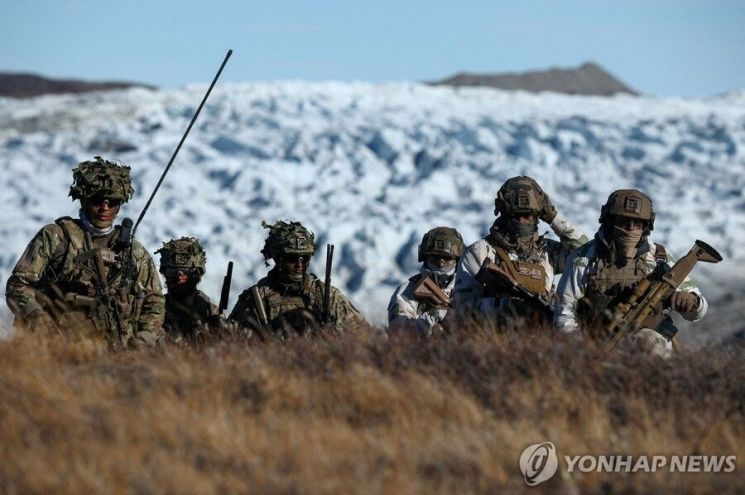
As the Arctic ice rapidly melts, countries are competing to secure the vast natural resources that will be exposed and to control the Arctic sea route, which is the shortest shipping route.
So far, the country that has been most proactive in seizing dominance in the Arctic is Russia. Of the 66 military bases in the Arctic Circle, 30 are Russian military facilities. The remaining 36 are North Atlantic Treaty Organization (NATO) bases, but on a country-by-country basis, the United States has 8 and Canada has 9, falling short of Russia's presence. This has led some to analyze that President Trump’s desire to annex Greenland has grown as a result.
CNN reported, "There is no doubt that Russia has exercised dominant influence in the Arctic," and noted that Russia has made massive investments to expand its military power in the region.

According to an analysis by the Royal United Services Institute (RUSI) in the United Kingdom, the Russian military has invested heavily in modernizing its nuclear-powered submarine fleet in the Arctic Circle. On January 21, Russian analysis outlet Riddle Russia also stated, "Since the Cold War, the Arctic has been a strategic stronghold for Moscow," and emphasized, "Both then and now, the U.S. and Russian militaries have focused on the fact that the shortest route for surface ships and nuclear submarines passes through the North Pole."
CNN interpreted, "At one time, there were attempts at security cooperation between Russia and the West, but with Sweden's accession to NATO in 2024, the Arctic has been split in half, with one half controlled by Russia and the other by NATO."
China has also been openly expressing its ambitions to expand into the Arctic. In its "White Paper on Arctic Policy" released in 2018, China defined itself as a "near-Arctic state."
China has included the Arctic in its Belt and Road Initiative, planning to develop resources and pioneer new shipping routes. It also operates icebreakers equipped with Arctic observation satellite equipment and has established and operates Arctic science bases in Iceland and Norway, conducting various research projects. In 2024, China began joint Arctic patrols with Russia as well.
© The Asia Business Daily(www.asiae.co.kr). All rights reserved.
![Clutching a Stolen Dior Bag, Saying "I Hate Being Poor but Real"... The Grotesque Con of a "Human Knockoff" [Slate]](https://cwcontent.asiae.co.kr/asiaresize/183/2026021902243444107_1771435474.jpg)

















