Only Institutions Were Net Buyers Last Year... Retail Investors Remained Skeptical of Domestic Market
Semiconductor Rally Fueled by AI Boom
Efforts to Resolve the "Korea Discount" Viewed Positively
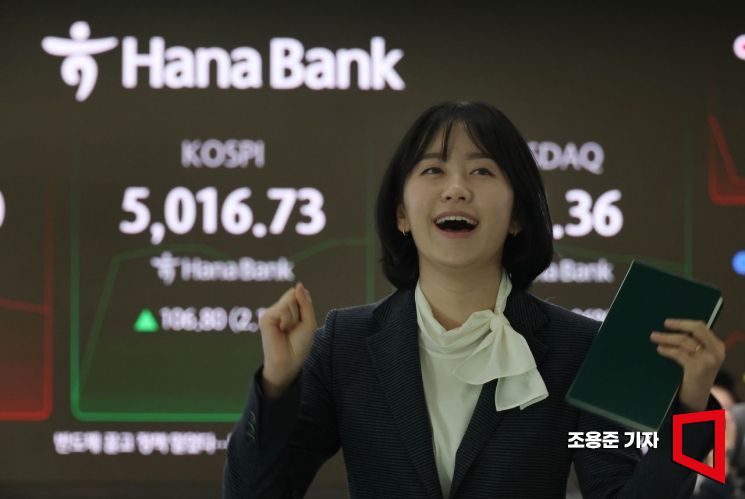 On the 22nd, when the KOSPI surpassed the dream index of 5000, employees at the Hana Bank dealing room in Jung-gu, Seoul, are seen clapping joyfully. January 22, 2026. Photo by Jo Yongjun
Foreign media outlets have pointed out that although the KOSPI index surpassed the 5000 mark for the first time ever, individual investors have been left out of the rally, highlighting this as a limitation. Concerns have also been raised that if institutional investors, who have led the KOSPI's upward trend since last year, start to realize profits in the future, market volatility could surge sharply in the short term.
On the 21st (local time), the Financial Times (FT), Bloomberg News, and others offered this analysis regarding the KOSPI's breakthrough of the 5000 mark.
Bloomberg News noted that the current rally is largely driven by buying from a relatively small group of institutional investors, making the market vulnerable to a sudden shift if there is a wave of profit-taking. The report also analyzed that the investment sentiment among Korean individual investors is much more subdued compared to the boom in 2021. It assessed that Korean retail investors still have a strong preference for U.S. stocks.
The Financial Times also highlighted that many individual investors have been excluded from the current rally, pointing out that Korean retail investors were net sellers in the domestic market last year. Many of these individual investors, often referred to as "Seohak Ants," participated in the trend of investing in overseas stocks last year.
In fact, according to the Korea Exchange, during the past year (from January 2 to December 30, 2025), institutional investors made net purchases of 20 trillion won in the KOSPI market, while individuals and foreigners were net sellers of 26 trillion won and 5 trillion won, respectively.
There is also a skeptical view that the KOSPI's strength may not spread throughout the real economy. Freelance photographer Kim Geumhee told the Financial Times, "I don't think the KOSPI surpassing 5000 is particularly meaningful," adding, "This does not mean the Korean economy is booming." The Bank of Korea recently reported that real GDP growth in the fourth quarter of last year shrank by 0.3% compared to the previous quarter. The year-on-year growth rate was 1.0%.
Foreign media cited the semiconductor rally driven by the artificial intelligence (AI) boom and efforts to reform the capital market as the background for the stock market's surge. Bloomberg News stated that large-cap stocks such as Samsung Electronics, SK Hynix, and Hyundai Motor led the index's rise, analyzing that this rally demonstrates the Korean stock market's transformation from a cyclical, export-driven market to a key beneficiary of the global AI boom. The report also noted that the so-called "Korea Discount," referring to the chronic undervaluation of the Korean stock market, is gradually being resolved.
The Financial Times pointed out that President Lee Jaemyung's "capital market advancement" measures are another factor behind the KOSPI's breakthrough of 5000. The president and the ruling party amended the Commercial Act twice in July and September last year to strengthen shareholder rights and improve opaque corporate governance. They are currently pursuing a third amendment to the Commercial Act, which includes making treasury share cancellation mandatory.
Jonathan Pines, Head of Asia Equities at the U.S.-based asset management firm Federated Hermes, said in an interview with the Financial Times, "The Korean government is addressing the main causes of the Korea Discount," adding, "The current stock price rise is based on sound fundamentals, and the flow of news entering the market is also positive."
© The Asia Business Daily(www.asiae.co.kr). All rights reserved.

















