Emergency Forum Held at Jeonil Building
Proposal for a Three-Tier Local Governance System
Warning Against Abuse of Special Provisions for Local Bond Issuance
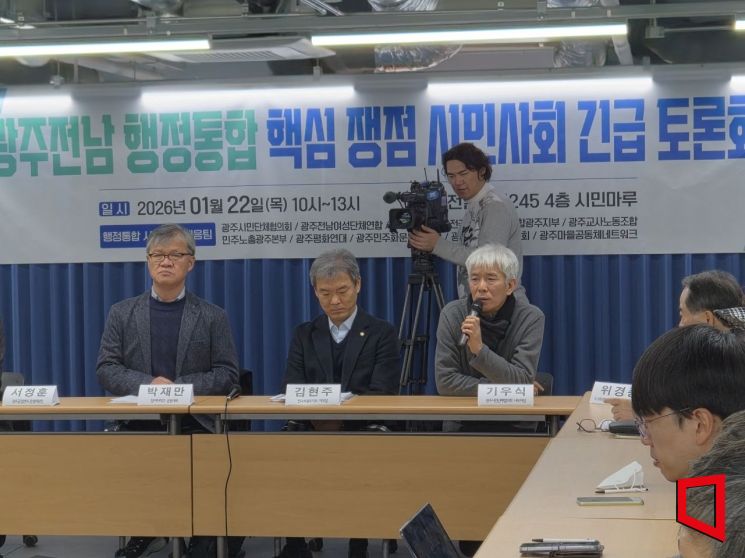 The Administrative Integration Civil Society Response Team, formed by civic groups in the Gwangju area, held an emergency discussion on the key issues of the Gwangju-Jeonnam administrative integration on the morning of the 22nd at Jeonil Building 245 in Dong-gu, Gwangju. Photo by Min Hyunki
As discussions on the administrative integration of Gwangju and Jeonnam accelerate, civic groups have voiced concerns about the potential loss of the "Gwangju" city brand and the erosion of fiscal and educational autonomy, calling for countermeasures.
On the 22nd, the "Administrative Integration Civil Society Response Team," composed of 10 civic organizations from the Gwangju area, held an "Emergency Civil Society Forum on Key Issues of Gwangju-Jeonnam Administrative Integration" at Jeonil Building 245 in Dong-gu, Gwangju.
During the forum, sharp criticisms were raised regarding major issues such as preserving Gwangju's identity during the integration process, ensuring fairness in resource allocation, and guaranteeing educational autonomy.
Ki Woosik, Secretary General of the Gwangju Civic Organizations Council, who served as a presenter, pointed out, "There are concerns that the meaning of 'Gwangju,' a symbol of the democratization movement, may be diminished during discussions about the name of the integrated special city."
Secretary General Ki suggested, "We need to reconsider whether the essence of integration is the dismantling of Gwangju or the redesign of local autonomy. Rather than dismantling an already existing major city, we should consider amending the Local Autonomy Act to implement a three-tier local governance system consisting of 'Gwangju-Jeonnam Special Province - Gwangju City - five autonomous districts.'"
Concerns about fiscal integration were also strongly voiced. Cho Jinsang, Professor Emeritus at Dongshin University, pointed out the ambiguity of the balanced development fund provision in the special law on city-province integration.
Professor Cho argued, "Although the draft special law provides a basis for creating the fund, it lacks specific methods for raising and distributing resources, which could lead to controversy. Clear principles should be established, such as specifying a certain percentage of local taxes." He also recommended deleting the special provision easing the limit on local bond issuance, stating, "In a region dominated by a single political party, this could lead to lax fiscal management."
In the field of education, criticism was raised that the value of balanced regional development was not properly reflected.
Kim Hyunju, head of the Gwangju branch of the Korean Teachers and Education Workers Union, criticized, "The special bill focuses only on special provisions such as establishing gifted schools, but fails to include measures to strengthen public education, such as support for general schools in the region or reducing overcrowded classes." She further emphasized, "A discussion body at the Gwangju-Jeonnam level is essential to reflect the opinions of education stakeholders and citizens in the process of enacting education-related ordinances."
© The Asia Business Daily(www.asiae.co.kr). All rights reserved.

















