Only Food Trucks Everywhere...
Criticism Over Lack of Distinctiveness
Min Kyungmae Stresses Need to Target External Tourists and Increase Youth Participation
Although the number of visitors to Haenam County's representative festivals in South Jeolla Province has been increasing, there have been criticisms that it is difficult to find what makes them uniquely "Haenam." The festivals have been described as lacking distinctiveness, with a monotonous composition that has changed little over the past 10 years-featuring similar setups such as local product stalls, performance stages, tasting corners, and food trucks.
Haenam County organizes major festivals such as the Minam Festival and the Myeongnyang Battle Festival. In particular, the Myeongnyang Battle Festival is hosted by South Jeolla Province, but both Haenam County and Jindo County invest in the event's budget. However, visitors have responded that "every festival feels the same, no matter which one you attend."
Mr. A, who runs a restaurant in Haenam, pointed out, "The festival is no different now than it was 10 years ago-there is nothing special about it," adding, "It could be held anywhere; it doesn't have to be in Haenam."
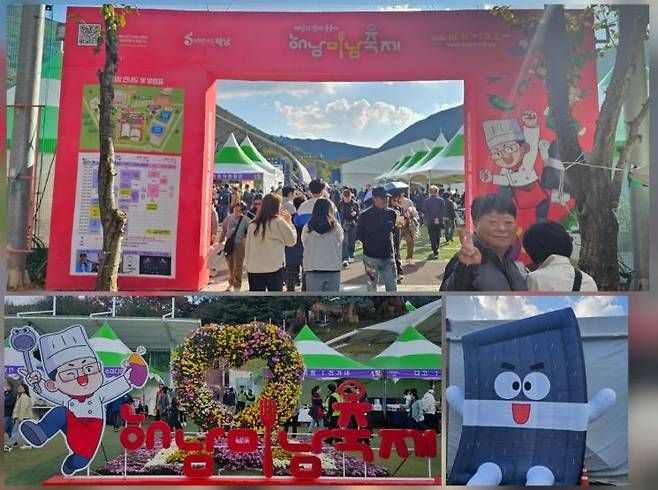 There have been criticisms that the representative festivals of Haenam County lack distinctiveness as they remain the same as they were 10 years ago. Photo by Lee Jungkyung
Local residents see the biggest problem with Haenam's festivals as a "lack of identity." They note that instead of booths featuring Haenam's unique ingredients or dishes, there are mostly generic food stalls that could be found anywhere, leaving "nothing particularly memorable." There is a consensus that the festivals lack killer content that would set them apart from other local agricultural and fisheries product festivals.
An even bigger issue is the prevalence of "day trips." Mr. B, who operates an accommodation near the festival site, said, "Even during the festival period, reservations are not much different from usual," and explained, "Most people come during the day and leave before evening." This means the festivals are not effectively contributing to the local economy.
There are also concerns about how the festivals are managed. One booth operator said, "We were simply notified by the local government to participate," adding, "We have little to no opportunity to plan or make suggestions." Critics argue that an administration-led approach, rather than a resident-led one, undermines the vitality of the festivals.
Haenam is geographically located at the "land’s end," making it relatively inaccessible, and issues such as traffic congestion and lack of parking during large-scale festivals continue to recur. There are also insufficient structural mechanisms to ensure that the economic benefits of the festivals are distributed evenly among all residents.
Mr. C, who runs a store in the town, remarked, "People only flock here during the festival, and it becomes quiet again once it's over," and pointed out, "We need programs that can attract visitors throughout the year."
In contrast, the Sancheoneo Festival in Hwacheon, Gangwon Province operates for 24 days and accepts only about 3,000 visitors per day through a reservation system. With cultural events, food offerings, and programs linked to the Hwacheon town center, the festival draws hundreds of thousands of visitors. The Gimcheon Gimbap Festival and the Wonju Dumpling Festival have also been recognized for successfully differentiating themselves by focusing on local specialties.
Local residents advise that Haenam County should conduct satisfaction analyses through professional festival evaluation agencies, develop storytelling elements such as an "Admiral Yi Sun-sin Table" based on the records of Admiral Yi Sun-sin, and expand SNS-friendly experiential events.
In response, County Assemblyman Min Kyungmae has called for a fundamental overhaul of Haenam's festivals. Assemblyman Min stated, "While promoting community harmony is important, if we are concerned about population decline and regional extinction, the role of festivals must go beyond that," and pointed out, "If it is not clear who the festival is for, tourists will not come."
He continued, "Festivals that last only a day or two have limitations in increasing both tourist and resident populations," and emphasized, "Even small-scale festivals should develop programs closely tied to daily life, such as making soybean paste, preparing kimchi, using local restaurants, and visiting cultural heritage sites on weekends."
As specific improvement measures, Assemblyman Min suggested: clearly targeting external tourists for the festivals; extending the festival period to at least a week, including weekends; strengthening the linkage between festivals and tourism resources; and introducing festivals planned and participated in by young people.
Regarding youth participation, he said, "Instead of inviting young people to government-planned festivals, local and external youth should jointly plan and operate them," and explained, "This could create a virtuous cycle where young people are attracted to Haenam and, in turn, help promote it."
He concluded, "A successful local festival is not just about attracting people, but also about making them stay and want to return," and added, "Haenam County, the County Council, and residents must pool their wisdom to transform the festivals into ones that expand the local population and contribute to the regional economy."
© The Asia Business Daily(www.asiae.co.kr). All rights reserved.

















