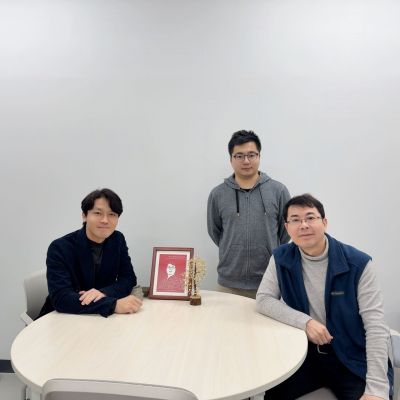
 Professor Won Yong Choi and Professor Myunghwan Oh's research team at Korea Energy Engineering University, Department of Energy Engineering.
Korea Energy Engineering University (KENTECH) announced on January 22 that it has developed a new electrochemical electrode system capable of simultaneously capturing and converting diluted carbon dioxide within a single electrode structure. This research demonstrates that conversion reactions are possible without a separate separation process, even in low-concentration carbon dioxide environments such as industrial exhaust gases.
Although carbon dioxide in the atmosphere is identified as a major cause of climate change, carbon dioxide emitted from industrial sites is often present in a diluted form, mixed with other gases such as nitrogen and oxygen. This has posed technical limitations to the efficient capture and conversion of carbon dioxide.
The research team led by Professor Won Yong Choi and Professor Myunghwan Oh at the Department of Energy Engineering, KENTECH, designed an electrode structure that enables carbon dioxide capture and electrochemical conversion to occur consecutively within a single electrode.
The electrode developed by the research team consists of a porous carbon layer that selectively captures carbon dioxide, a tin oxide catalyst layer that converts carbon dioxide into formic acid, and a carbon paper layer responsible for gas diffusion and electron transfer. Through this design, carbon dioxide separation and chemical conversion can occur consecutively within a single electrode. Formic acid, which is relatively easy to store and handle in liquid form, is significant in that it allows carbon dioxide to be converted into a more usable chemical substance.
Professor Myunghwan Oh stated, "We have proposed the design principle for how the three layers should be arranged and what roles they should play," adding, "This demonstrates an electrode structure optimized for the electrochemical reaction in which gaseous carbon dioxide is converted into liquid formic acid."
Experimental results showed that the electrode stably produced formic acid even under simulated exhaust gas conditions composed of 15% carbon dioxide, 8% oxygen, and 77% nitrogen, and was also capable of reacting at low carbon dioxide concentrations of around 400 ppm.
The research team conducted molecular dynamics simulations and theoretical calculations alongside experiments to analyze the movement and adsorption behavior of carbon dioxide and oxygen within the electrode. During this process, Jaeyeon Yang, a fourth-year undergraduate student at the Department of Energy Engineering, KENTECH, played a key role in performing the molecular dynamics calculations and contributed to the results through undergraduate research participation.
Professor Won Yong Choi explained, "This research demonstrates that carbon capture and conversion do not necessarily have to be separate processes," and added, "We have presented a simple carbon dioxide utilization pathway that can operate even in real exhaust gas environments."
First author Donglai Pan, a researcher, commented, "Our results show that carbon capture and conversion can be integrated into a single electrode platform," and added, "By expanding the design of catalysts and carbon materials in the future, this approach could be applied to various carbon conversion reactions."
The research team expects that this achievement could develop into a carbon reduction technology applicable not only to large-scale plants but also to small industrial facilities and distributed emission sources.
This research was supported by the Leader Researcher Support Program of the National Research Foundation of Korea. The results were published in the international journal ACS Energy Letters. The American Chemical Society (ACS) selected this study as a noteworthy achievement and introduced it through an official press release.
© The Asia Business Daily(www.asiae.co.kr). All rights reserved.
![Clutching a Stolen Dior Bag, Saying "I Hate Being Poor but Real"... The Grotesque Con of a "Human Knockoff" [Slate]](https://cwcontent.asiae.co.kr/asiaresize/183/2026021902243444107_1771435474.jpg)
















