CEPI Provides $30 Million in Funding for MSD's Vaccine Development Project
SK Bioscience is accelerating the development of a next-generation Ebola vaccine with funding support from the Coalition for Epidemic Preparedness Innovations (CEPI).
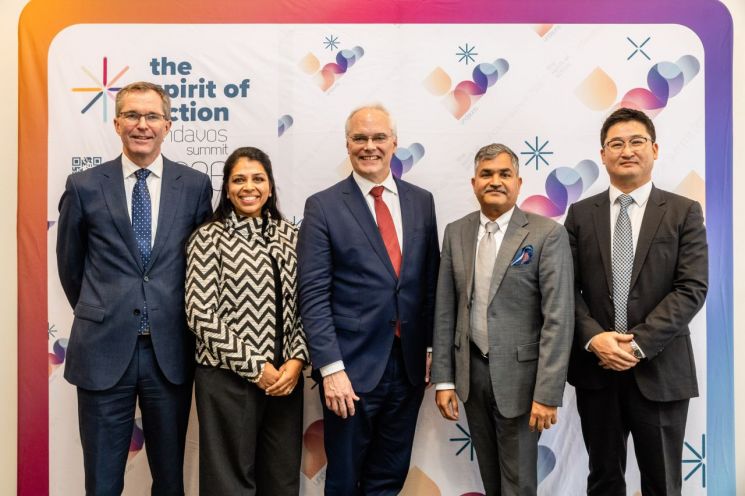 (From left) John Arne Rottingen, CEO of Wellcome Trust; Priya Agrawal, Vice President of Health Equity & Partnerships at MSD; Richard Hatchett, CEO of CEPI; Raman Rao, CEO of the Heileman Institute; and Kim Ikjung, Head of BD2 at SK Bioscience, are posing for a commemorative photo after presenting on next-generation Zaire Ebola vaccine development funding and collaboration at the World Economic Forum (WEF) held in Davos, Switzerland, on the 21st. SK Bioscience
On January 22, SK Bioscience announced that, following the signing of a funding agreement between global pharmaceutical company Merck (MSD) and CEPI for the development of a Zaire Ebola virus vaccine, it will receive financial support for key projects it is undertaking as a development partner. Under this agreement, CEPI will provide a total of 30 million dollars to MSD, and MSD will use these funds to support the costs of core projects entrusted to SK Bioscience and the Heileman Institute, including research and development (R&D), manufacturing process improvements, and the development of clinical trial vaccines.
This project was initiated to address the complexity of the existing manufacturing process for MSD’s Zaire Ebola vaccine and its requirement for ultra-cold storage. In particular, considering the frequent outbreaks of Zaire Ebola in regions with vulnerable healthcare and logistics infrastructure, the goal is to enhance supply stability and accessibility by developing a manufacturing process that increases vaccine yield and improves thermal stability.
Through this collaboration, the Heileman Institute will lead the clinical development of the improved Ebola vaccine, while SK Bioscience and IDT Biologika will be responsible for the upgraded bulk manufacturing process and the related finished product development.
SK Bioscience plans to leverage its accumulated process and production capabilities at its own vaccine manufacturing facility, Andong L HOUSE, and collaborate with its subsidiary IDT Biologika to carry out clinical vaccine production and the advancement of manufacturing processes.
The Zaire Ebola virus is a high-risk infectious disease with a survival rate of only 50% upon infection. Recently, cases of re-emergence have been reported in some African regions, including the Democratic Republic of Congo (DRC), raising international awareness. In particular, in areas with insufficient healthcare infrastructure, rapid response is difficult, resulting in severe harm to women, children, and vulnerable populations. Therefore, the stable supply of vaccines has become a critical humanitarian issue.
Richard Hatchett, CEO of CEPI, stated, “With CEPI’s support, MSD’s Zaire Ebola virus vaccine will be able to be supplied more stably and sustainably at a more reasonable price over the coming years. Based on our longstanding partnership, CEPI will contribute to saving more lives by strengthening global response capabilities against deadly infectious diseases.”
SK Bioscience CEO Ahn Jaeyong said, “Global cooperation is essential in responding to deadly infectious diseases such as Ebola. Based on CEPI’s funding, SK Bioscience will play a pivotal role in vaccine development and production with global partners, making a tangible contribution to public health worldwide.”
© The Asia Business Daily(www.asiae.co.kr). All rights reserved.

















