Jamsil Woosung 1, 2, and 3 Facing Sunset Deadlines
Delays in Maintenance Plan Change Procedures
Associations Seek to Shorten Timelines with Integrated Review
"Additional Extensions to the Sunset Clause Needed"
The risk of expiration for redevelopment and reconstruction zones in Seoul, such as Jamsil Woosung and Yongsan Maintenance Depot, is once again coming to the forefront. Although these projects previously avoided dissolution through deadline extensions, the expiration dates are approaching again, increasing the pressure to lift the zone designations. There are concerns that if the number of projects subject to the sunset clause increases, it could negatively impact the private sector-led housing supply.
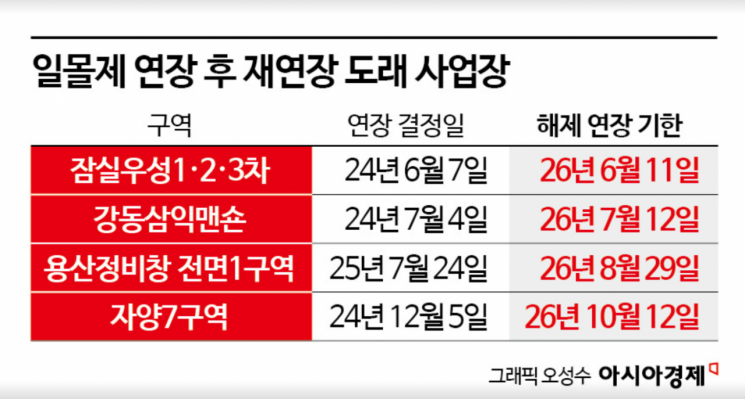
According to the industry on January 25, there are a total of 34 redevelopment and reconstruction projects in Seoul that have already received a one-time extension related to the sunset clause for maintenance zones. Among these, four projects will see their extended deadlines expire this year. For the Jamsil Woosung 1, 2, and 3 complexes and the Gangdong Samik Mansion, both reconstruction projects, the extensions will expire on June 11 and July 12, respectively. The first zone of the Yongsan Maintenance Depot, where construction costs reach 1 trillion won, faces its deadline on August 29, while the Jayang 7 District in Gwangjin-gu will reach its deadline on October 12.
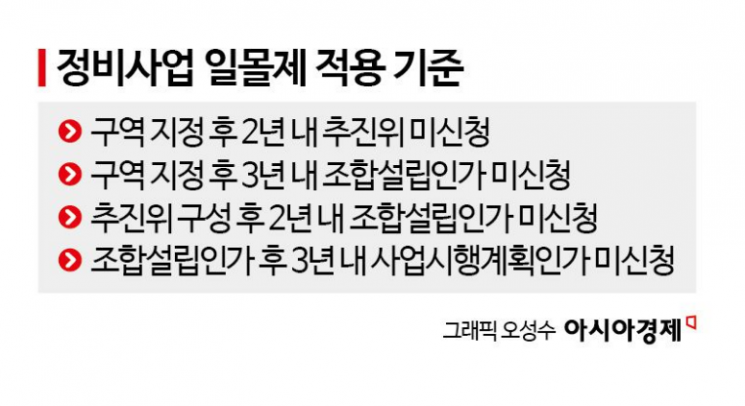
The maintenance zone sunset clause is a system that lifts the designation of a zone if redevelopment does not proceed within a certain period. It was introduced to prevent conflicts within associations and the expansion of sunk costs due to project delays. If an association fails to apply for establishment approval within three years of zone designation, or fails to apply for project implementation approval within three years after establishing the association, the sunset clause applies. However, with the consent of association members, a one-time extension of up to two years is possible.
Interest in the extension of these four projects is high because they have already received a one-time extension in 2024 or last year, making further extensions uncertain. Although the current Urban Maintenance Act does not explicitly limit the number of extensions, the Ministry of Government Legislation issued an authoritative interpretation in 2020 stating that "an extension of the maintenance zone is limited to one time only."
To avoid the sunset deadlines, these projects are accelerating their progress. Three zones, including Jayang 7 District in Gwangjin-gu, have recently made progress by selecting top-tier construction companies as contractors. However, due to the need for integrated development or to supplement business feasibility, changes to the maintenance plans have become inevitable, making the schedules even tighter.
The Jayang 7 District is at risk of missing the sunset deadline as it must go through the process of changing its maintenance plan in accordance with Gwangjin-gu's integrated development policy. Initially, the Gwangjin-gu Office proposed applying for project implementation approval with the existing plan, but the association chose to shorten the period by utilizing Seoul City's integrated review system. The Gangdong Samik Mansion project was delayed in applying for project implementation approval due to a land division lawsuit concerning the exclusion of one building. The association plans to apply for a change in the maintenance plan next month after completing the registration and division of land parcels. The first zone of the Yongsan Maintenance Depot plans to apply for project implementation approval with the existing plan in March. After avoiding the sunset clause, they intend to pursue another change to the maintenance plan based on the assumption of an upgrade to a higher commercial zoning for the entire area.
Such detour procedures are causing unintended side effects, such as lengthening the overall project period. An official from the association of the first zone of the Yongsan Maintenance Depot stated, "After applying for project implementation approval with the existing plan, we will have to go through another round of general meetings and resolutions with the revised plan. If we had started the process of changing the maintenance plan from the beginning, we estimate that we could have shortened the timeline by at least two years."
The Seoul Metropolitan Government has stated that it will not immediately lift the maintenance zone designation just because the sunset deadline has arrived. Considering the confusion at the sites, the city plans to make comprehensive judgments based on the progress of each association's project. In response to a recent inquiry from an association member about whether the maintenance zone is automatically lifted when the sunset deadline expires, the city replied, "The expiration of the sunset deadline does not automatically trigger dissolution. It is reasonable to make a decision after comprehensively reviewing the status of the redevelopment project and the conditions of the zone."
However, industry experts argue that rather than relying on individual decisions by local governments, the overall system of the maintenance zone sunset clause needs to be revised. As long as the authoritative interpretation by the Ministry of Government Legislation remains in effect, the risk of dissolution could re-emerge at any time depending on changes in administrative policy.
Kim Jaekyung, Director of Toomee Real Estate Consulting, emphasized, "There are a significant number of associations that cannot apply for project implementation approval within three years after establishment due to rejections or requests for supplementation during the approval process. Since the sunset deadline could put pressure on associations and lead to inefficient decision-making, it is necessary to revise the regulations to allow for multiple additional extension applications."
© The Asia Business Daily(www.asiae.co.kr). All rights reserved.
![From Bar Hostess to Organ Seller to High Society... The Grotesque Con of a "Human Counterfeit" [Slate]](https://cwcontent.asiae.co.kr/asiaresize/183/2026021902243444107_1771435474.jpg)

















