Trump Excludes Military Option in Davos Speech
Market Calms as Previous 'Sell America' Shock Eases
"Immediate Negotiations to Secure Greenland"
Potential for Ongoing Conflict Remains
All three major indexes on the New York Stock Exchange in the United States rebounded simultaneously on January 21 (local time). This turnaround was influenced by President Donald Trump’s official exclusion of military options for the annexation of Greenland, which calmed the sell-off of dollar-denominated assets that had been triggered the previous day.
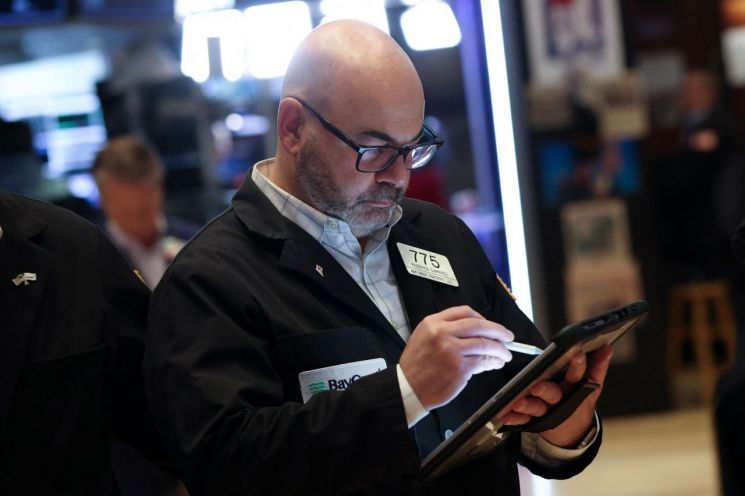 A trader is working on the floor of the New York Stock Exchange (NYSE) in the United States. Photo by AFP Yonhap News
As of 10:39 a.m. on the New York Stock Exchange, the Dow Jones Industrial Average, which focuses on blue-chip stocks, was up 462.04 points (0.95%) to 48,950.63 compared to the previous trading day. The S&P 500 Index, centered on large-cap stocks, rose 67.69 points (1.0%) to 6,864.55, while the tech-heavy Nasdaq Index jumped 241.844 points (1.05%) to 23,196.166.
The rebound in the market, which had plunged the previous day, is attributed to President Trump’s statement that he would not use force regarding the Greenland issue. In his speech at the World Economic Forum (WEF) in Davos, Switzerland, Trump expressed his intention to pursue immediate negotiations to secure Greenland, but drew a clear line by stating that military means would not be used. President Trump said, “People think I will use force, but there is no need for that,” adding, “I do not want to use force, and I will not use it.”
However, he reiterated his intention to annex Greenland, stating, “Only the United States can protect this vast land, this massive block of ice,” and added, “We can develop and improve Greenland to make it beneficial and safe for Europe, and this will also benefit the United States,” leaving open the possibility of continued conflict in the future.
Previously, concerns had grown that the U.S. push to annex Greenland could escalate tensions between the United States and Europe into a trade war. This led to a simultaneous decline in U.S. stocks, bonds, and the dollar the previous day-a phenomenon referred to as “Sell America.” Although President Trump once again emphasized his strong intention to secure Greenland, the market focused on the immediate exclusion of military conflict, which helped ease some of the anxiety.
As a result, the sell-off in U.S. Treasuries and the dollar that had been triggered the previous day has also subsided. The yield on the benchmark 10-year U.S. Treasury note, a global bond rate benchmark, fell by 1 basis point (1bp = 0.01 percentage point) from the previous session to 4.28%. The yield on the 2-year U.S. Treasury note, which is sensitive to monetary policy, remained unchanged at 3.59%. The dollar index, which measures the value of the dollar against the currencies of six major countries, was recorded at 98.38, similar to the previous day.
Brian Jacobsen, Chief Economist at Annex Wealth Management, commented, “President Trump did not repeat tariff threats against Europe and did not mention the use of force regarding Greenland. While the speech was still delivered in President Trump’s style, the tone of the content seemed noticeably softer.”
Additionally, U.S. Treasury Secretary Scott Bessent also mentioned at the Davos Forum that he had spoken with Christian Sewing, CEO of Deutsche Bank, and clarified that the Deutsche Bank report suggesting Europe could sell off U.S. stocks and bonds due to the Greenland conflict does not represent the official position.
By stock, Nvidia was up 1.79%, showing strong performance. Alphabet, Google’s parent company, rose 2.15%, and Apple was up 0.7%. Meta and Tesla also gained 1.27% and 2.27%, respectively, joining the upward trend. In contrast, Microsoft (MS) was down 0.91%.
© The Asia Business Daily(www.asiae.co.kr). All rights reserved.
![Clutching a Stolen Dior Bag, Saying "I Hate Being Poor but Real"... The Grotesque Con of a "Human Knockoff" [Slate]](https://cwcontent.asiae.co.kr/asiaresize/183/2026021902243444107_1771435474.jpg)
















