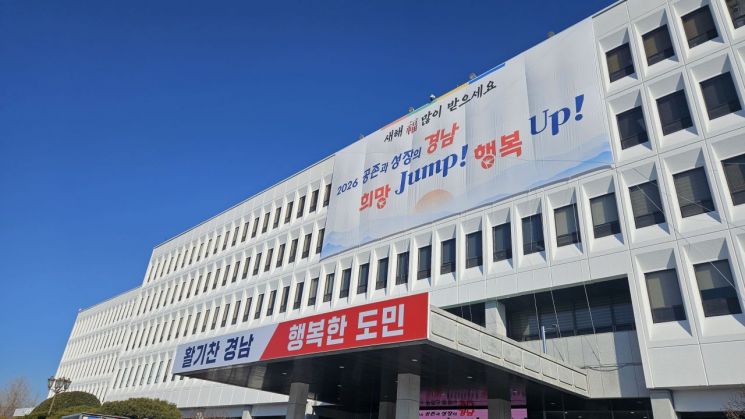
On the morning of January 21, Gyeongsangnam-do expressed a welcoming stance toward Ulsan City's announcement that it would participate in discussions on promoting administrative integration between Gyeongnam and Busan, provided that citizen consent is confirmed.
The provincial government stated, "With Ulsan's decision, the foundation has been laid for the birth of a true metropolitan local government that can rival the Seoul metropolitan area, with a population of 7.7 million and a gross regional domestic product (GRDP) of 370 trillion won."
They also added, "We fully agree with Ulsan City's position to proceed based on the transfer of authority equivalent to the U.S. federal system and clear consent from citizens."
The government further stated, "As soon as the position of Ulsan citizens is confirmed, we will include Ulsan City in future discussions on administrative integration and continue consultations without wavering to achieve the complete integration of Busan, Ulsan, and Gyeongnam."
Gyeongsangnam-do has previously emphasized that, for successful integration, it is essential in the long term to achieve the complete integration of the Busan, Ulsan, and Gyeongnam regions with Ulsan's participation.
They have also stated that integration must secure identity and legitimacy through a resident referendum, and that the status, legislative authority, organizational rights, autonomy, and fiscal authority of the integrated local government must be guaranteed.
On this day, Ulsan Mayor Kim Dookyum held a press conference at City Hall and announced, "If more than 50% consent is confirmed through a citizen opinion poll conducted by a public discussion committee, we will sufficiently discuss and consult on administrative integration."
However, he noted, "Currently, the structure of our country is such that the work and authority of local governments are vested in the central government. If this fundamental framework remains unchanged and only the administrative units are expanded, it may simply lead to another regional imbalance, end up as a political slogan, and make it difficult to realize the intended goals of administrative efficiency and strengthening regional competitiveness."
He emphasized, "The Busan-Ulsan-Gyeongnam Special Alliance, launched in 2022, was a special local government without substantial authority and finances, which clearly limited its ability to drive regional development. Rather than temporary incentives, a genuine transfer of authority on par with the U.S. federal system must come first."
He also said, "It is a priority to boldly convert a portion of national taxes into local taxes, strengthen autonomous legislative authority, and establish a system that allows local governments to independently decide and implement policies, such as pursuing development projects tailored to regional characteristics."
He further stressed, "Most importantly, it is the judgment of Ulsan citizens that matters. Administrative integration is not something to be decided by administrative agencies, but must be based on the clear consent of the citizens."
© The Asia Business Daily(www.asiae.co.kr). All rights reserved.

![Clutching a Stolen Dior Bag, Saying "I Hate Being Poor but Real"... The Grotesque Con of a "Human Knockoff" [Slate]](https://cwcontent.asiae.co.kr/asiaresize/183/2026021902243444107_1771435474.jpg)















